







Question: . 1. (40%) True and False 1. If a function is itegrable then it must be differentiable. 2. The fact that f is an integrable
.
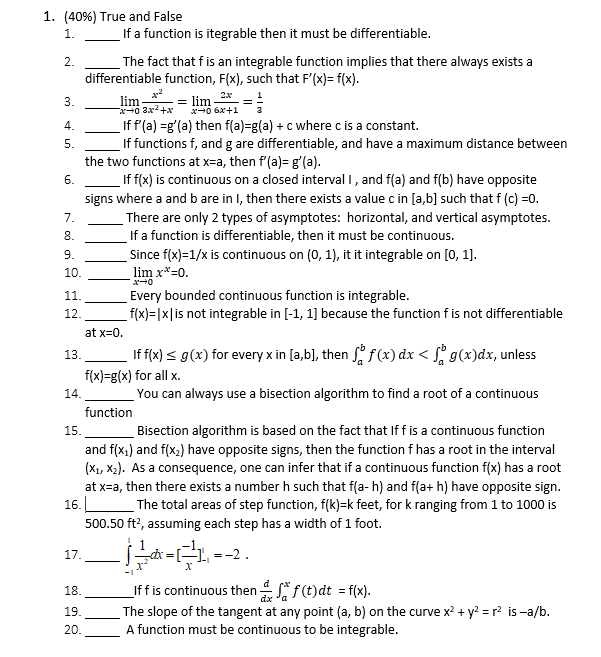
1. (40%) True and False 1. If a function is itegrable then it must be differentiable. 2. The fact that f is an integrable function implies that there always exists a differentiable function, F(x), such that F'(x)= f(x). 3. lim = 140 3x3+x = lim - x40 6x+1 4. If f(a) =g'(a) then f(a)=g(a) + c where c is a constant. 5 If functions f, and g are differentiable, and have a maximum distance between the two functions at x=a, then f(a)= g'(a). 6. If f(x) is continuous on a closed interval I , and f(a) and f(b) have opposite signs where a and b are in I, then there exists a value c in [a, b] such that f (c) =0. 7. There are only 2 types of asymptotes: horizontal, and vertical asymptotes. If a function is differentiable, then it must be continuous. 9 Since f(x)=1/x is continuous on (0, 1), it it integrable on [0, 1]. 10 lim x*=0. 11 Every bounded continuous function is integrable. 12. f(x)=[x| is not integrable in [-1, 1] because the function f is not differentiable at x=0. 13. If f(x)
Step by Step Solution
There are 3 Steps involved in it

Get step-by-step solutions from verified subject matter experts
 Study Help