Question: 1 5 1 According to a study by MIT labor economist David Autor, automation advances up to this poi have increased the demand for goods
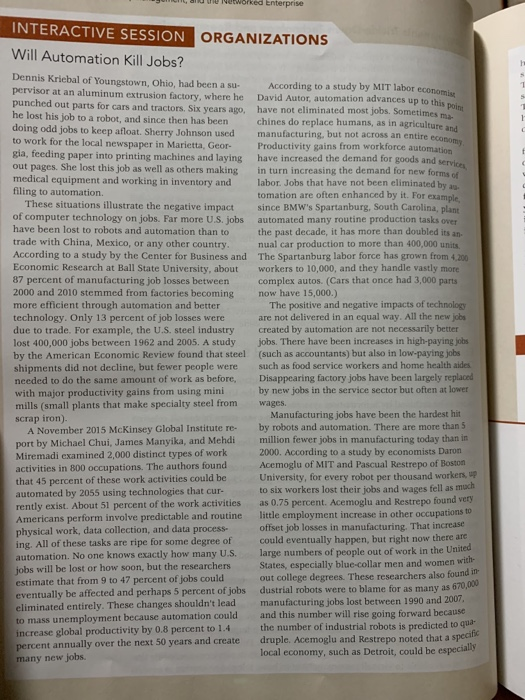
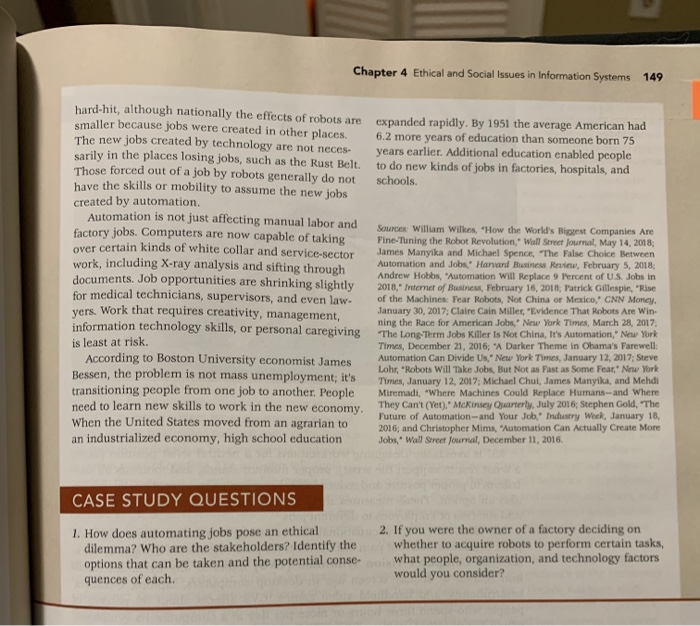
1 5 1 According to a study by MIT labor economist David Autor, automation advances up to this poi have increased the demand for goods and servi worked Enterprise INTERACTIVE SESSION ORGANIZATIONS Will Automation Kill Jobs? Dennis Kriebal of Youngstown, Ohio, had been a su- pervisor at an aluminum extrusion factory, where he punched out parts for cars and tractors. Six years ago, have not eliminated most jobs. Sometimes mo he lost his job to a robot, and since then has been doing odd jobs to keep afloat. Sherry Johnson used chines do replace humans, as in agriculture and to work for the local newspaper in Marietta, Geor- manufacturing, but not across an entire economy Productivity gains from workforce automation gia, feeding paper into printing machines and laying out pages. She lost this job as well as others making in turn increasing the demand for new forms of medical equipment and working in inventory and labor. Jobs that have not been eliminated by as. filing to automation tomation are often enhanced by it. For example, These situations illustrate the negative impact since BMW's Spartanburg, South Carolina, plant of computer technology on jobs. Far more U.S. jobs automated many routine production tasks over have been lost to robots and automation than to the past decade, it has more than doubled its an trade with China, Mexico, or any other country. nual car production to more than 400,000 units, According to a study by the Center for Business and The Spartanburg labor force has grown from 4,200 Economic Research at Ball State University, about workers to 10,000, and they handle vastly more 87 percent of manufacturing job losses between complex autos. (Cars that once had 3,000 parts 2000 and 2010 stemmed from factories becoming now have 15,000.) more efficient through automation and better The positive and negative impacts of technology technology. Only 13 percent of job losses were are not delivered in an equal way. All the new jobs due to trade. For example, the U.S. steel industry created by automation are not necessarily better lost 400,000 jobs between 1962 and 2005. A study jobs. There have been increases in high-paying jobs by the American Economic Review found that steel (such as accountants) but also in low-paying jobs shipments did not decline, but fewer people were such as food service workers and home health aides needed to do the same amount of work as before, Disappearing factory jobs have been largely replaced with major productivity gains from using mini by new jobs in the service sector but often at lower mills (small plants that make specialty steel from wages. scrap iron) Manufacturing jobs have been the hardest hit A November 2015 McKinsey Global Institute re by robots and automation. There are more than 5 port by Michael Chui, James Manyika, and Mehdi million fewer jobs in manufacturing today than in Miremadi examined 2,000 distinct types of work 2000. According to a study by economists Daron activities in 800 occupations. The authors found Acemoglu of MIT and Pascual Restrepo of Boston that 45 percent of these work activities could be University, for every robot per thousand workers, up automated by 2055 using technologies that cur to six workers lost their jobs and wages fell as much rently exist. About 51 percent of the work activities as 0.75 percent. Acemoglu and Restrepo found very Americans perform involve predictable and routine little employment increase in other occupations to physical work, data collection, and data process offset job losses in manufacturing. That increase ing. All of these tasks are ripe for some degree of could eventually happen, but right now there are automation. No one knows exactly how many U.S. large numbers of people out of work in the United jobs will be lost or how soon, but the researchers States, especially blue-collar men and women with estimate that from 9 to 47 percent of jobs could out college degrees. These researchers also found in eventually be affected and perhaps 5 percent of jobs dustrial robots were to blame for as many as 670,000 eliminated entirely. These changes shouldn't lead manufacturing jobs lost between 1990 and 2007 to mass unemployment because automation could and this number will rise going forward because increase global productivity by 0.8 percent to 1.4 the number of industrial robots is predicted to qua percent annually over the next 50 years and create druple. Acemoglu and Restrepo noted that a local economy, such as Detroit, could be especially specific many new jobs Chapter 4 Ethical and Social Issues in Information Systems 149 hard-hit, although nationally the effects of robots are expanded rapidly. By 1951 the average American had smaller because jobs were created in other places. The new jobs created by technology are not neces- 6.2 more years of education than someone born 75 sarily in the places losing jobs, such as the Rust Belt. years earlier. Additional education enabled people Those forced out of a job by robots generally do not to do new kinds of jobs in factories, hospitals, and schools. have the skills or mobility to assume the new jobs created by automation Automation is not just affecting manual labor and Sources William Wilkes, "How the World's Best Companies Are factory jobs. Computers are now capable of taking Fine-Tuning the Robot Revolution," Wall Street Journal, May 14, 2018; over certain kinds of white collar and service-sector James Manyika and Michael Spence, "The False Choice Between work, including X-ray analysis and sifting through Automation and Jobs, Harvard Business Review, February 5, 2018 Andrew Hobbs, Automation Will Replace 9 Percent of U.S. Jobs in documents. Job opportunities are shrinking slightly 2018, Internet of Business, February 16, 2018; Patrick Gillespie, 'Rise for medical technicians, supervisors, and even law of the Machines Pear Robots, Not China or Mexico, GNN Money, yers. Work that requires creativity, management, January 30, 2017; Claire Cain Miller, "Evidence That Robots Are Win ning the Race for American Jobs, New York Times, March 28, 2017 information technology skills, or personal caregiving "The Long-Term Jobs Killer Is Not China, It's Automation, New York is least at risk. Times, December 21, 2016; "A Darker Theme in Obama's Farewell: According to Boston University economist James Automation Can Divide Us," New York Times, January 12, 2017; Steve Lohr, "Robots Will Take Jobs, But Not as fast as Some Fear, New York Bessen, the problem is not mass unemployment; it's Times, January 12, 2017, Michael Chui, James Manyika, and Mehdi transitioning people from one job to another. People Miremadi, "Where Machines Could Replace Humans-and Where need to learn new skills to work in the new economy. They Can't (Yet)." McKinsey Quarterly, July 2016; Stephen Gold, "The Future of Automation-and Your Job, Industry Week, January 18, When the United States moved from an agrarian to 2016; and Christopher Mims, Automation Can Actually Create More an industrialized economy, high school education Jobs, Wall Street Journal, December 11, 2016. CASE STUDY QUESTIONS 1. How does automating jobs pose an ethical dilemma? Who are the stakeholders? Identify the options that can be taken and the potential conse- quences of each 2. If you were the owner of a factory deciding on whether to acquire robots to perform certain tasks, what people, organization, and technology factors would you consider









 Study Help