







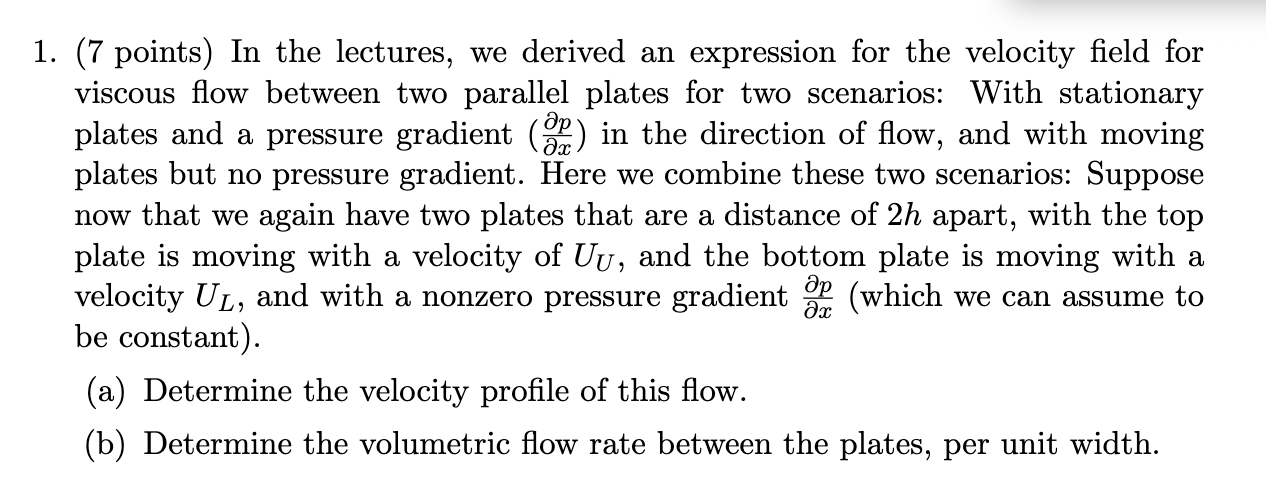
Question: 1 . ( 7 points ) In the lectures, we derived an expression for the velocity field for viscous flow between two parallel plates for
points In the lectures, we derived an expression for the velocity field for viscous flow between two parallel plates for two scenarios: With stationary plates and a pressure gradient leftfracpartial ppartial xright in the direction of flow, and with moving plates but no pressure gradient. Here we combine these two scenarios: Suppose now that we again have two plates that are a distance of h apart, with the top plate is moving with a velocity of UU and the bottom plate is moving with a velocity UL and with a nonzero pressure gradient fracpartial ppartial xwhich we can assume to be constant
a Determine the velocity profile of this flow.
b Determine the volumetric flow rate between the plates, per unit width.
Step by Step Solution
There are 3 Steps involved in it
1 Expert Approved Answer
Step: 1 Unlock

Question Has Been Solved by an Expert!
Get step-by-step solutions from verified subject matter experts
Step: 2 Unlock
Step: 3 Unlock
 Study Help