



Question: 1. (9 point) The earth's temperature over the shorter term, compared to centuries, might be modelled as pdT/dt=(TT(t)) where T(t)=Aexp(t/w)+B+Ccos(t)). The parameters are: (i) p
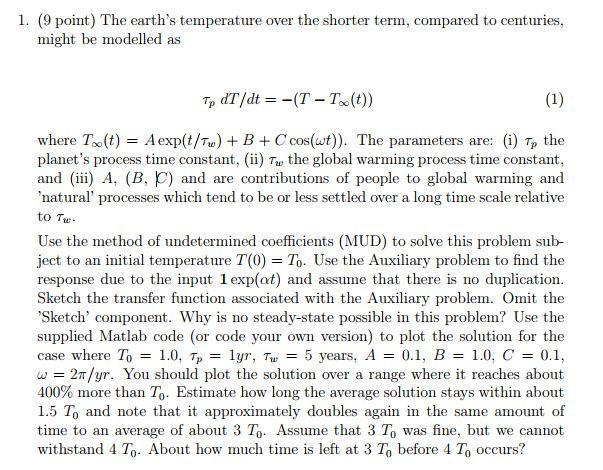
1. (9 point) The earth's temperature over the shorter term, compared to centuries, might be modelled as pdT/dt=(TT(t)) where T(t)=Aexp(t/w)+B+Ccos(t)). The parameters are: (i) p the planet's process time constant, (ii) w the global warming process time constant, and (iii) A,(B,K) and are contributions of people to global warming and 'natural' processes which tend to be or less settled over a long time scale relative to w. Use the method of undetermined coefficients (MUD) to solve this problem subject to an initial temperature T(0)=T0. Use the Auxiliary problem to find the response due to the input 1exp(t) and assume that there is no duplication. Sketch the transfer function associated with the Auxiliary problem. Omit the 'Sketch' component. Why is no steady-state possible in this problem? Use the supplied Matlab code (or code your own version) to plot the solution for the case where T0=1.0,p=1yr,w=5 years, A=0.1,B=1.0,C=0.1, =2/yr. You should plot the solution over a range where it reaches about 400% more than T0. Estimate how long the average solution stays within about 1.5T0 and note that it approximately doubles again in the same amount of time to an average of about 3T0. Assume that 3T0 was fine, but we cannot withstand 4T0. About how much time is left at 3T0 before 4T0 occurs
Step by Step Solution
There are 3 Steps involved in it

Get step-by-step solutions from verified subject matter experts