







Question: 1. (9 pts) Consider a simultaneous-move game in which player A chooses one of two actions (Up or Down), and player B chooses one of
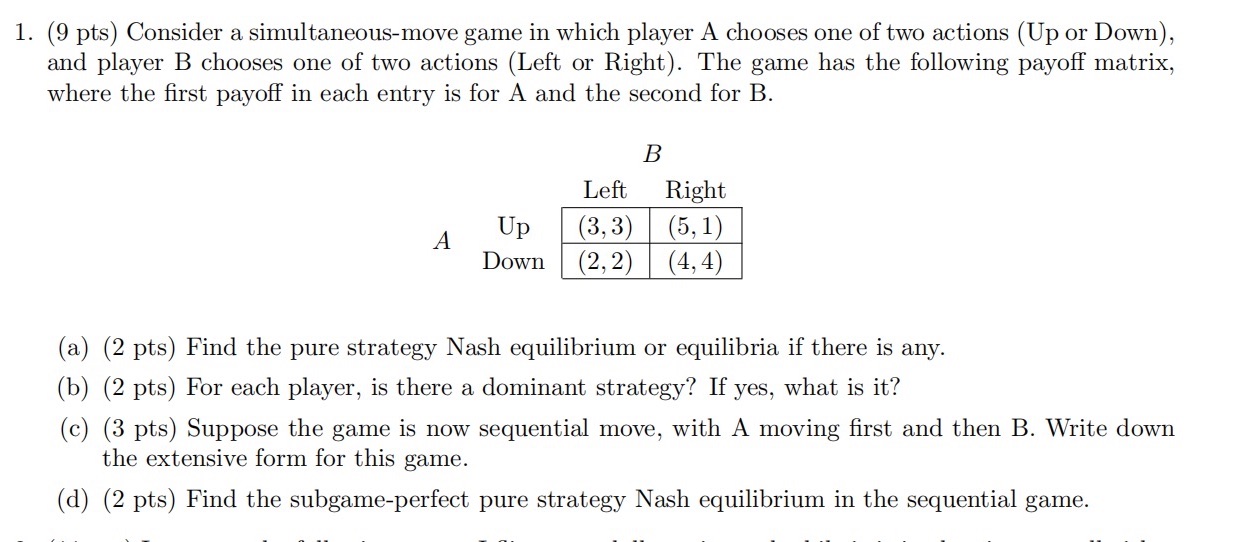
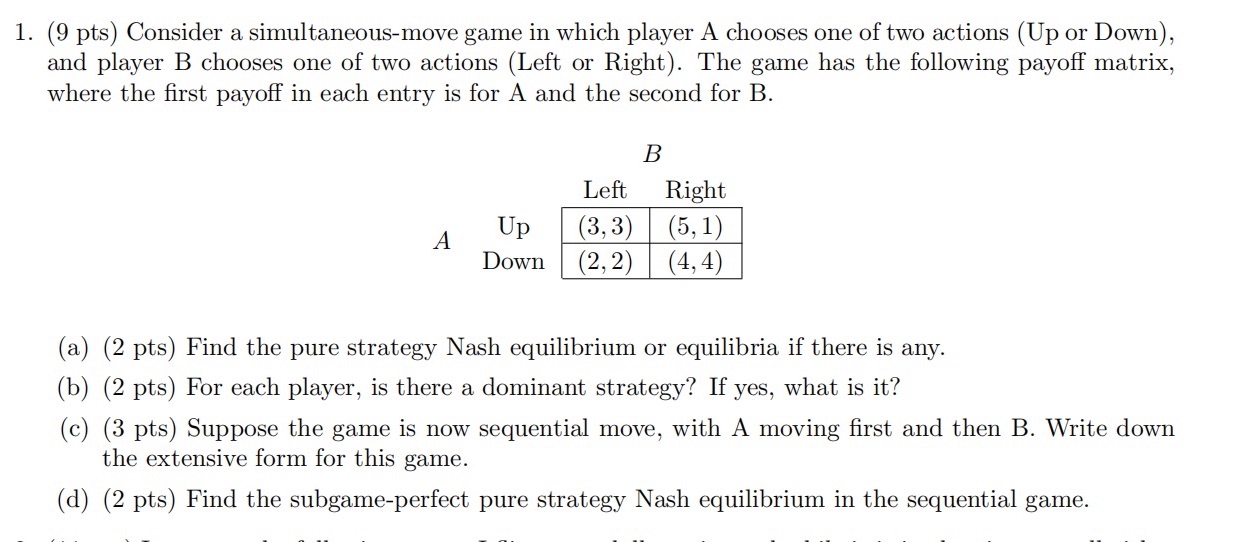
1. (9 pts) Consider a simultaneous-move game in which player A chooses one of two actions (Up or Down), and player B chooses one of two actions (Left or Right). The game has the following payoff matrix, where the first payoff in each entry is for A and the second for B. B Left Right , Down | (2,2) (a) (2 pts) Find the pure strategy Nash equilibrium or equilibria if there is any. (b) (2 pts) For each player, is there a dominant strategy? If yes, what is it? ( (c) (3 pts) Suppose the game is now sequential move, with A moving first and then B. Write down the extensive form for this game. (d) (2 pts) Find the subgame-perfect pure strategy Nash equilibrium in the sequential game
Step by Step Solution
There are 3 Steps involved in it

Get step-by-step solutions from verified subject matter experts
 Study Help