



Question: 2. Consider a two-player game where the player A chooses up or down and player B chooses left or right Their payoffs are as follows:
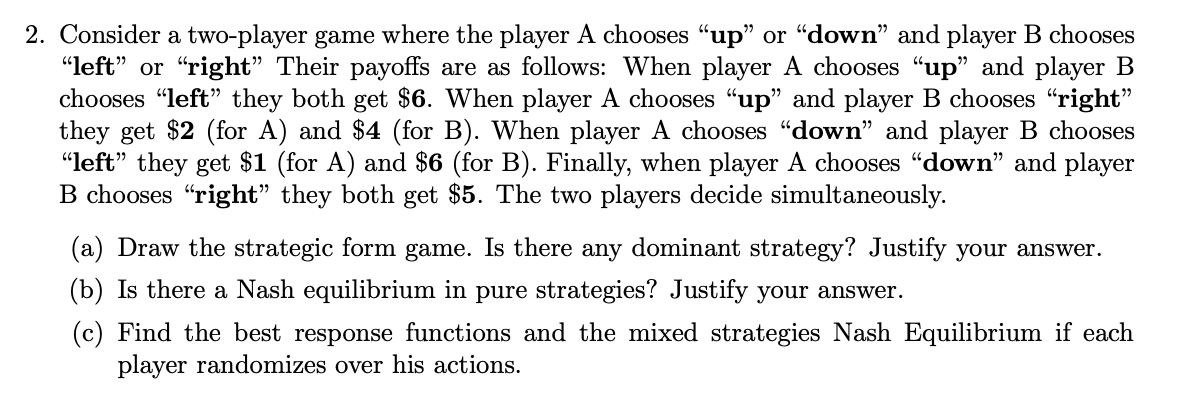
2. Consider a two-player game where the player A chooses "up" or "down" and player B chooses "left" or "right" Their payoffs are as follows: When player A chooses "up" and player B chooses "left" they both get $6. When player A chooses "up" and player B chooses "right" they get $2 (for A) and $4 (for B). When player A chooses "down" and player B chooses "left" they get $1 (for A) and $6 (for B). Finally, when player A chooses "down" and player B chooses "right" they both get $5. The two players decide simultaneously.
(a) Draw the strategic form game. Is there any dominant strategy? Justify your answer.
(b) Is there a Nash equilibrium in pure strategies? Justify your answer.
(c) Find the best response functions and the mixed strategies Nash Equilibrium if each player randomizes over his actions. 1
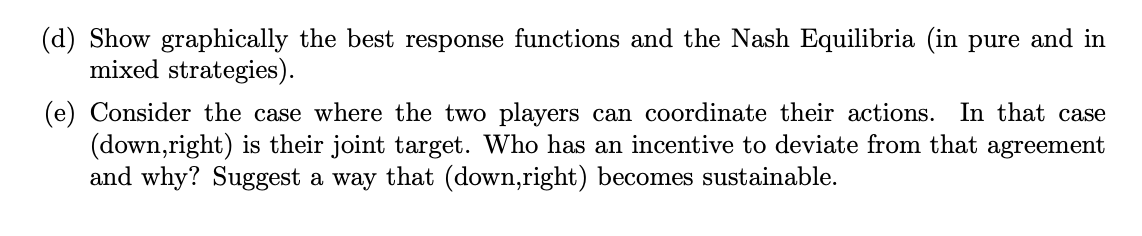
(d) Show graphically the best response functions and the Nash Equilibria (in pure and in mixed strategies). (
e) Consider the case where the two players can coordinate their actions. In that case (down,right) is their joint target. Who has an incentive to deviate from that agreement and why? Suggest a way that (down,right) becomes sustainable.
2. Consider a two-player game where the player A chooses \"up\" or \"down\" and player B chooses \"left\" or \"right\" Their payoffs are as follows: When player A chooses \"up\" and player B chooses \"left\" they both get $6. When player A chooses \"up\" and player B chooses \"right\" they get $2 (for A) and $4 (for B). When player A chooses \"down\" and player B chooses \"left\" they get $1 (for A) and $6 (for B). Finally, when player A chooses \"down\" and player B chooses \"right\" they both get $5. The two players decide simultaneously. (a) Draw the strategic form game. Is there any dominant stratew? Justify your answer. (b) Is there a Nash equilibrium in pure strategies? Justify your answer. (0) Find the best response functions and the mixed strategies Nash Equilibrium if each player randomizes over his actions. (d) Show graphically the best response functions and the Nash Equilibria (in pure and in mixed strategies). (e) Consider the case where the two players can coordinate their actions. In that case (down,right) is their joint target. Who has an incentive to deviate from that agreement and why? Suggest a way that (down,right) becomes sustainable
Step by Step Solution
There are 3 Steps involved in it

Get step-by-step solutions from verified subject matter experts