







Question: 1. (a) (4 Marks) Let f(x) = e zz, x > 0. Show that, for every n 2 1, the n'th derivative f()(x) is of
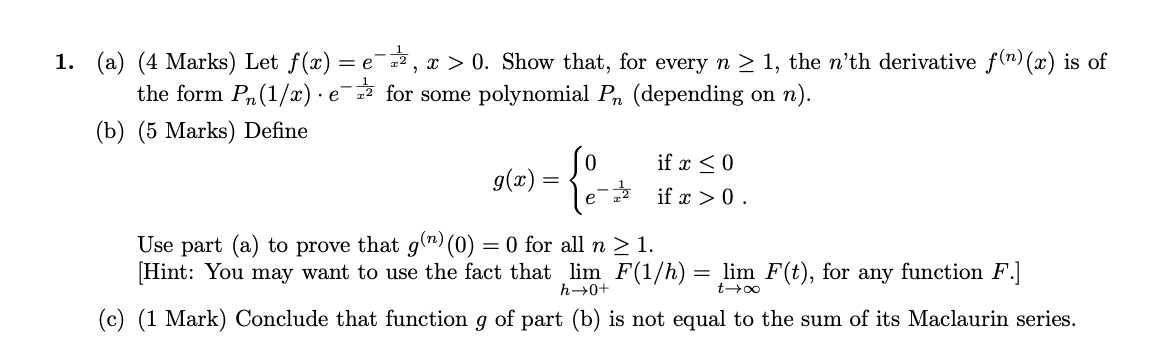
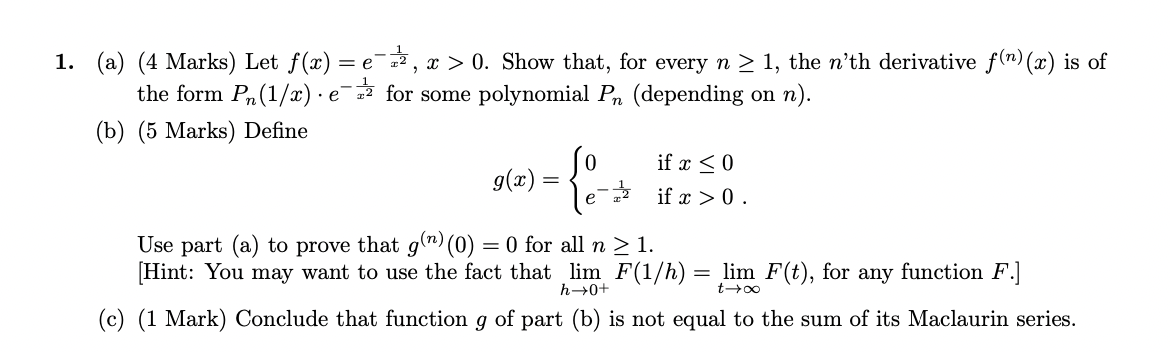
1. (a) (4 Marks) Let f(x) = e zz, x > 0. Show that, for every n 2 1, the n'th derivative f(")(x) is of the form Pn(1/x) . e 2 for some polynomial Pn (depending on n). (b) (5 Marks) Define 0 g(x) = if x 0 . Use part (a) to prove that g(") (0) = 0 for all n 2 1. Hint: You may want to use the fact that lim F(1/h) = lim F(t), for any function F.] h-+0+ t -+ 0o (c) (1 Mark) Conclude that function g of part (b) is not equal to the sum of its Maclaurin series
Step by Step Solution
There are 3 Steps involved in it
1 Expert Approved Answer
Step: 1 Unlock

Question Has Been Solved by an Expert!
Get step-by-step solutions from verified subject matter experts
Step: 2 Unlock
Step: 3 Unlock
 Study Help