







Question: (a) Apply a CNOT gate to (10)+1)). Here 10) acts as the control qubit. (b) What conclusions do you draw from the operation of
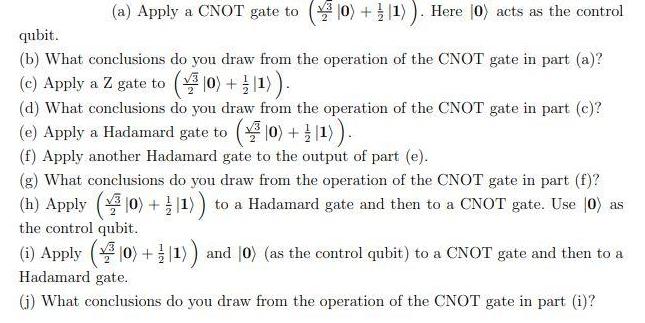
(a) Apply a CNOT gate to (10)+1)). Here 10) acts as the control qubit. (b) What conclusions do you draw from the operation of the CNOT gate in part (a)? (c) Apply a Z gate to (10) + 1)). (d) What conclusions do you draw from the operation of the CNOT gate in part (c)? (e) Apply a Hadamard gate to (0) + 1)). (f) Apply another Hadamard gate to the output of part (e). (g) What conclusions do you draw from the operation of the CNOT gate in part (f)? (h) Apply (10) +11)) to a Hadamard gate and then to a CNOT gate. Use (0) as the control qubit. (1) Apply (10) +11)) and 10) (as the control qubit) to a CNOT gate and then to a Hadamard gate. (i) What conclusions do you draw from the operation of the CNOT gate in part (i)?
Step by Step Solution
There are 3 Steps involved in it
SOLUTION a Applying a CNOT gate to sqrt32 0 rangle 1 2 1 rangle with 0 as the control qubit we get CNOT sqrt32 0 rangle 1 2 1 rangle sqrt32 0 rangle 1 2 1 rangle 1 0 rangle sqrt32 0 rangle 1 2 1 rangl... View full answer

Get step-by-step solutions from verified subject matter experts
 Study Help