


Question: 1. A batch of 1000 components is produced by a milling machine. The piecework rate (direct labour) per piece is 1.50, and the direct material
1. A batch of 1000 components is produced by a

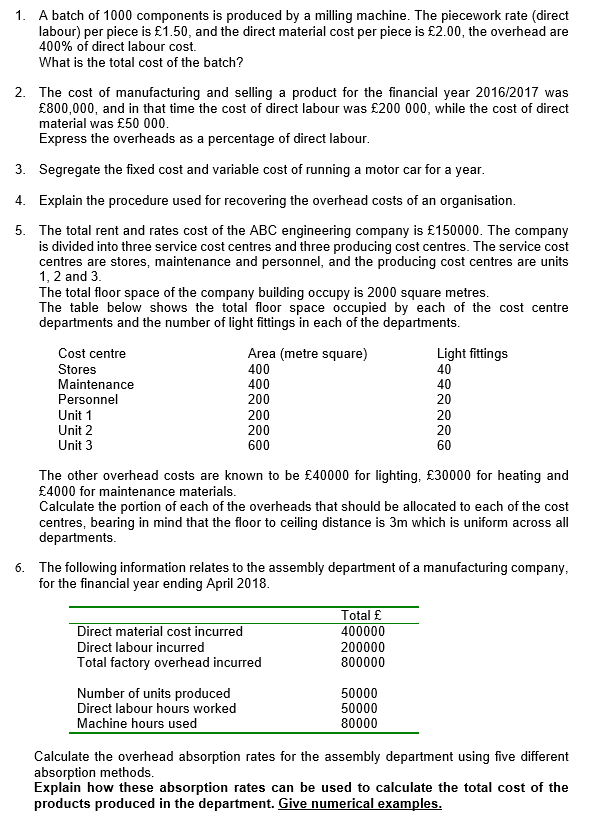
1. A batch of 1000 components is produced by a milling machine. The piecework rate (direct labour) per piece is 1.50, and the direct material cost per piece is 2.00, the overhead are 400% of direct labour cost. What is the total cost of the batch? 2. The cost of manufacturing and selling a product for the financial year 2016/2017 was 800,000, and in that time the cost of direct labour was 200 000, while the cost of direct material was 50 000. Express the overheads as a percentage of direct labour. 3. Segregate the fixed cost and variable cost of running a motor car for a year. 4. Explain the procedure used for recovering the overhead costs of an organisation. 5. The total rent and rates cost of the ABC engineering company is 150000. The company is divided into three service cost centres and three producing cost centres. The service cost centres are stores, maintenance and personnel, and the producing cost centres are units 1, 2 and 3. The total floor space of the company building occupy is 2000 square metres. The table below shows the total floor space occupied by each of the cost centre departments and the number of light fittings in each of the departments. Cost centre Area (metre square) Light fittings Stores 400 40 Maintenance 400 40 Personnel 200 20 Unit 1 200 20 Unit 2 20 Unit 3 600 60 200 The other overhead costs are known to be 40000 for lighting, 30000 for heating and 4000 for maintenance materials. Calculate the portion of each of the overheads that should be allocated to each of the cost centres, bearing in mind that the floor to ceiling distance is 3m which is uniform across all departments. 6. The following information relates to the assembly department of a manufacturing company, for the financial year ending April 2018. Direct material cost incurred Direct labour incurred Total factory overhead incurred Total 400000 200000 800000 Number of units produced Direct labour hours worked Machine hours used 50000 50000 80000 Calculate the overhead absorption rates for the assembly department using five different absorption methods. Explain how these absorption rates can be used to calculate the total cost of the products produced in the department. Give numerical examples

Step by Step Solution

There are 3 Steps involved in it

1 Expert Approved Answer
Step: 1 Unlock blur-text-image

Question Has Been Solved by an Expert!

Get step-by-step solutions from verified subject matter experts

Step: 2 Unlock
Step: 3 Unlock

Students Have Also Explored These Related General Management Questions!