



Question: 1 . A building is to be constructed on the soil profile shown in figure 1 . Construction will begin by excavating 1 5 -
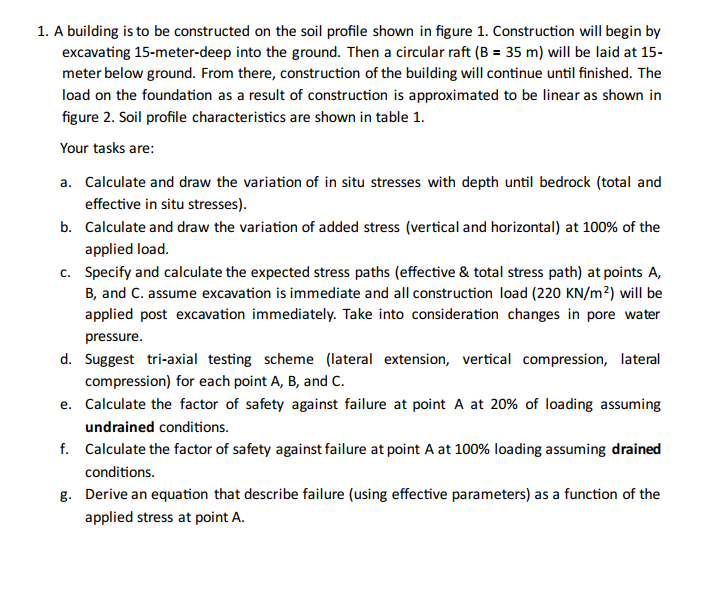
A building is to be constructed on the soil profile shown in figure Construction will begin by excavating meterdeep into the ground. Then a circular raft Bmathrm~m will be laid at meter below ground. From there, construction of the building will continue until finished. The load on the foundation as a result of construction is approximated to be linear as shown in figure Soil profile characteristics are shown in table
Your tasks are:
a Calculate and draw the variation of in situ stresses with depth until bedrock total and effective in situ stresses
b Calculate and draw the variation of added stress vertical and horizontal at of the applied load.
c Specify and calculate the expected stress paths effective & total stress path at points A B and C assume excavation is immediate and all construction load mathrmKNmathrmm will be applied post excavation immediately. Take into consideration changes in pore water pressure.
d Suggest triaxial testing scheme lateral extension, vertical compression, lateral compression for each point A B and C
e Calculate the factor of safety against failure at point A at of loading assuming undrained conditions.
f Calculate the factor of safety against failure at point A at loading assuming drained conditions.
g Derive an equation that describe failure using effective parameters as a function of the applied stress at point A Figure : Soil profile adopted for design and excavation details. Figure : Pressure applied on foundation as a result of constructed building
Step by Step Solution
There are 3 Steps involved in it
1 Expert Approved Answer
Step: 1 Unlock

Question Has Been Solved by an Expert!
Get step-by-step solutions from verified subject matter experts
Step: 2 Unlock
Step: 3 Unlock