







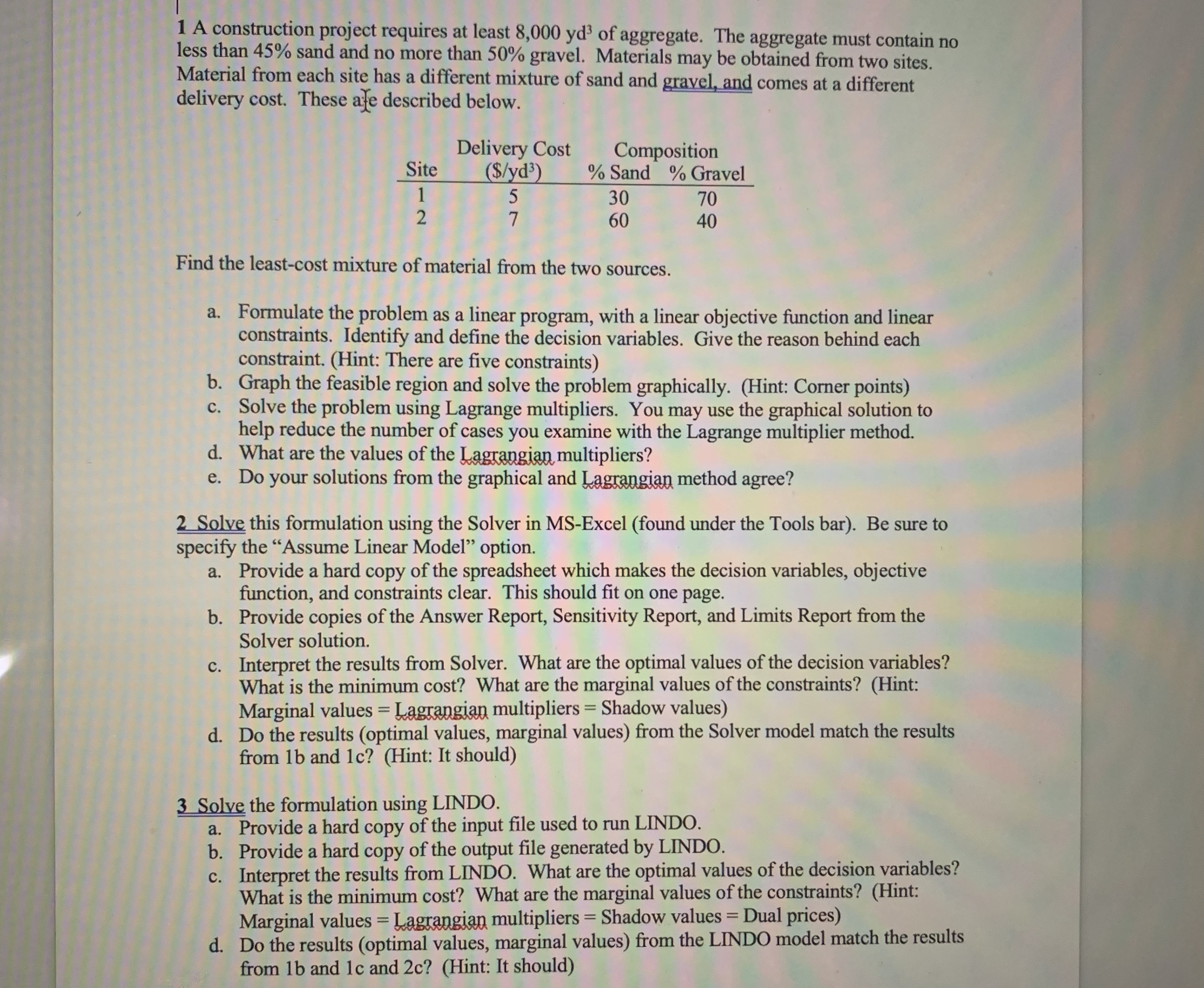
Question: 1 A construction project requires at least 8 , 0 0 0 y d 3 of aggregate. The aggregate must contain no less than 4
A construction project requires at least of aggregate. The aggregate must contain no
less than sand and no more than gravel. Materials may be obtained from two sites.
Material from each site has a different mixture of sand and gravel, and comes at a different
delivery cost. These afe described below.
Find the leastcost mixture of material from the two sources.
a Formulate the problem as a linear program, with a linear objective function and linear
constraints. Identify and define the decision variables. Give the reason behind each
constraint. Hint: There are five constraints
b Graph the feasible region and solve the problem graphically. Hint: Corner points
c Solve the problem using Lagrange multipliers. You may use the graphical solution to
help reduce the number of cases you examine with the Lagrange multiplier method.
d What are the values of the Lagrangian multipliers?
e Do your solutions from the graphical and Lagrangian method agree?
Solve this formulation using the Solver in MSExcel found under the Tools bar Be sure to
specify the "Assume Linear Model" option.
a Provide a hard copy of the spreadsheet which makes the decision variables, objective
function, and constraints clear. This should fit on one page.
b Provide copies of the Answer Report, Sensitivity Report, and Limits Report from the
Solver solution.
c Interpret the results from Solver. What are the optimal values of the decision variables?
What is the minimum cost? What are the marginal values of the constraints? Hint:
Marginal values Lagrangian multipliers Shadow values
Step by Step Solution
There are 3 Steps involved in it
1 Expert Approved Answer
Step: 1 Unlock

Question Has Been Solved by an Expert!
Get step-by-step solutions from verified subject matter experts
Step: 2 Unlock
Step: 3 Unlock
 Study Help