Question: 1. A database stores A) data B) relationships C) applications D) Both A and B are correct 2. It allows changing data storage structures and
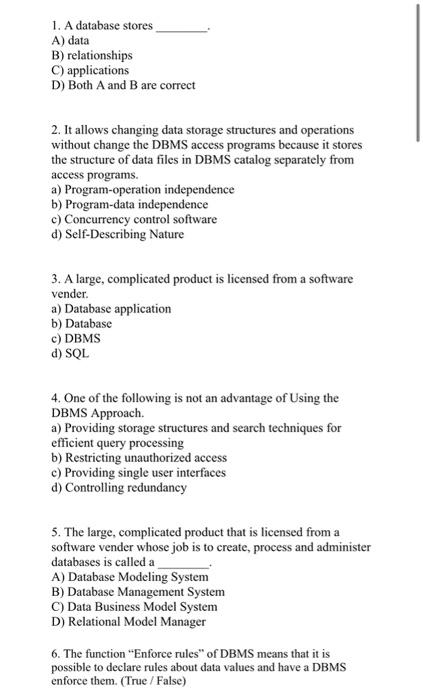
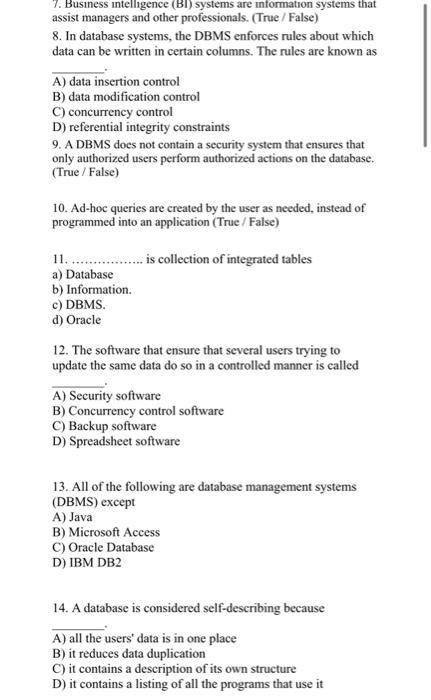
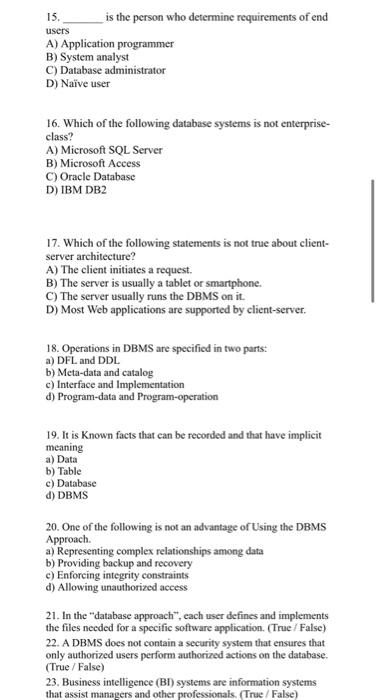
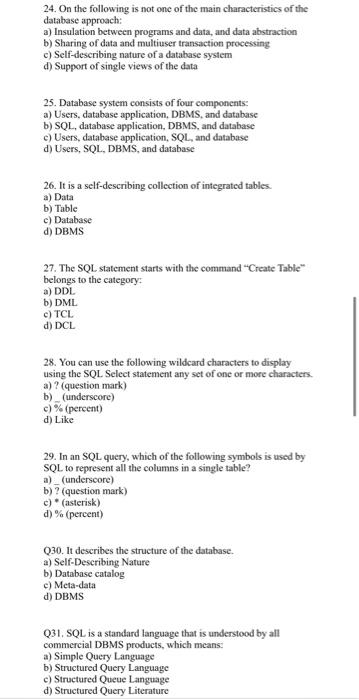
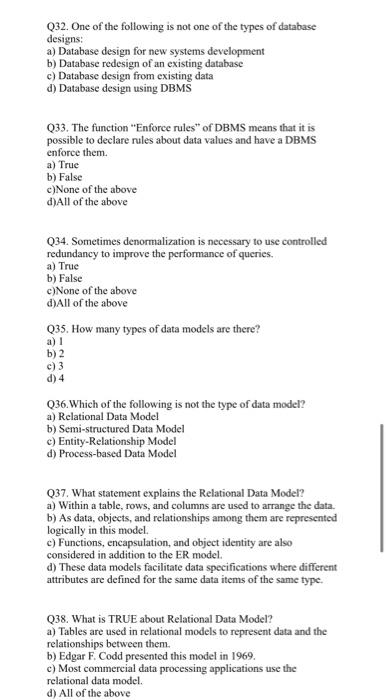
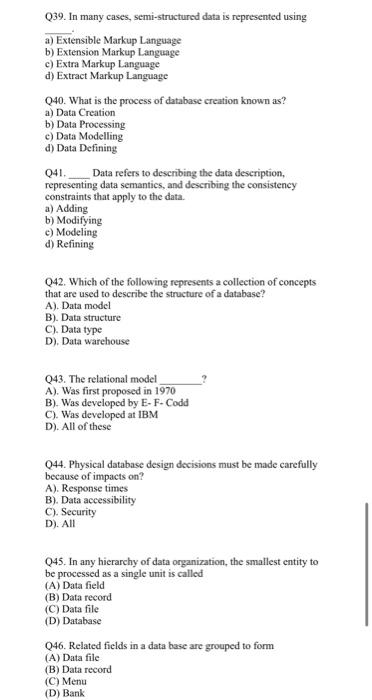
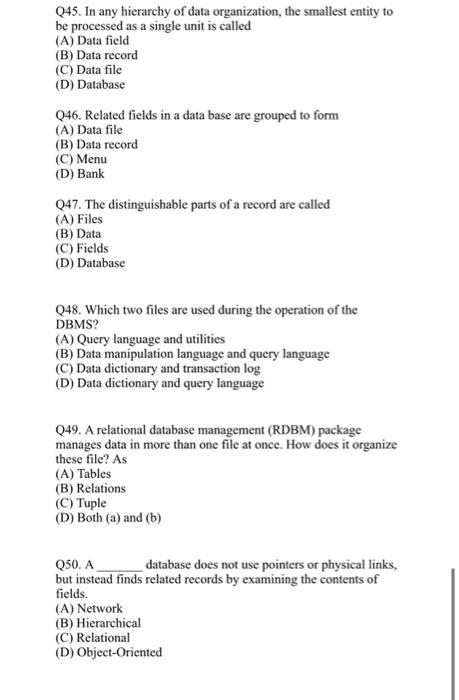
1. A database stores A) data B) relationships C) applications D) Both A and B are correct 2. It allows changing data storage structures and operations without change the DBMS access programs because it stores the structure of data files in DBMS catalog separately from access programs. a) Program-operation independence b) Program-data independence c) Concurrency control software d) Self-Describing Nature 3. A large, complicated product is licensed from a software vender. a) Database application b) Database c) DBMS d) SQL 4. One of the following is not an advantage of Using the DBMS Approach. a) Providing storage structures and search techniques for efficient query processing b) Restricting unauthorized access c) Providing single user interfaces d) Controlling redundancy 5. The large, complicated product that is licensed from a software vender whose job is to create, process and administer databases is called a A) Database Modeling System B) Database Management System C) Data Business Model System D) Relational Model Manager 6. The function "Enforce rules" of DBMS means that it is possible to declare rules about data values and have a DBMS enforce them. (True / False) 7. Business intelligence (B1) systems are information systems that assist managers and other professionals. (True / False) 8. In database systems, the DBMS enforces rules about which data can be written in certain columns. The rules are known as A) data insertion control B) data modification control C) concurrency control D) referential integrity constraints 9. A DBMS does not contain a security system that ensures that only authorized users perform authorized actions on the database. (True / False) 10. Ad-hoc queries are created by the user as needed, instead of programmed into an application (True / False) 11. is collection of integrated tables a) Database b) Information. c) DBMS. d) Oracle 12. The software that ensure that several users trying to update the same data do so in a controlled manner is called A) Security software B) Concurrency control software C) Backup software D) Spreadsheet software 13. All of the following are database management systems (DBMS) except A) Java B) Microsoft Access C) Oracle Database D) IBM DB2 14. A database is considered self-describing because A) all the users' data is in one place B) it reduces data duplication C) it contains a description of its own structure D) it contains a listing of all the programs that use it 15. is the person who determine requirements of end users A) Application programmer B) System analyst C) Database administrator D) Nave user 16. Which of the following database systems is not enterpriseclass? A) Microsoft SQL Server B) Microsoft Access C) Oracle Database D) IBM DB2 17. Which of the following statements is not true about clientserver architecture? A) The client initiates a request. B) The server is usually a tablet or smartphone. C) The server usually runs the DBMS on it. D) Most Web applications are supported by client-server. 18. Operations in DBMS are specified in two parts: a) DFL and DDL b) Meta-data and catalog c) Interface and Implementation d) Program-data and Program-operation 19. It is Known facts that can be recorded and that have implicit meaning a) Data b) Table c) Database d) DBMS 20. One of the following is not an advantage of Using the DBMS Approach. a) Representing complex relationships among data b) Providing backup and recovery c) Enforcing integrity constraints d) Allowing unauthorized aceess 21. In the "database approach", each user defines and implements the files needed for a specific software application. (True/False) 22. A DBMS does not contain a security system that ensures that only authorized users perform authorized actions on the database. (True / False) 23. Business intelligence (BI) systems are information systems that assist managers and other professionals. (True / False) 24. On the following is not one of the main characteristics of the database approach: a) Insulation between programs and data, and data abstraction b) Sharing of data and multiuser transaction processing c) Self-describing nature of a database system d) Support of single views of the data 25. Database system consists of four components: a) Users, database application, DBMS, and database b) SQL, database application, DBMS, and database c) Users, database application, SQL, and database d) Users, SQL, DBMS, and database 26. It is a self-describing collection of integrated tables. a) Data b) Table c) Database d) DBMS 27. The SQL statement starts with the command "Create Table" belongs to the category: a) DDL. b) DML c) TCL. d) DCL 28. You can use the following wildcard characters to display using the SQL Select statement any set of one or more characters. a) ? (question mark) b) (underscore) c) \% (percent) d) Like 29. In an SQL query, which of the following symbols is used by SQL to represent all the columns in a single table? a) (underscore) b) ? (question mark) c) (asterisk) d) % (percent) Q30. It describes the structure of the database. a) Self-Describing Nature b) Database catalog c) Meta-data d) DBMS Q31, SQL is a standard language that is understood by all commercial DBMS products, which means: a) Simple Query Language b) Structured Query Language c) Structured Queue Language d) Structured Query Literature Q32. One of the following is not one of the types of database designs: a) Database design for new systems development b) Database redesign of an existing database c) Database design from existing data d) Database design using DBMS Q33. The function "Enforce rules" of DBMS means that it is possible to declare rules about data values and have a DBMS enforce them. a) True b) False c)None of the above d)All of the above Q34. Sometimes denormalization is necessary to use controlled redundancy to improve the performance of queries. a) True b) False c)None of the above d)All of the above Q35. How many types of data models are there? a) 1 b) 2 c) 3 d) 4 Q36. Which of the following is not the type of data model? a) Relational Data Model b) Semi-structured Data Model c) Entity-Relationship Model d) Process-based Data Model Q37. What statement explains the Relational Data Model? a) Within a table, rows, and columns are used to arrange the data. b) As data, objects, and relationships among them are represented logically in this model. c) Functions, encapsulation, and object identity are also considered in addition to the ER model. d) These data models facilitate data specifications where different attributes are defined for the same data items of the same type. Q38. What is TRUE about Relational Data Model? a) Tables are used in relational models to represent data and the relationships between them. b) Edgar F. Codd presented this model in 1969. c) Most commercial data processing applications use the relational data model. d) All of the above Q39. In many cases, semi-structured data is represented using a) Extensible Markup Language b) Extension Markup Language c) Extra Markup Language d) Extract Markup Language Q40. What is the process of database creation known as? a) Data Creation b) Data Processing c) Data Modelling d) Data Defining Q41. Data refers to describing the data description, representing data semantics, and describing the consistency constraints that apply to the data. a) Adding b) Modifying c) Modeling d) Refining Q42. Which of the following represents a collection of concepts that are used to describe the structure of a database? A). Data model B). Data structure C). Data type D). Data warehouse Q43. The relational model A). Was first proposed in 1970 B). Was developed by E-F-Codd C). Was developed at IBM D). All of these Q44. Physical database design decisions must be made carefully because of impacts on? A). Response times B). Data accessibility C). Security D). All Q45. In any hierarchy of data organization, the smallest entity to be processed as a single unit is called (A) Data field (B) Data record (C) Data file (D) Database Q46. Related fields in a data base are grouped to form (A) Data file (B) Data record (C) Menu (D) Bank Q45. In any hierarchy of data organization, the smallest entity to be processed as a single unit is called (A) Data field (B) Data record (C) Data file (D) Database Q46. Related fields in a data base are grouped to form (A) Data file (B) Data record (C) Menu (D) Bank Q47. The distinguishable parts of a record are called (A) Files (B) Data (C) Fields (D) Database Q48. Which two files are used during the operation of the DBMS? (A) Query language and utilities (B) Data manipulation language and query language (C) Data dictionary and transaction log (D) Data dictionary and query language Q49. A relational database management (RDBM) package manages data in more than one file at once. How does it organize these file? As (A) Tables (B) Relations (C) Tuple (D) Both (a) and (b) Q50. A database does not use pointers or physical links, but instead finds related records by examining the contents of fields. (A) Network (B) Hierarchical (C) Relational (D) Object-Oriented









 Study Help