







Question: 1. A database uses record identifiers that are alphanumeric strings in which the 10 decimal digits and 26 upper-case letters are valid symbols. The criteria
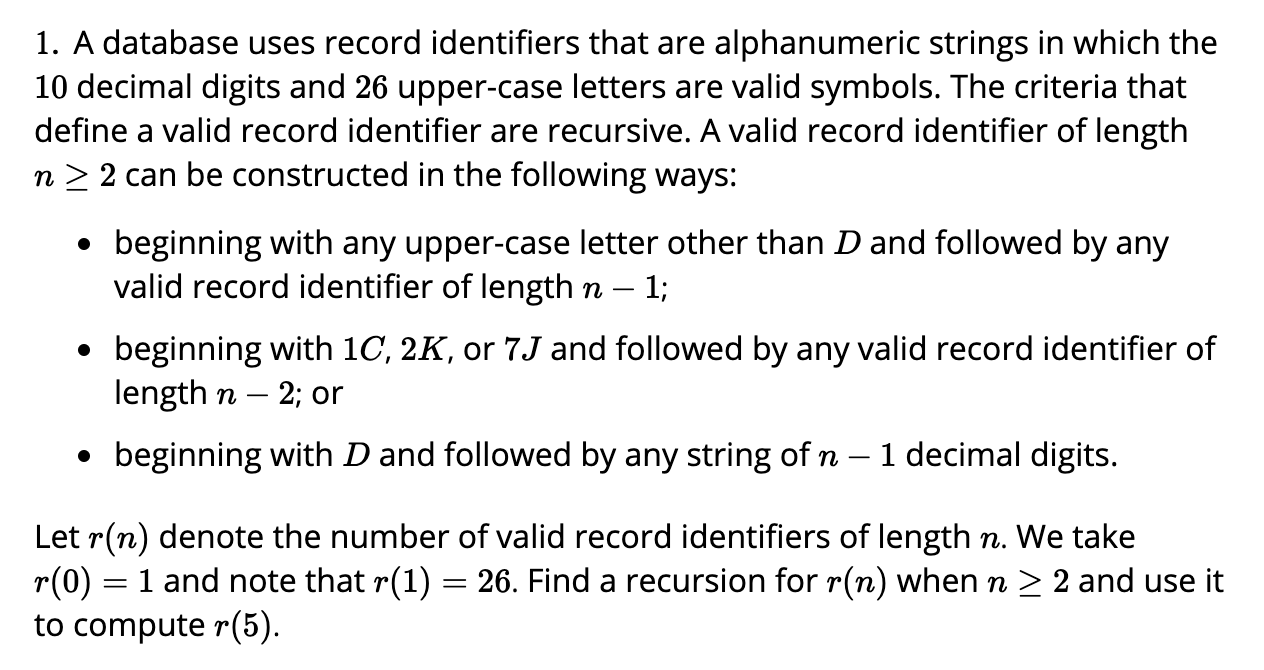

1. A database uses record identifiers that are alphanumeric strings in which the 10 decimal digits and 26 upper-case letters are valid symbols. The criteria that define a valid record identifier are recursive. A valid record identifier of length n> 2 can be constructed in the following ways: beginning with any upper-case letter other than D and followed by any valid record identifier of length n - 1; beginning with 1C, 2K, or 7J and followed by any valid record identifier of length n 2; or beginning with D and followed by any string of n - 1 decimal digits. Let r(n) denote the number of valid record identifiers of length n. We take r(0) = 1 and note that r(1) = 26. Find a recursion for r(n) when n > 2 and use it to compute r(5). 3. Give a recursion for the number g(n) of ternary strings of length n that do not contain 102 as a substring
Step by Step Solution
There are 3 Steps involved in it

Get step-by-step solutions from verified subject matter experts
 Study Help