







Question: ### 1 A discrete random variable $X$ has possible values 0, 1, 2, 3, 4, 5, 6, 7, 8 with the following partial probability distribution.
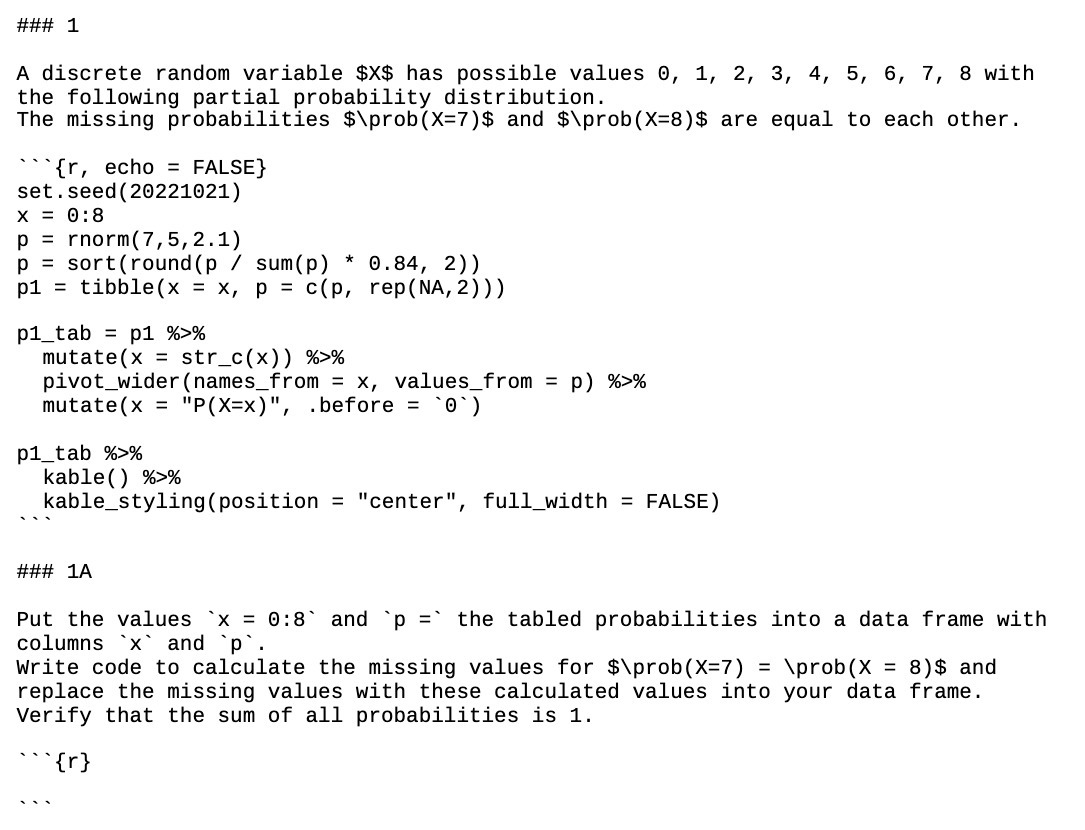
### 1 A discrete random variable $X$ has possible values 0, 1, 2, 3, 4, 5, 6, 7, 8 with the following partial probability distribution. The missing probabilities $\\prob(x=7)$ and $\\prob(x=8)$ are equal to each other. \"'{r, echo = FALSE} set.seed(26221021) 0:8 rnorm(7,5,2.1) sort(round(p / sum(p) * 0.84, 2}) 1 = tibble(x = x, p = c{p, rep(NA,2))) II ll ll 'U'D'UX p1_tab 2 p1 %>% mutate(x : str_c(x)) %>% pivot_wider(names_from : X, values_from : p) %>% mutate(x : "P(X:x)", .before : '0') p1_tab %>% kable() %>% kable_styling(position : "center", full_width : FALSE) ### 1A Put the values 'x = 0:8' and 'p =' the tabled probabilities into a data frame with columns 'x' and 'p'. Write code to calculate the missing values for $\\prob(X:7) : \\prob(X : 8)$ and replace the missing values with these calculated values into your data frame. Verify that the sum of all probabilities is 1. \"{r}
Step by Step Solution
There are 3 Steps involved in it

Get step-by-step solutions from verified subject matter experts
 Study Help