







Question: 1. A forwarding table is constructed from routing tables maintained by two different routing protocols. The lower administrative weight is considered to provide better routing
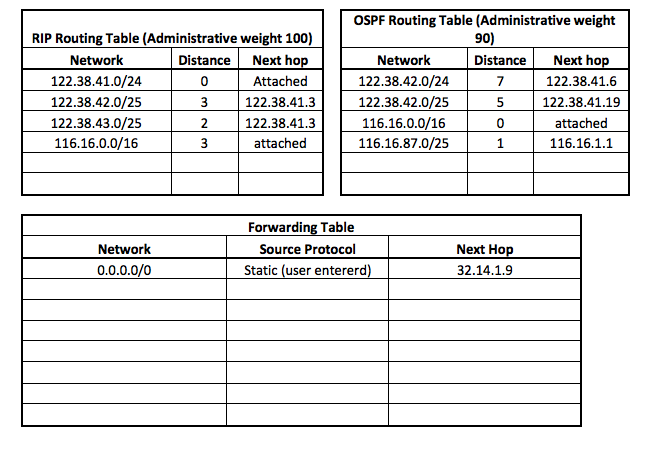
1. A forwarding table is constructed from routing tables maintained by two different routing protocols. The lower administrative weight is considered to provide better routing information. Below you see the routing tables for the RIP protocol and the OSPF routing protocol on a router in the network. Use the information in the two routing tables to fill in the forwarding table below the two routing tables.
2. Examine figure BELOW. The stable routing tables for each node are shown in this figure.
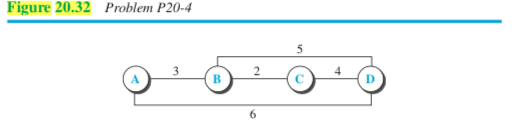
Assume the following 2 changes occur to the network:
(a) The A-D link is reduced to 2;
(b) the C-D link is reduced to 1.
(c) Show the routing tables for Node A, B, C, and D after the routing tables have converged following these two changes.
OSPF Routing Table (Administrative weight RIP Routing Table (Administrative weight 100) 90 Next ho Network 122.38.41.0/24 122.38.42.0/25 122.38.43.0/25 116.16.0.0/16 Distance Next ho Network 122.38.42.0/24 122.38.42.0/25 116.16.0.0/16 116.16.87.0/25 Distance 0 Attached 122.38.41.3 122.38.41.3 attached 7 122.38.41.6 122.38.41.19 attached 116.16.1.1 0 Forwarding Table Source Protocol Static (user entererd Network Next Ho 0.0.0.0/0 32.14.1.9
Step by Step Solution
There are 3 Steps involved in it
Question 1 Constructing the Forwarding Table Administrative Weight Priority OSPF 90 preferred over RIP RIP 100 Stepbystep selection We compare the sam... View full answer

Get step-by-step solutions from verified subject matter experts
 Study Help