







Question: 1. 3. Ten (10) specimens of 90/10 copper-nickel alloys, each with a specific percentage iron content, were tested in a corrosion-wheel setup in salt
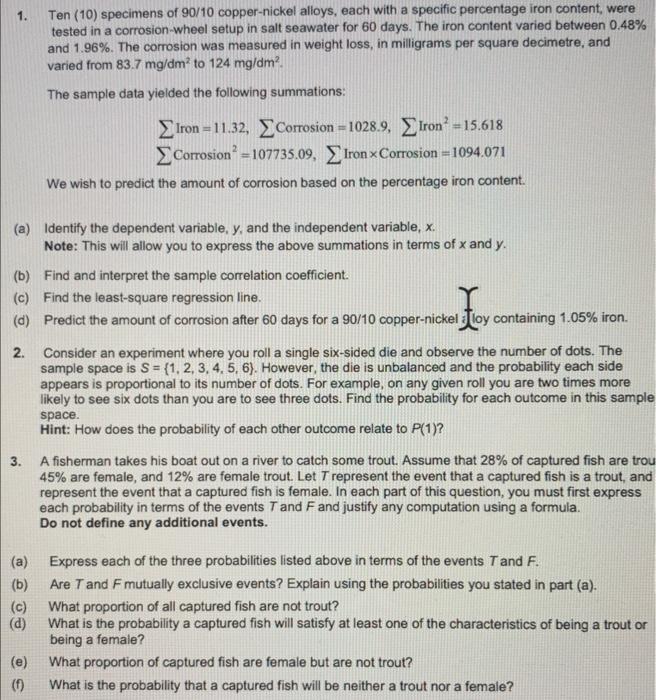
1. 3. Ten (10) specimens of 90/10 copper-nickel alloys, each with a specific percentage iron content, were tested in a corrosion-wheel setup in salt seawater for 60 days. The iron content varied between 0.48% and 1.96%. The corrosion was measured in weight loss, in milligrams per square decimetre, and varied from 83.7 mg/dm to 124 mg/dm. The sample data yielded the following summations: (a) Identify the dependent variable, y, and the independent variable, x. Note: This will allow you to express the above summations in terms of x and y. (a) (b) (c) (d) Iron 11.32, = Corrosion = 1028.9, Iron =15.618 Corrosion=107735.09, Ironx Corrosion = 1094.071 We wish to predict the amount of corrosion based on the percentage iron content. (b) (c) Find the least-square regression line. (d) Predict the amount of corrosion after 60 days for a 90/10 copper-nickel loy containing 1.05% iron. 2. (e) (f) Find and interpret the sample correlation coefficient. Consider an experiment where you roll a single six-sided die and observe the number of dots. The sample space is S = (1, 2, 3, 4, 5, 6). However, the die is unbalanced and the probability each side appears is proportional to its number of dots. For example, on any given roll you are two times more likely to see six dots than you are to see three dots. Find the probability for each outcome in this sample space. Hint: How does the probability of each other outcome relate to P(1)? A fisherman takes his boat out on a river to catch some trout. Assume that 28% of captured fish are trou 45% are female, and 12% are female trout. Let T represent the event that a captured fish is a trout, and represent the event that a captured fish is female. In each part of this question, you must first express each probability in terms of the events T and F and justify any computation using a formula. Do not define any additional events. Express each of the three probabilities listed above in terms of the events T and F. Are T and F mutually exclusive events? Explain using the probabilities you stated in part (a). What proportion of all captured fish are not trout? What is the probability a captured fish will satisfy at least one of the characteristics of being a trout or being a female? What proportion of captured fish are female but are not trout? What is the probability that a captured fish will be neither a trout nor a female?
Step by Step Solution
3.35 Rating (155 Votes )
There are 3 Steps involved in it

Get step-by-step solutions from verified subject matter experts
 Study Help