







Question: 1. A Model with a Small and a Large Country (100 points) Let us consider a one-period model with two countries. Each of them is
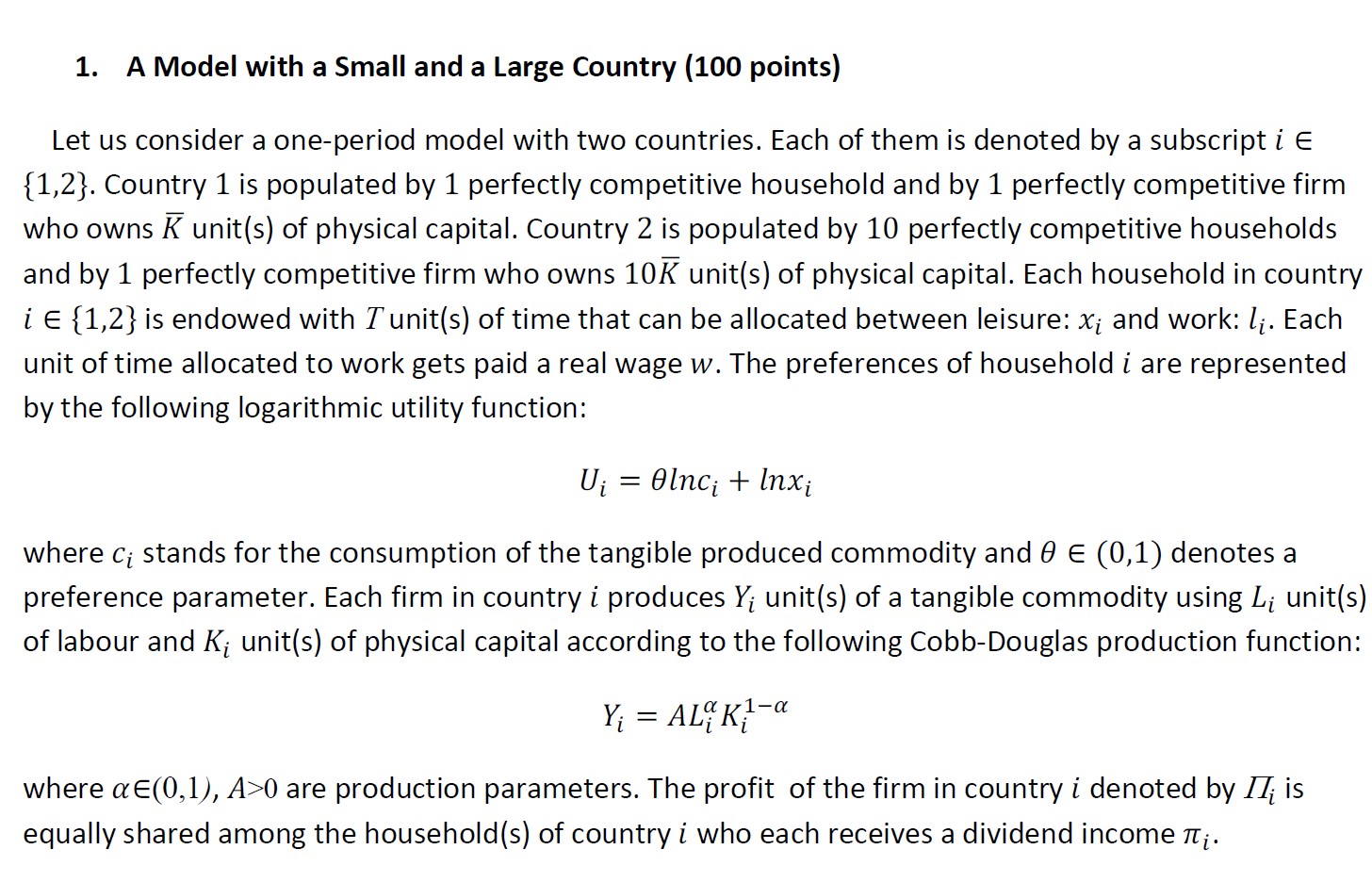

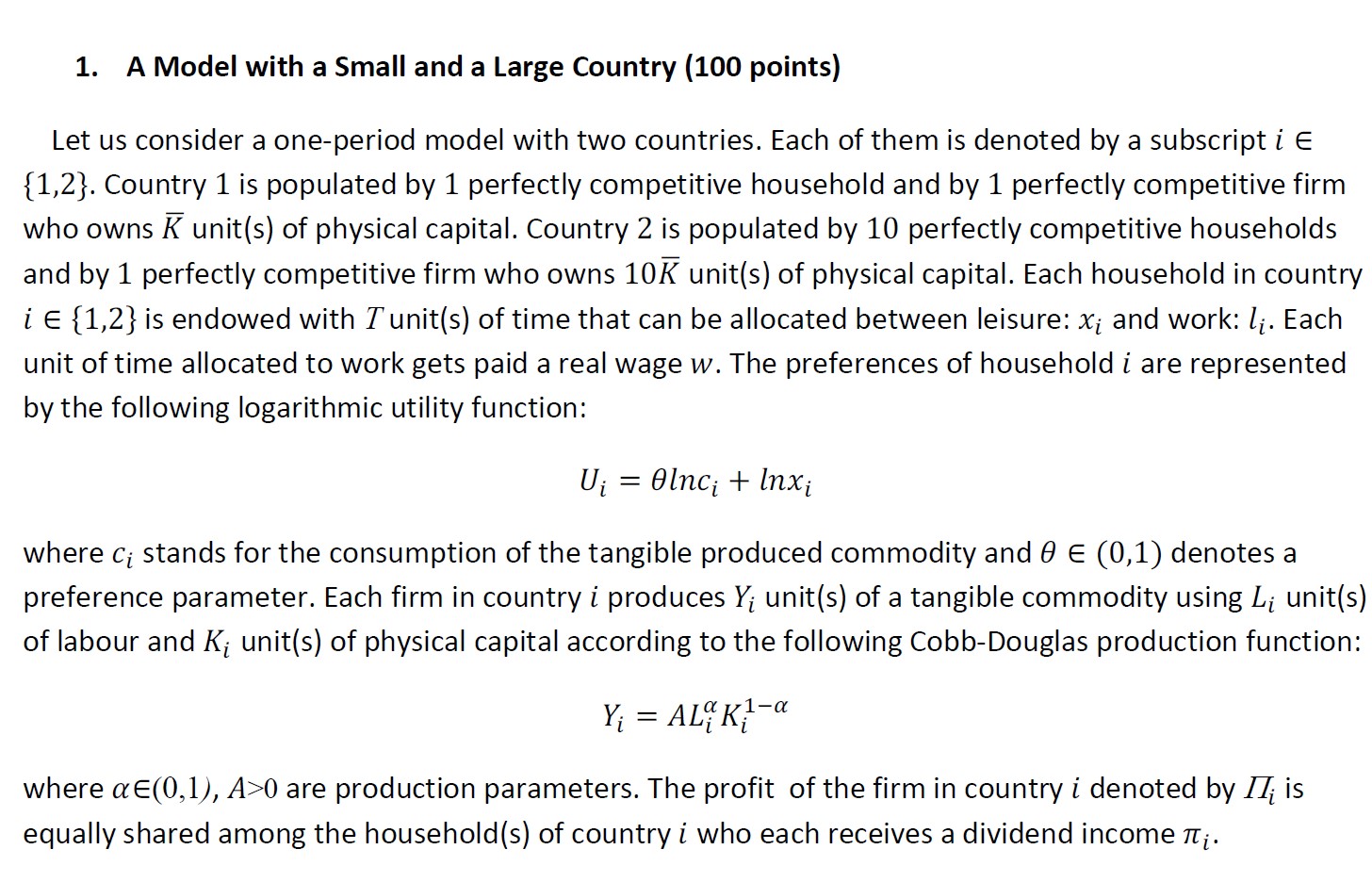

1. A Model with a Small and a Large Country (100 points) Let us consider a one-period model with two countries. Each of them is denoted by a subscript i {1,2}. Country 1 is populated by 1 perfectly competitive household and by 1 perfectly competitive firm who owns K unit(s) of physical capital. Country 2 is populated by 10 perfectly competitive households and by 1 perfectly competitive firm who owns 10K unit(s) of physical capital. Each household in country [ {1,2}is endowed with T unit(s) of time that can be allocated between leisure: x; and work: [;. Each unit of time allocated to work gets paid a real wage w. The preferences of household i are represented by the following logarithmic utility function: U; = Binc; + Inx; where ; stands for the consumption of the tangible produced commodity and 8 (0,1) denotes a preference parameter. Each firm in country i produces Y; unit(s) of a tangible commodity using L; unit(s) of labour and K; unit(s) of physical capital according to the following Cobb-Douglas production function: Y, = AL7K; " where a(0,1), A>0 are production parameters. The profit of the firm in country i denoted by /7 is equally shared among the household(s) of country i who each receives a dividend income ;. 5) Under autarky, derive the competitive equilibrium expression for the real wage in country 1: wy and in country 2: wy. Which country has the higher real wage? (25 points)
Step by Step Solution
There are 3 Steps involved in it

Get step-by-step solutions from verified subject matter experts
 Study Help