



Question: 1. A rectangular board is made of two pieces, as shown. Frictionless The shaded piece and the unshaded piece are made of pivot materials of
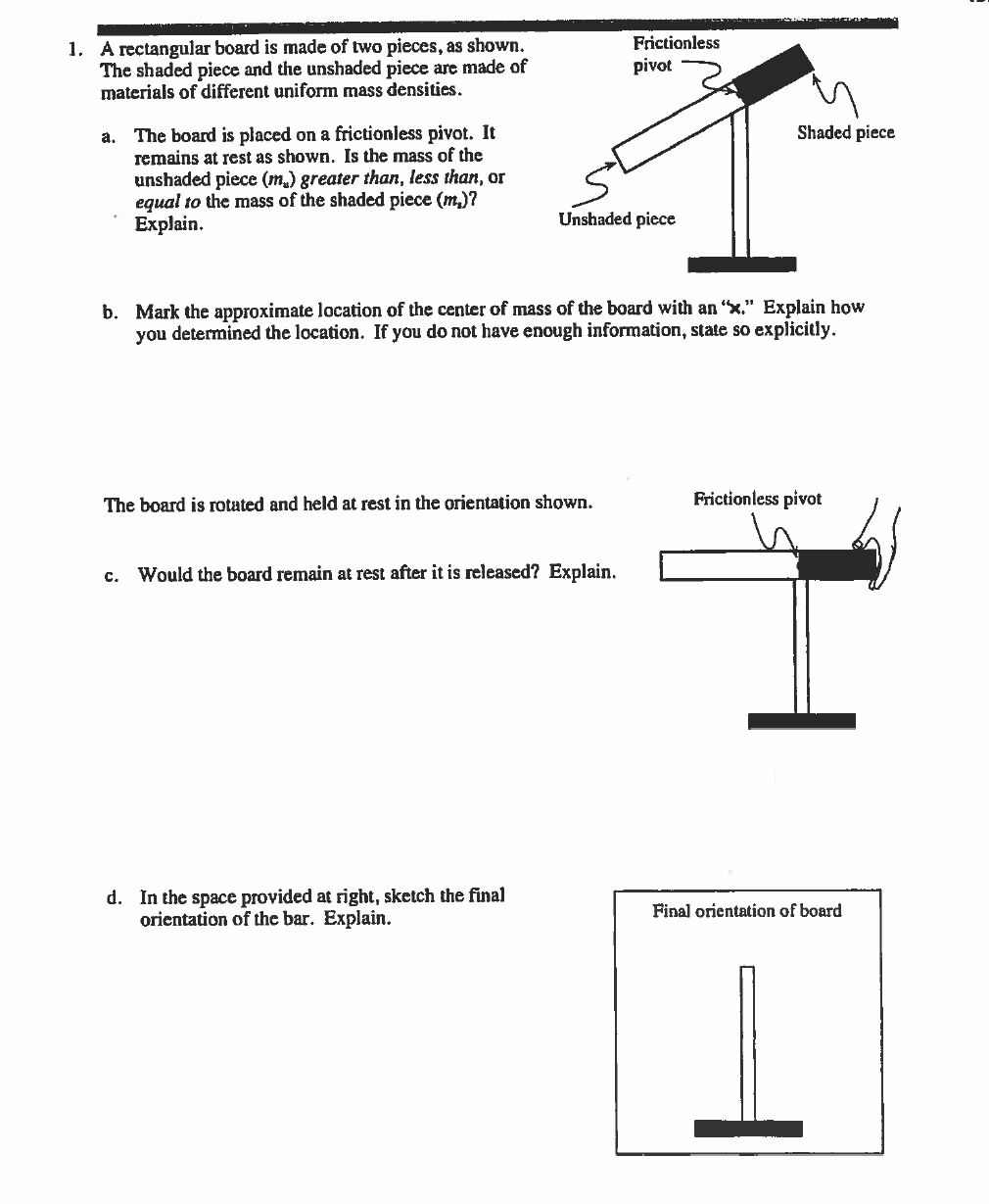
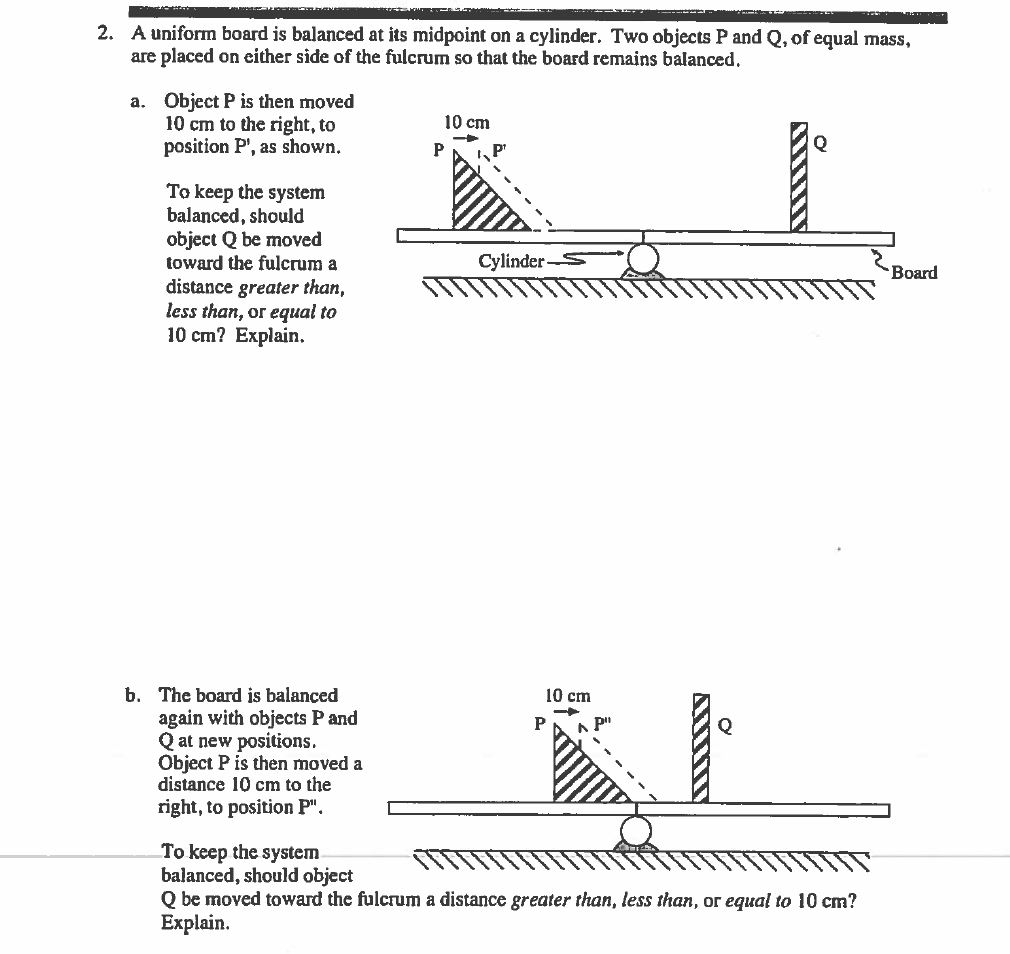
1. A rectangular board is made of two pieces, as shown. Frictionless The shaded piece and the unshaded piece are made of pivot materials of different uniform mass densities a. The board is placed on a frictionless pivot. It Shaded piece remains at rest as shown. Is the mass of the unshaded piece (m.) greater than, less than, or equal to the mass of the shaded piece (m,)? Explain. Unshaded piece b. Mark the approximate location of the center of mass of the board with an "x." Explain how you determined the location. If you do not have enough information, state so explicitly. The board is rotated and held at rest in the orientation shown. Frictionless pivot c. Would the board remain at rest after it is released? Explain. d. In the space provided at right, sketch the final orientation of the bar. Explain. Final orientation of board2. A uniform board is balanced at its midpoint on a cylinder. Two objects P and Q. of equal mass. are placed on either side of the fulcrum so that the board remains balanced. :1. Object P is then moved lcrnlothcright.to '00"! o- position I", as shown. [I Q To keep the system balanced. should object Q be moved toward the fulcrum a distance greater than. less than, or aqua! to 10 cm? Explain. b. The hour] is balanced again with objects P and Q at new positions. Object P is then moved a distance 10 cm to the right, to position P". To keep the system balanced, should object (2 be moved toward the fulcrum a distance greater than. less than, or equal to ID cm? Explain
Step by Step Solution
There are 3 Steps involved in it

Get step-by-step solutions from verified subject matter experts