Question: 1. A requisition is a gatekeeping tool that manages the flow of information through 3 gates; identify each gate and the pertinent question that supply
1. A requisition is a gatekeeping tool that manages the flow of information through 3 gates; identify each gate and the pertinent question that supply personnel should ask themselves upon receipt
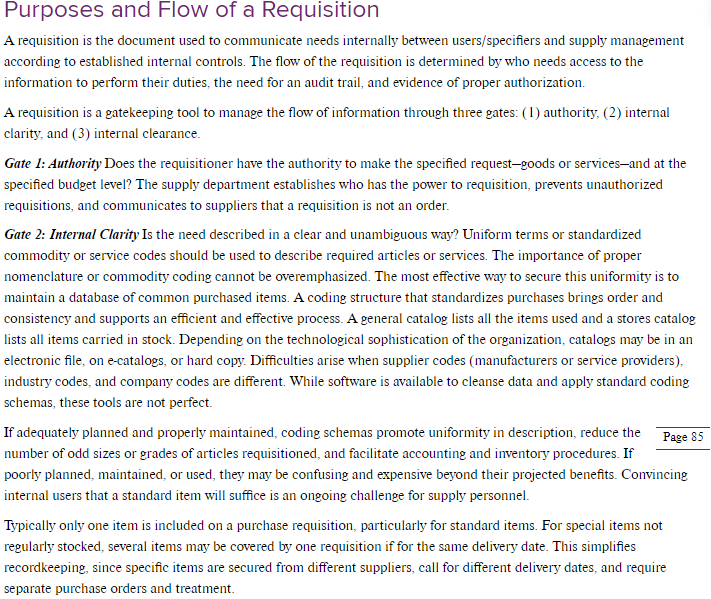
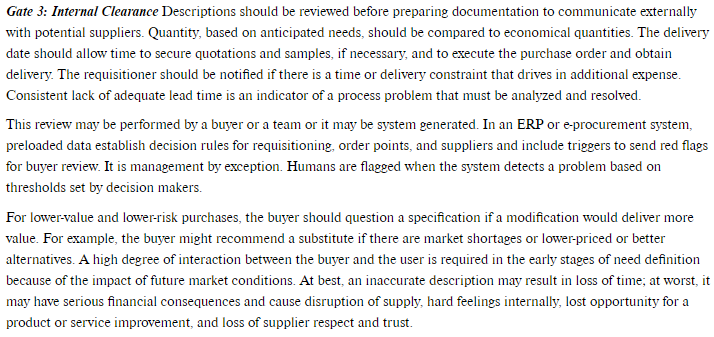
Purposes and Flow of a Requisition A requisition is the document used to communicate needs internally between users/specifiers and supply management according to established internal controls. The flow of the requisition is determined by who needs access to the information to perform their duties, the need for an audit trail, and evidence of proper authorization. A requisition is a gatekeeping tool to manage the flow of information through three gates: (1) authority, (2) internal clarity, and (3) internal clearance. Gate I: Authority Does the requisitioner have the authority to make the specified request-goods or services and at the specified budget level? The supply department establishes who has the power to requisition, prevents unauthorized requisitions, and communicates to suppliers that a requisition is not an order. Gate 2: Internal Clarity Is the need described in a clear and unambiguous way? Uniform terms or standardized commodity or service codes should be used to describe required articles or services. The importance of proper nomenclature or commodity coding cannot be overemphasized. The most effective way to secure this uniformity is to maintain a database of common purchased items. A coding structure that standardizes purchases brings order and consistency and supports an efficient and effective process. A general catalog lists all the items used and a stores catalog lists all items carried in stock. Depending on the technological sophistication of the organization, catalogs may be in an electronic file, on e-catalogs, or hard copy. Difficulties arise when supplier codes (manufacturers or service providers), industry codes, and company codes are different. While software is available to cleanse data and apply standard coding schemas, these tools are not perfect. If adequately planned and properly maintained, coding schemas promote uniformity in description, reduce the Page 85 number of odd sizes or grades of articles requisitioned, and facilitate accounting and inventory procedures. If poorly planned, maintained, or used, they may be confusing and expensive beyond their projected benefits. Convincing internal users that a standard item will suffice is an ongoing challenge for supply personnel. Typically only one item is included on a purchase requisition, particularly for standard items. For special items not regularly stocked, several items may be covered by one requisition if for the same delivery date. This simplifies recordkeeping, since specific items are secured from different suppliers, call for different delivery dates, and require separate purchase orders and treatment. Gate 3: Internal Clearance Descriptions should be reviewed before preparing documentation to communicate externally with potential suppliers. Quantity, based on anticipated needs, should be compared to economical quantities. The delivery date should allow time to secure quotations and samples, if necessary, and to execute the purchase order and obtain delivery. The requisitioner should be notified if there is a time or delivery constraint that drives in additional expense. Consistent lack of adequate lead time is an indicator of a process problem that must be analyzed and resolved. This review may be performed by a buyer or a team or it may be system generated. In an ERP or e-procurement system, preloaded data establish decision rules for requisitioning, order points, and suppliers and include triggers to send red flags for buyer review. It is management by exception. Humans are flagged when the system detects a problem based on thresholds set by decision makers. For lower-value and lower-risk purchases, the buyer should question a specification if a modification would deliver more value. For example, the buyer might recommend a substitute if there are market shortages or lower-priced or better alternatives. A high degree of interaction between the buyer and the user is required in the early stages of need definition because of the impact of future market conditions. At best, an inaccurate description may result in loss of time, at worst, it may have serious financial consequences and cause disruption of supply, hard feelings internally, lost opportunity for a product or service improvement, and loss of supplier respect and trust




