



Question: 1. A startup is a organization designed to search for a repeatable and scalable business model (under extreme uncertainty). A. lean B. temporary C. small
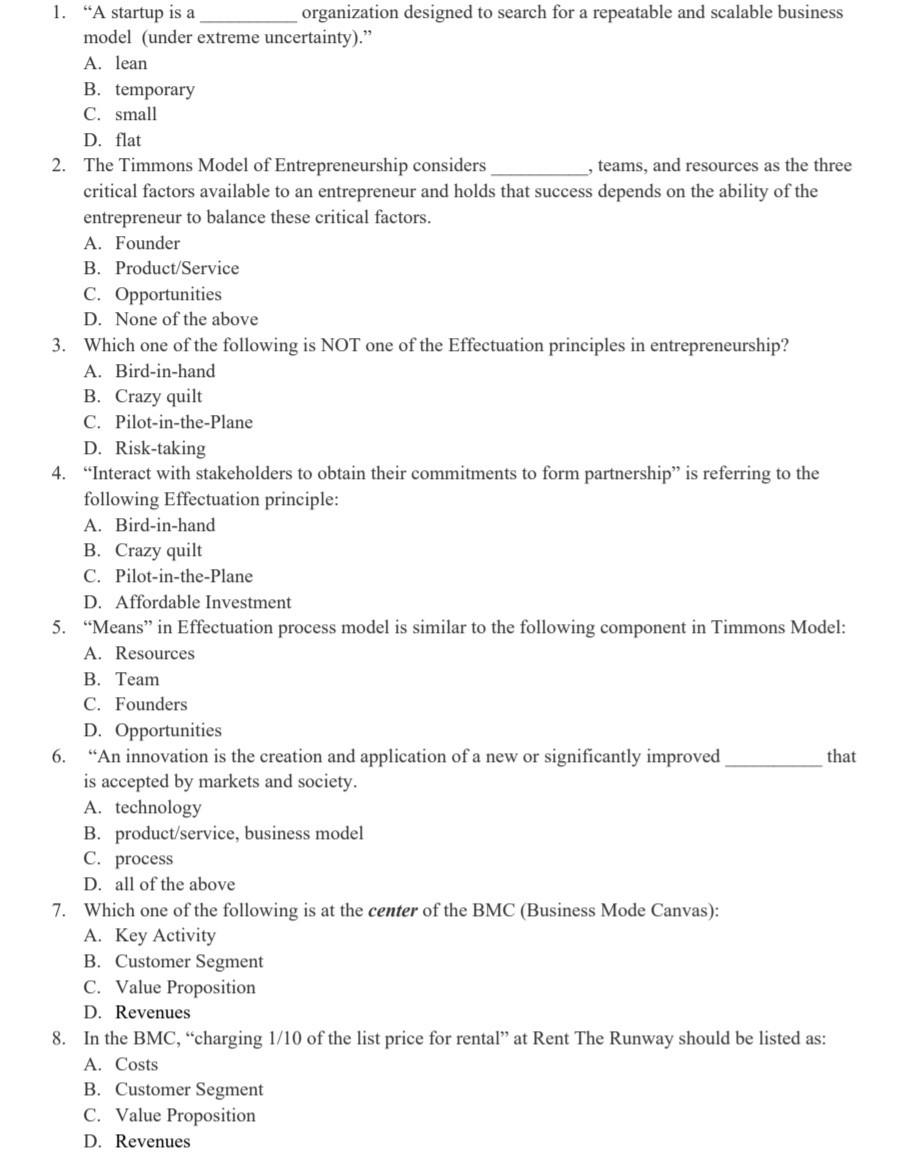
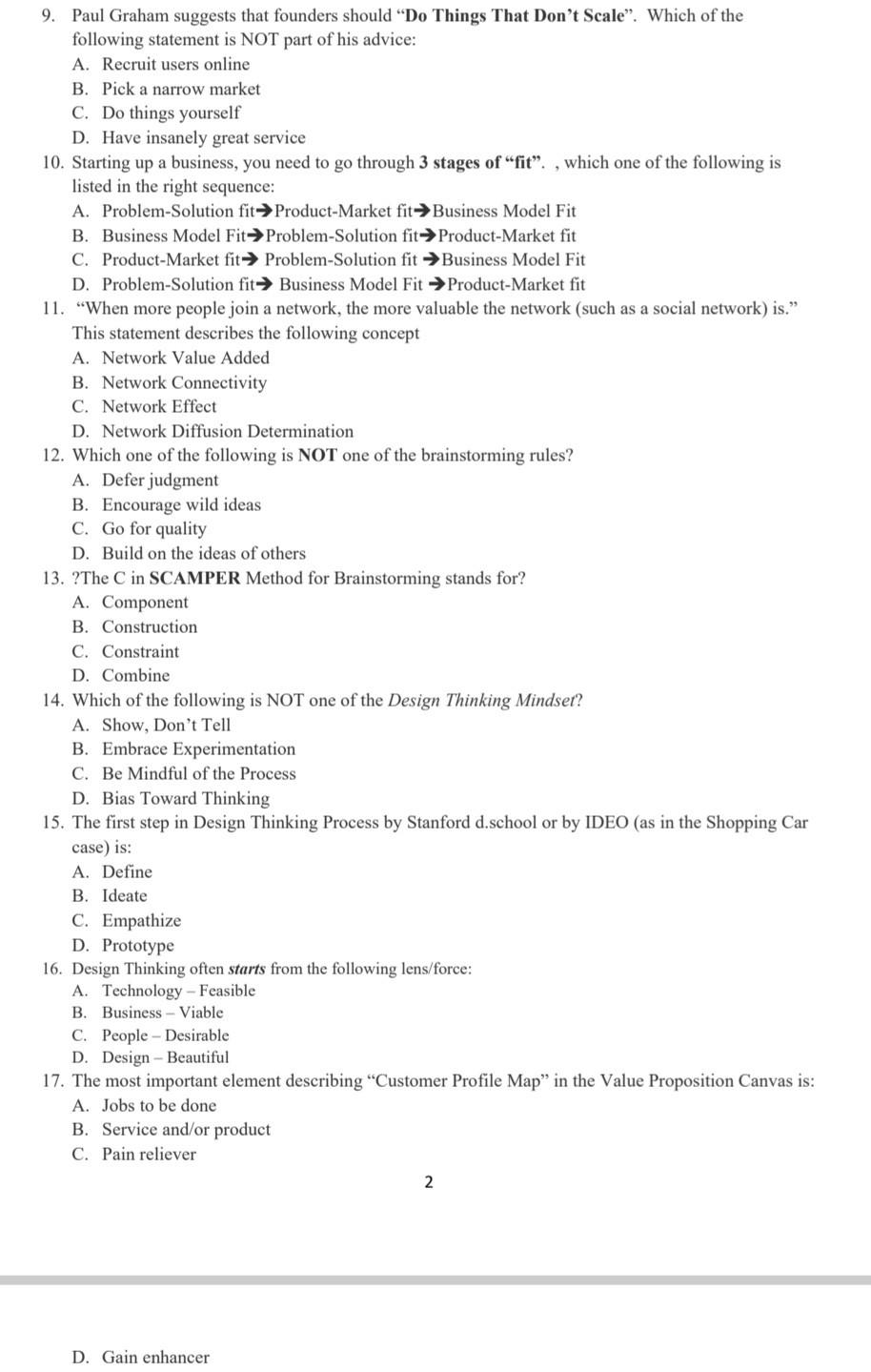
1. "A startup is a organization designed to search for a repeatable and scalable business model (under extreme uncertainty)." A. lean B. temporary C. small D. flat 2. The Timmons Model of Entrepreneurship considers , teams, and resources as the three critical factors available to an entrepreneur and holds that success depends on the ability of the entrepreneur to balance these critical factors. A. Founder B. Product/Service C. Opportunities D. None of the above 3. Which one of the following is NOT one of the Effectuation principles in entrepreneurship? A. Bird-in-hand B. Crazy quilt C. Pilot-in-the-Plane D. Risk-taking 4. "Interact with stakeholders to obtain their commitments to form partnership" is referring to the following Effectuation principle: A. Bird-in-hand B. Crazy quilt C. Pilot-in-the-Plane D. Affordable Investment 5. "Means" in Effectuation process model is similar to the following component in Timmons Model: A. Resources B. Team C. Founders D. Opportunities 6. "An innovation is the creation and application of a new or significantly improved that is accepted by markets and society. A. technology B. product/service, business model C. process D. all of the above 7. Which one of the following is at the center of the BMC (Business Mode Canvas): A. Key Activity B. Customer Segment C. Value Proposition D. Revenues 8. In the BMC, "charging 1/10 of the list price for rental" at Rent The Runway should be listed as: A. Costs B. Customer Segment C. Value Proposition D. Revenues 9. Paul Graham suggests that founders should "Do Things That Don't Scale". Which of the following statement is NOT part of his advice: A. Recruit users online B. Pick a narrow market C. Do things yourself D. Have insanely great service 10. Starting up a business, you need to go through 3 stages of "fit". , which one of the following is listed in the right sequence: A. Problem-Solution fit Product-Market fit Business Model Fit B. Business Model Fit Problem-Solution fit Product-Market fit C. Product-Market fit Problem-Solution fit Business Model Fit D. Problem-Solution fit Business Model Fit Product-Market fit 11. "When more people join a network, the more valuable the network (such as a social network) is." This statement describes the following concept A. Network Value Added B. Network Connectivity C. Network Effect D. Network Diffusion Determination 12. Which one of the following is NOT one of the brainstorming rules? A. Defer judgment B. Encourage wild ideas C. Go for quality D. Build on the ideas of others 13. ?The C in SCAMPER Method for Brainstorming stands for? A. Component B. Construction C. Constraint D. Combine 14. Which of the following is NOT one of the Design Thinking Mindset? A. Show, Don't Tell B. Embrace Experimentation C. Be Mindful of the Process D. Bias Toward Thinking 15. The first step in Design Thinking Process by Stanford d.school or by IDEO (as in the Shopping Car case) is: A. Define B. Ideate C. Empathize D. Prototype 16. Design Thinking often starts from the following lens/force: A. Technology - Feasible B. Business - Viable C. People-Desirable D. Design Beautiful 17. The most important element describing "Customer Profile Map" in the Value Proposition Canvas is: A. Jobs to be done B. Service and/or product C. Pain reliever 2
Step by Step Solution
There are 3 Steps involved in it
1 Expert Approved Answer
Step: 1 Unlock

Question Has Been Solved by an Expert!
Get step-by-step solutions from verified subject matter experts
Step: 2 Unlock
Step: 3 Unlock