







Question: 1. A study, published in 1993, used U.S. state panel data to investigate the relationship between minimum wages and employment of teenagers. The sample period
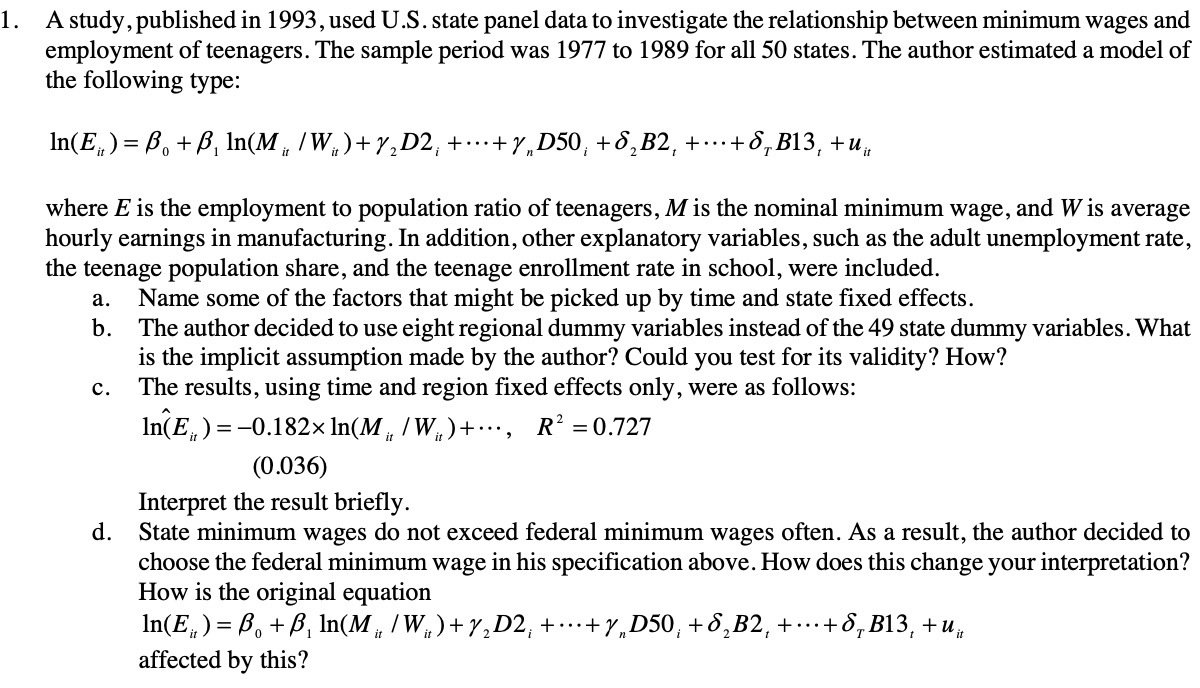
1. A study, published in 1993, used U.S. state panel data to investigate the relationship between minimum wages and employment of teenagers. The sample period was 1977 to 1989 for all 50 states. The author estimated a model of the following type: In(E; ) = Bo + B, In(M . /W; ) + y, D2; + ...+ y, D50, +6, B2, + ...+0, B13, +u; where E is the employment to population ratio of teenagers, M is the nominal minimum wage, and W is average hourly earnings in manufacturing. In addition, other explanatory variables, such as the adult unemployment rate, the teenage population share, and the teenage enrollment rate in school, were included. a. Name some of the factors that might be picked up by time and state fixed effects. b. The author decided to use eight regional dummy variables instead of the 49 state dummy variables. What is the implicit assumption made by the author? Could you test for its validity? How? c. The results, using time and region fixed effects only, were as follows: In(E; ) = -0.182x In(M . /W.)+ ..., R2 =0.727 (0.036) Interpret the result briefly. d. State minimum wages do not exceed federal minimum wages often. As a result, the author decided to choose the federal minimum wage in his specification above. How does this change your interpretation? How is the original equation In(E; ) = B. + B, In(M . /W;) + y, D2; + . . . + y, D50, + 6, B2, + ...+6, B13, + u; affected by this
Step by Step Solution
There are 3 Steps involved in it

Get step-by-step solutions from verified subject matter experts
 Study Help