







Question: 1. a. Summarize the differences among simple instruction pipelining, superscalar, and simultaneous multithreading and Multicore organization. Illustrate with diagrams. (4 marks) b. Using Intel Core
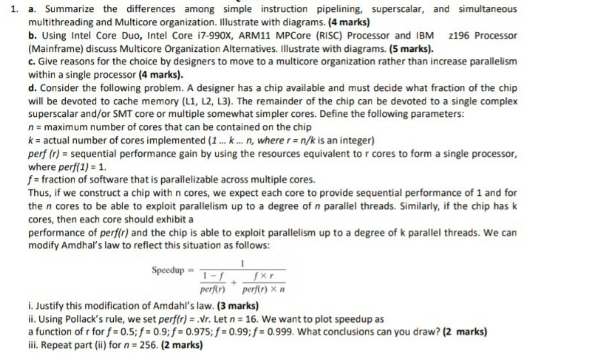
1. a. Summarize the differences among simple instruction pipelining, superscalar, and simultaneous multithreading and Multicore organization. Illustrate with diagrams. (4 marks) b. Using Intel Core Duo, Intel Core i7-990X, ARMII MPCore (RISC) Processor and IBM 2196 Processor (Mainframe) discuss Multicore Organization Alternatives. Illustrate with diagrams. (5 marks). c. Give reasons for the choice by designers to move to a multicore organization rather than increase parallelism within a single processor (4 marks). d. Consider the following problem. A designer has a chip available and must decide what fraction of the chip will be devoted to cache memory (L1, L2, L3). The remainder of the chip can be devoted to a single complex superscalar and/or SMT core or multiple somewhat simpler cores. Define the following parameters: n maximum number of cores that can be contained on the chip k-actual number of cores implemented (1 ... k... n, where r = n/k is an integer) perf (r) sequential performance gain by using the resources equivalent to r cores to form a single processor, where perf(1) = 1. ffraction of software that is parallelizable across multiple cores. Thus, if we construct a chip with n cores, we expect each core to provide sequential performance of 1 and for then cores to be able to exploit parallelism up to a degree of n parallel threads. Similarly, if the chip has k cores, then each core should exhibit a performance of perftr) and the chip is able to exploit parallelism up to a degree of k parallel threads. We can modify Amdhal's law to reflect this situation as follows: Speedup 1 XT p ) perf) i. Justify this modification of Amdahl's law. (3 marks) ii. Using Pollack's rule, we set perfer) = r. Let n = 16. We want to plot speedup as a function of r for f-0.5; -0.9;f-0.975; f = 0.99; f = 0.999. What conclusions can you draw? (2 marks) ii. Repeat part() for n = 256 (2 marks)
Step by Step Solution
There are 3 Steps involved in it

Get step-by-step solutions from verified subject matter experts
 Study Help