







Question: 1) Adding addresses is a common task in assembly language. For Real-Address mode programming (16-bit programs), calculating addresses is essential. The bus is only 16
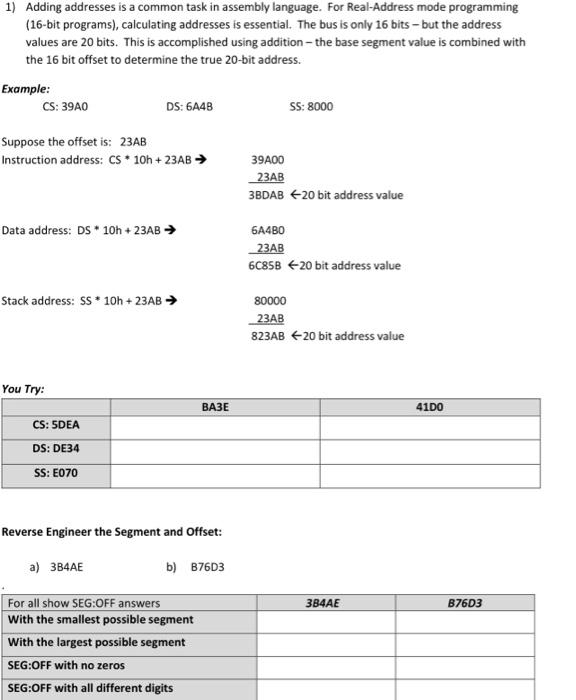
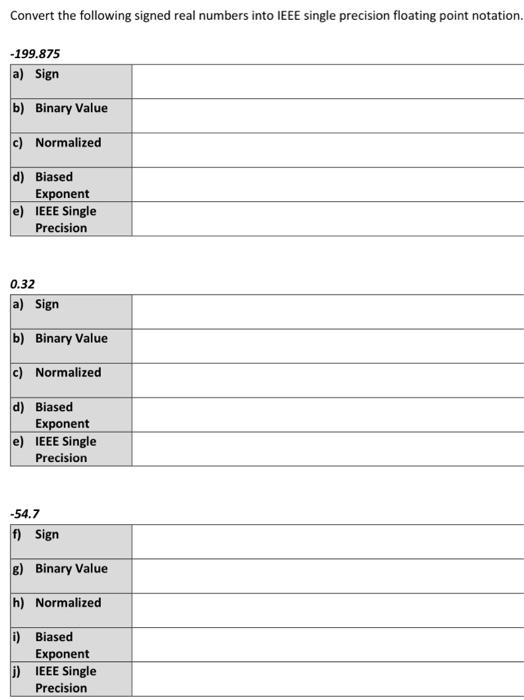
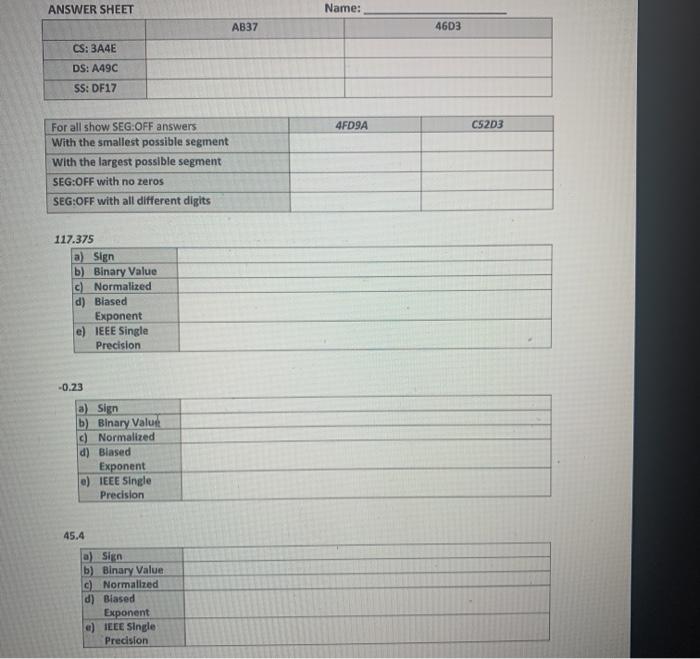
1) Adding addresses is a common task in assembly language. For Real-Address mode programming (16-bit programs), calculating addresses is essential. The bus is only 16 bits - but the address values are 20 bits. This is accomplished using addition - the base segment value is combined with the 16 bit offset to determine the true 20-bit address. Example: CS: 39A0 DS: 6A4B SS: 8000 Suppose the offset is: 23AB Instruction address: CS* 10h + 23AB 39A00 23AB 3BDAB +20 bit address value Data address: DS * 10h+23AB 6A4B0 23AB 6C858 +20 bit address value Stack address: SS 10h + 23AB 80000 23AB 823AB 20 bit address value You Try: 41DO CS: 5DEA DS: DE34 SS: E070 Reverse Engineer the Segment and Offset: a) 3B4AE b) B7603 3B4AE B7603 For all show SEG:OFF answers With the smallest possible segment With the largest possible segment SEG:OFF with no zeros SEG:OFF with all different digits Convert the following signed real numbers into IEEE single precision floating point notation. -199.875 a) Sign b) Binary Value c) Normalized d) Biased Exponent e) IEEE Single Precision 0.32 a) Sign b) Binary Value c) Normalized d) Biased Exponent e) IEEE Single Precision -54.7 f) Sign g) Binary Value h) Normalized i) Biased Exponent i) IEEE Single Precision ANSWER SHEET Name: AB37 4603 CS: 3A4E DS: A49C SS: DF17 4FD9A CS2D3 For all show SEG:OFF answers With the smallest possible segment With the largest possible segment SEG:OFF with no zeros SEG:OFF with all different digits 117.375 a) Sign b) Binary Value c) Normalized d) Blased Exponent e) IEEE Single Precision -0.23 a) Sign b) Binary Value c) Normalized d) Blased Exponent ) IEEE Single Precision 45.4 a) Sien b) Binary Value c) Normalized d) Blased Exponent a) IEEE Single Precision
Step by Step Solution
There are 3 Steps involved in it

Get step-by-step solutions from verified subject matter experts
 Study Help