







Question: 1. AGT cell will machine the components for a family of parts. The parts come in several different sizes and the cel will be designed
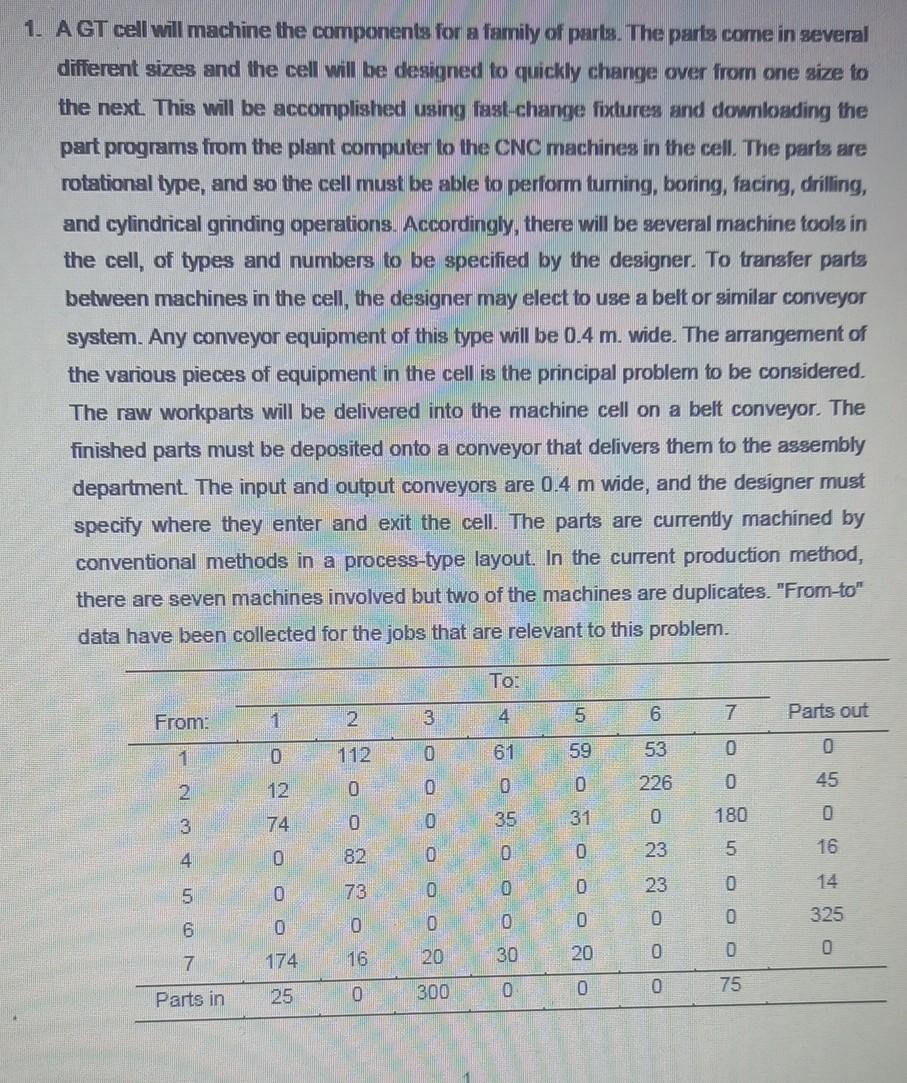
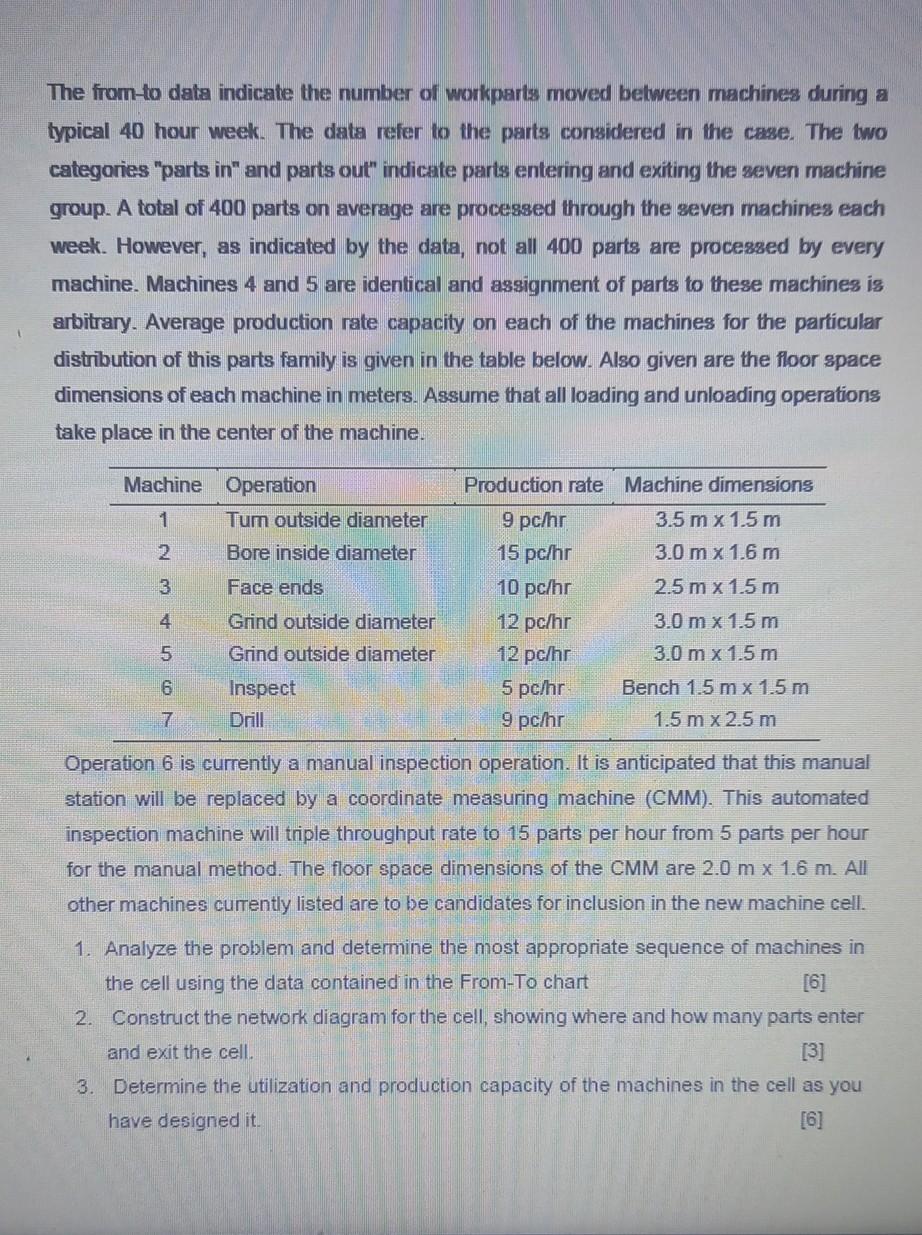
1. AGT cell will machine the components for a family of parts. The parts come in several different sizes and the cel will be designed to quickly change over from one size to the next. This will be accomplished using fast-change fixtures and downloading the part programs from the plant computer to the CNC machines in the cell. The parts are rotational type, and so the cell must be able to perform tuming, boring, facing, drilling, and cylindrical grinding operations. Accordingly, there will be several machine tools in the cell, of types and numbers to be specified by the designer. To transfer parts between machines in the cell, the designer may elect to use a belt or similar conveyor system. Any conveyor equipment of this type will be 0.4 m. wide. The arrangement of the various pieces of equipment in the cell is the principal problem to be considered. The raw workparts will be delivered into the machine cell on a belt conveyor. The finished parts must be deposited onto a conveyor that delivers them to the assembly department. The input and output conveyors are 0.4 m wide, and the designer must specify where they enter and exit the cell. The parts are currently machined by conventional methods in a process-type layout. In the current production method, there are seven machines involved but two of the machines are duplicates. "From-to" data have been collected for the jobs that are relevant to this problem. To: 1 From: 2 3 4 5 6. Parts out 7 112 1 0 61 59 53 0 0 0 2 12 0 226 0 45 0 74 35 31 0 3 180 0 loooo 82 0 0 23 NO 5 16 oooo 73 0 oooooo 0 0 14 123 0 0 325 6 o 0 174 16 O 20 20 0 30 0 300 0 75 Parts in 25 The from to data indicate the number of workparts moved between machines during a typical 40 hour week. The data refer to the parts considered in the case. The two categories "parts in" and parts out" indicate parts entering and exiting the seven machine group. A total of 400 parts on average are processed through the seven machines each week. However, as indicated by the data, not all 400 parts are processed by every machine. Machines 4 and 5 are identical and assignment of parts to these machines is arbitrary. Average production rate capacity on each of the machines for the particular distribution of this parts family is given in the table below. Also given are the floor space dimensions of each machine in meters. Assume that all loading and unloading operations take place in the center of the machine. Machine Operation 1 Tum outside diameter 2 Bore inside diameter 3 Production rate Machine dimensions 9 pc/hr 3.5 mx1.5 m 15 pc/hr 3.0 mx 1.6 m 10 pc/hr 2.5 m x 1.5 m 12 pc/hr 3.0 m x 1.5 m 12 pc/hr 3.0 m x 1.5 m 5 pc/hr Bench 1.5 mx 1.5 m 9 pc/hr 1.5 m x 2.5 m 4 Face ends Grind outside diameter Grind outside diameter - 5 6 Inspect Drill 7 Operation 6 is currently a manual inspection operation. It is anticipated that this manual station will be replaced by a coordinate measuring machine (CMM). This automated inspection machine will triple throughput rate to 15 parts per hour from 5 parts per hour for the manual method. The floor space dimensions of the CMM are 2.0 m x 1.6 m. All other machines currently listed are to be candidates for inclusion in the new machine cell. 1. Analyze the problem and determine the most appropriate sequence of machines in the cell using the data contained in the From-To chart [6] 2. Construct the network diagram for the cell, showing where and how many parts enter and exit the cell. [3] 3. Determine the utilization and production capacity of the machines in the cell as you have designed it [6]
Step by Step Solution
There are 3 Steps involved in it
1 Expert Approved Answer
Step: 1 Unlock

Question Has Been Solved by an Expert!
Get step-by-step solutions from verified subject matter experts
Step: 2 Unlock
Step: 3 Unlock
 Study Help