







Question: 1.) All macroscopic objects emit a continuous spectrum of radiation with a peak at a wavelength that depends on temperature. You saw this in lab
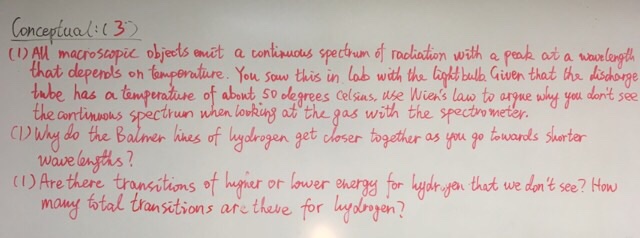
Conceptual (3) (1) All macroscopic objects emit a continuous spectrum of radiation with a peak at a wavelength that depends on temperature. You saw this in lab with the light bulb. Given that the discharge tube has a temperature of about 50 degrees Celsius, use Wien's law to argue why you don't see the continuous spectrum when looking at the gas with the spectrometer. (1) Why do the Balmer lines of hydrogen get closer together as you go towards shorter wavelengths? (1) Are there transitions of higher or lower energy for hydr. yen that we don't see? How many total transitions are there for hydrogen?
Step by Step Solution
3.53 Rating (160 Votes )
There are 3 Steps involved in it
1 According to Wiens law the peak wavelength of a bodys emission spectrum is inversely proportional to its temperature This means that as the temperat... View full answer

Get step-by-step solutions from verified subject matter experts
 Study Help