







Question: 1. An object moves clockwise with decreasing speed around an oval track. The velocity vectors at points G and H are shown. C. Top
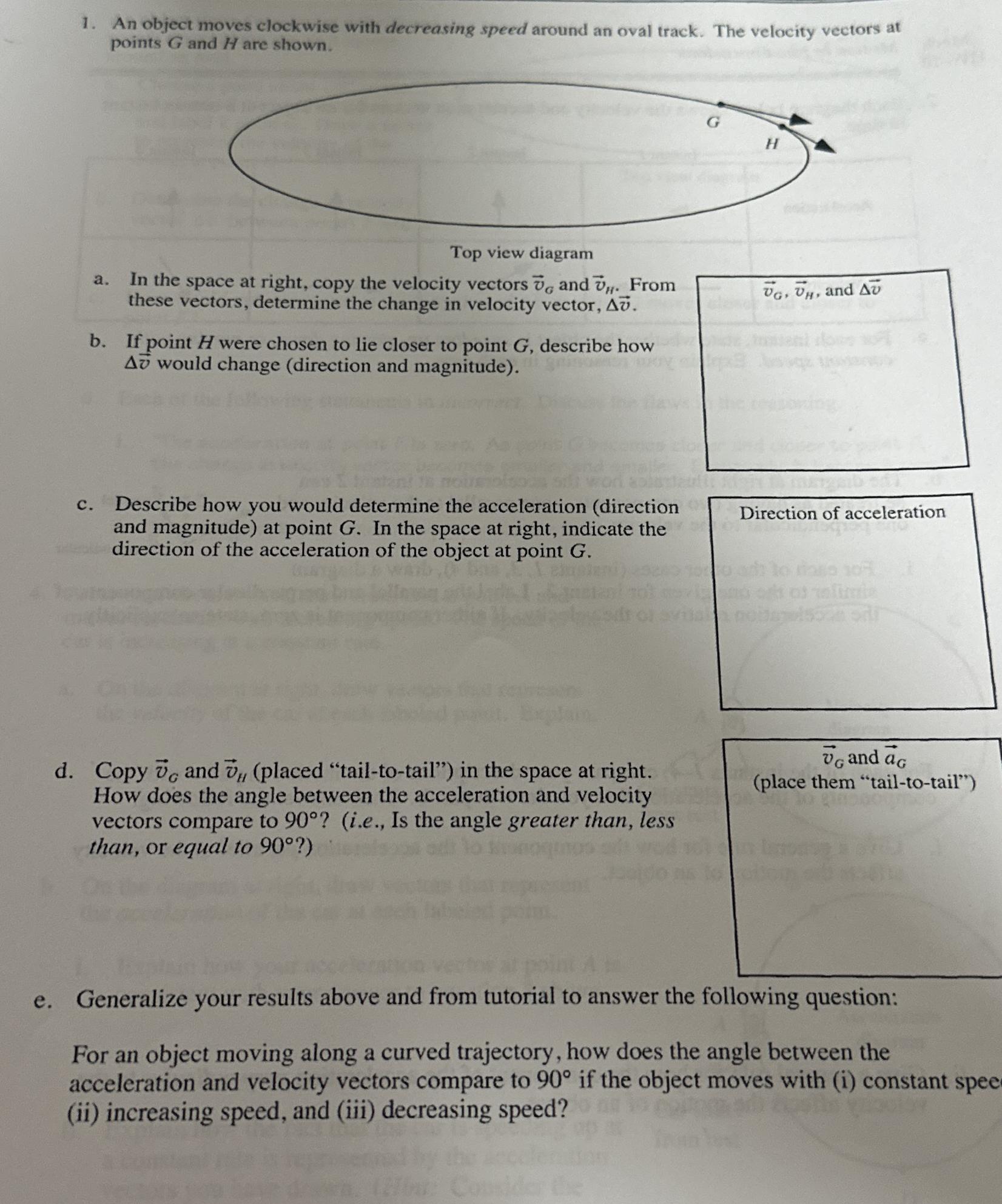
1. An object moves clockwise with decreasing speed around an oval track. The velocity vectors at points G and H are shown. C. Top view diagram a. In the space at right, copy the velocity vectors V and V. From these vectors, determine the change in velocity vector, Av. b. If point H were chosen to lie closer to point G, describe how A would change (direction and magnitude). Describe how you would determine the acceleration (direction and magnitude) at point G. In the space at right, indicate the direction of the acceleration of the object at point G. G H UG, VH, and Av Direction of acceleration infimie d. Copy v, and 7, (placed "tail-to-tail") in the space at right. How does the angle between the acceleration and velocity vectors compare to 90? (i.e., Is the angle greater than, less than, or equal to 90?) V and ac (place them "tail-to-tail") e. Generalize your results above and from tutorial to answer the following question: For an object moving along a curved trajectory, how does the angle between the acceleration and velocity vectors compare to 90 if the object moves with (i) constant spee (ii) increasing speed, and (iii) decreasing speed?
Step by Step Solution
There are 3 Steps involved in it
a To calculate the velocity vector change To find the final velocity vector vH we subtract the begin... View full answer

Get step-by-step solutions from verified subject matter experts
 Study Help