







Question: 1. Assuming that a single pixel inside this camera is imaging an overfilled object with a reflectivity of 50%, calculate the flux (in watts) that
1. Assuming that a single pixel inside this camera is imaging an overfilled object with a reflectivity of 50%, calculate the flux (in watts) that is incident on a single detector pixel. Assume the following conditions (these are not necessarily the same as in part I):
a. Pixel size of 10 microns x 10 microns;
b. Lens focal length of 50 mm;
c. Lens diameter of 10 mm;
d. The solar illumination is normally incident on the object;
e. The object is at the bottom of the atmosphere;
f. The imaging system is 1 km away from the object;
g. Motion blur is negligible;
h. Atmospheric transmission between the object and optical system is 95%;
i. The optical system is sensitive only to wavelengths spanning 500-600 nm;
j. The optics transmission is 90%;
k. Earth-sun distance of 149.6E6 km;
l. Sun radius of 695.7E3 km;
m. Sun?s blackbody temperature is 6000 K (see note below).
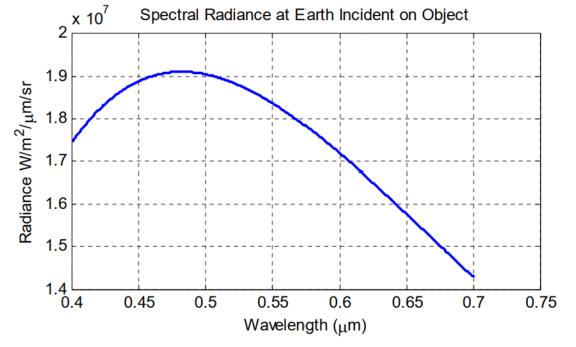
2. Two detectors could be used to measure the light above. Within the desired spectral passband:
a. Detector A has a responsivity of 45%, a pixel size of 15x15 microns, and a dark current generation rate of 15 e/s;
b. Detector B has a responsivity of 60%, a pixel size of 10x10 microns, and a dark current generation rate of 0.01 e/s. What is the signal to noise ratio for both detector A and B when used in the imaging scenario above (Part II, problem 1) ? which detector provides the biggest SNR? Assume an integration time of 15 milliseconds for both detectors.
3. Besides SNR, what is the biggest tradeoff between Detectors A and B in terms of their imaging performances?
Radiance W/m2/um/sr 2 1.9 1.8 1.7 1.6 1.5 1.4 0.4 10 Spectral Radiance at Earth Incident on Object 0.45 0.5 0.55 0.6 Wavelength (um) 0.65 0.7 0.75
Step by Step Solution
3.31 Rating (148 Votes )
There are 3 Steps involved in it
To solve these questions we need to go through them step by step Question 1 Calculate the incident flux on a single detector pixel Step 1 Calculate th... View full answer

Get step-by-step solutions from verified subject matter experts
 Study Help