







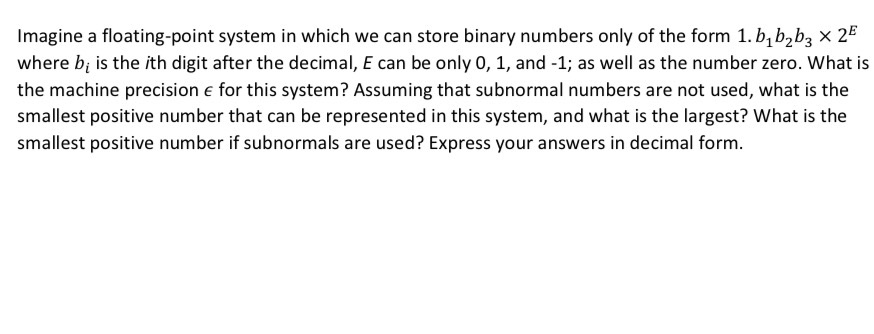
Question: 1. b, b2b, X 2?where b; is the ith digit after the decimal, E can be only 0, 1, and -1; as well as the
1. b, b2b, X 2?where b; is the ith digit after the decimal, E can be only 0, 1, and -1; as well as the number zero. What isthe machine precision ? for this system? Assuming that subnormal numbers are not used, what is thesmallest positive number that can be represented in this system, and what is the largest? What is thesmallest positive number if subnormal are used? Express your answers in decimal form.
Step by Step Solution
There are 3 Steps involved in it
1 Expert Approved Answer
Step: 1 Unlock

Question Has Been Solved by an Expert!
Get step-by-step solutions from verified subject matter experts
Step: 2 Unlock
Step: 3 Unlock
 Study Help