







Question: 1. Based on data from the US Census Bureau, the US population in 1990 was approximately 250 million people and in 2000 was approximately
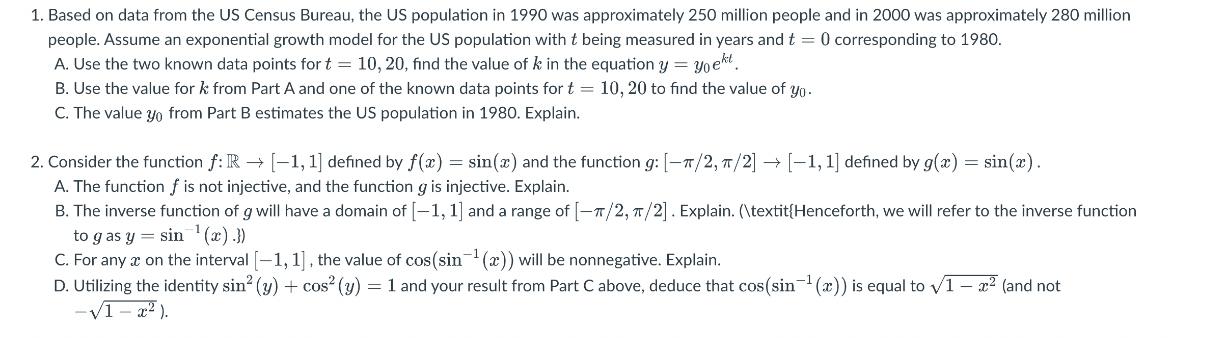
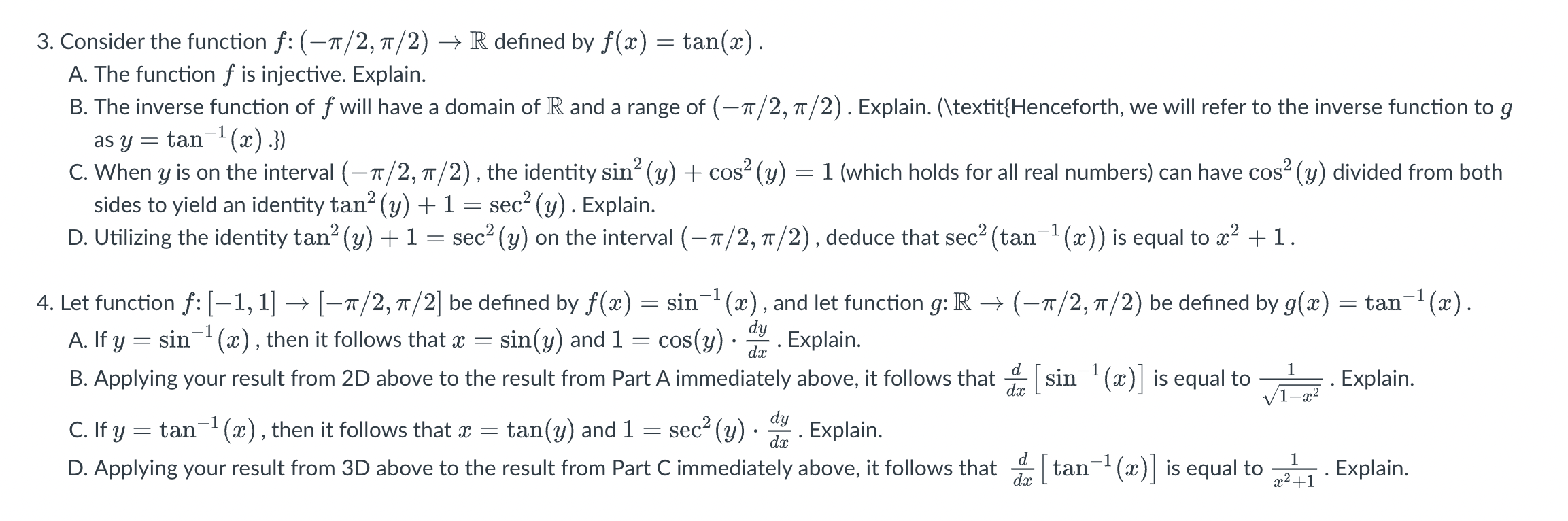
1. Based on data from the US Census Bureau, the US population in 1990 was approximately 250 million people and in 2000 was approximately 280 million people. Assume an exponential growth model for the US population with t being measured in years and t = 0 corresponding to 1980. A. Use the two known data points for t = 10, 20, find the value of k in the equation y = yoekt. B. Use the value for k from Part A and one of the known data points for t = 10, 20 to find the value of yo. C. The value yo from Part B estimates the US population in 1980. Explain. 2. Consider the function f: R [-1, 1] defined by f(x) = sin(x) and the function g: [-T/2, T/2] [-1, 1] defined by g(x) = sin(x). A. The function f is not injective, and the function g is injective. Explain. B. The inverse function of g will have a domain of [-1, 1] and a range of [-/2, /2]. Explain. (\textit{Henceforth, we will refer to the inverse function to gas y sin 1(x).}) C. For any a on the interval [-1, 1], the value of cos(sin-(x)) will be nonnegative. Explain. D. Utilizing the identity sin (y) + cos (y) = 1 and your result from Part C above, deduce that cos(sin(x)) is equal to 1 - x (and not -1-x). 3. Consider the function f: (-/2, /2) R defined by f(x) = tan(x). A. The function f is injective. Explain. B. The inverse function of f will have a domain of R and a range of (-/2, /2). Explain. (\textit{Henceforth, we will refer to the inverse function to g as y = tan(x) .}) C. When y is on the interval (/2, /2), the identity sin (y) + cos (y) = 1 (which holds for all real numbers) can have cos (y) divided from both sides to yield an identity tan (y) + 1 = sec (y) . Explain. D. Utilizing the identity tan (y) + 1 = sec (y) on the interval (/2, /2), deduce that sec (tan(x)) is equal to x + 1. 4. Let function f: [1, 1] [-/2, /2] be defined by f(x) = sin (x), and let function g: R (/2, /2) be defined by g(x) = tan(x). A. If y = sin(x), then it follows that x = = dy sin(y) and 1 cos(y). Explain. dx B. Applying your result from 2D above to the result from Part A immediately above, it follows that sin-(x)] is equal to d dx dy C. If y = tan(x), then it follows that x = tan(y) and 1 sec (y) = Explain. dx D. Applying your result from 3D above to the result from Part C immediately above, it follows that d dx 1 V. Explain. [tan (x)] is equal to Explain. 1 x +1
Step by Step Solution
There are 3 Steps involved in it
1Solution To find the exponential growth model for the US population lets use the general form of an exponential growth equation yy0ekt where y is the ... View full answer

Get step-by-step solutions from verified subject matter experts
 Study Help