







Question: 1. Based on the annual data for the U.S. manufacturing sector for 1899-1922, Dougherty obtained the following regression results. lny=2.810.53lnK+0.91lnL+0.047tse=(1.38)(0.34)(0.14)(0.021)R2=0.97,F=189.8 where y= index of real
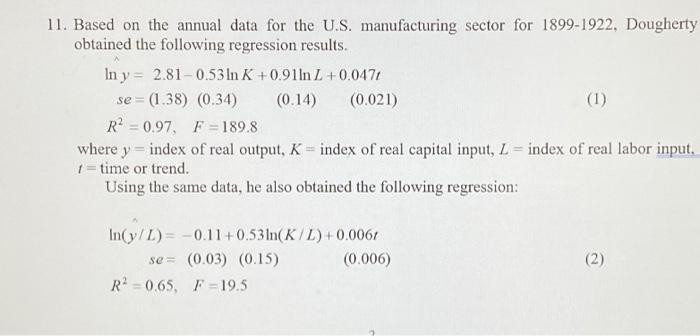
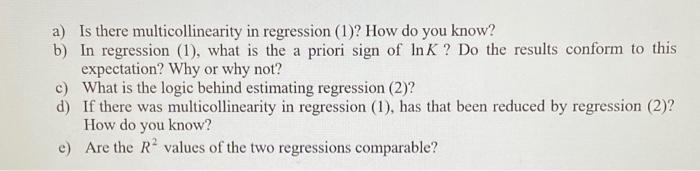
1. Based on the annual data for the U.S. manufacturing sector for 1899-1922, Dougherty obtained the following regression results. lny=2.810.53lnK+0.91lnL+0.047tse=(1.38)(0.34)(0.14)(0.021)R2=0.97,F=189.8 where y= index of real output, K= index of real capital input, L= index of real labor input, t= time or trend. Using the same data, he also obtained the following regression: ln(y^/L)=0.11+0.53ln(K/L)+0.006tse=(0.03)(0.15)(0.006)R2=0.65,F=19.5 a) Is there multicollinearity in regression (1)? How do you know? b) In regression (1), what is the a priori sign of lnK ? Do the results conform to this expectation? Why or why not? c) What is the logic behind estimating regression (2)? d) If there was multicollinearity in regression (1), has that been reduced by regression (2)? How do you know? e) Are the R2 values of the two regressions comparable
Step by Step Solution
There are 3 Steps involved in it

Get step-by-step solutions from verified subject matter experts
 Study Help