







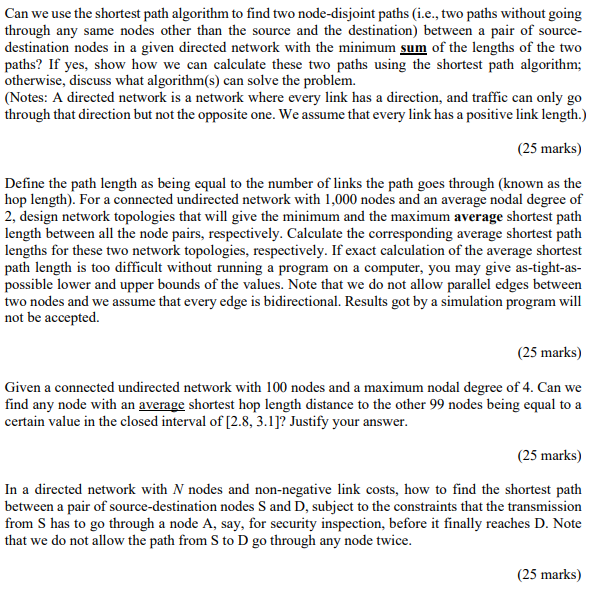
Question: 1 ) Can we use the shortest path algorithm to find two node - disjoint paths ( i . e . , two paths without
Can we use the shortest path algorithm to find two nodedisjoint paths ie two paths without going through any same nodes other than the source and the destination between a pair of sourcedestination nodes in a given directed network with the minimum sum of the lengths of the two paths? If yes, show how we can calculate these two paths using the shortest path algorithm; otherwise, discuss what algorithms can solve the problem.
Notes: A directed network is a network where every link has a direction, and traffic can only go through that direction but not the opposite one. We assume that every link has a positive link length.
Define the path length as being equal to the number of links the path goes through known as the hop length For a connected undirected network with nodes and an average nodal degree of design network topologies that will give the minimum and the maximum average shortest path length between all the node pairs, respectively. Calculate the corresponding average shortest path lengths for these two network topologies, respectively. If exact calculation of the average shortest path length is too difficult without running a program on a computer, you may give astightaspossible lower and upper bounds of the values. Note that we do not allow parallel edges between two nodes and we assume that every edge is bidirectional. Results got by a simulation program will not be accepted.
Given a connected undirected network with nodes and a maximum nodal degree of Can we find any node with an average shortest hop length distance to the other nodes being equal to a certain value in the closed interval of Justify your answer.
In a directed network with N nodes and nonnegative link costs, how to find the shortest path between a pair of sourcedestination nodes S and D subject to the constraints that the transmission from S has to go through a node A say, for security inspection, before it finally reaches D Note that we do not allow the path from S to D go through any node twice.
Step by Step Solution
There are 3 Steps involved in it
1 Expert Approved Answer
Step: 1 Unlock

Question Has Been Solved by an Expert!
Get step-by-step solutions from verified subject matter experts
Step: 2 Unlock
Step: 3 Unlock
 Study Help