Question: 1. Carefully read the sample Code of Ethics for Napier Environmental appended below. 2. This Code was written by me approximately 20 years ago. Is
1. Carefully read the sample "Code of Ethics" for Napier Environmental appended below.
2. This Code was written by me approximately 20 years ago. Is a document like this, signed by all employees in an organization or business, still necessary in today's fast paced business world? Why or why not...........explain.
3. How would you update this document to reflect current business trends, communications technology (social media, outside data hacking, privacy concerns) and corporate needs today? Are there any sections that should be delete? Why....
Report should not exceed 5 to 7 pages, be well formatted and written in a clear and concise manner. Point form is just fine.
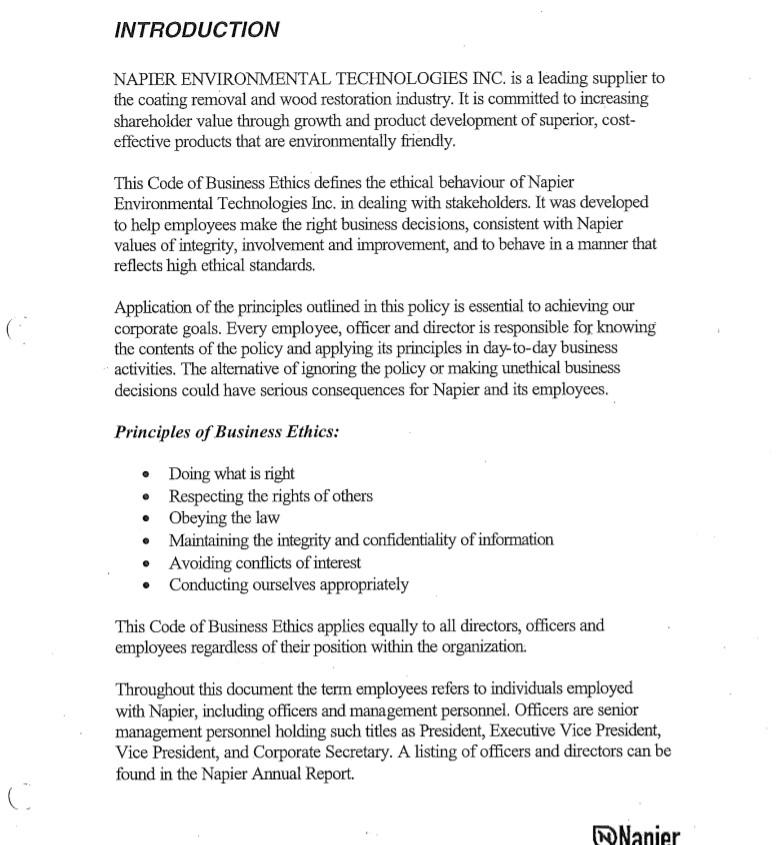
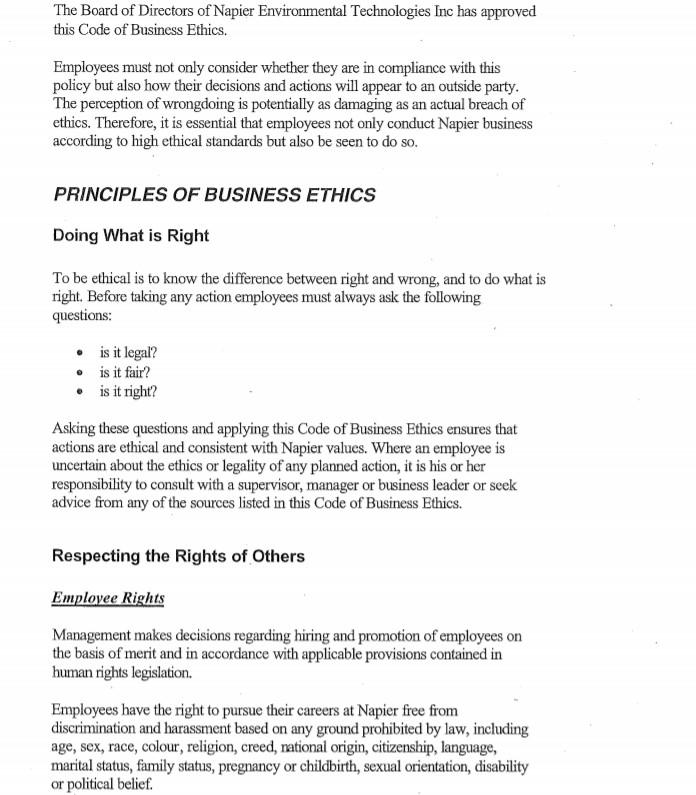
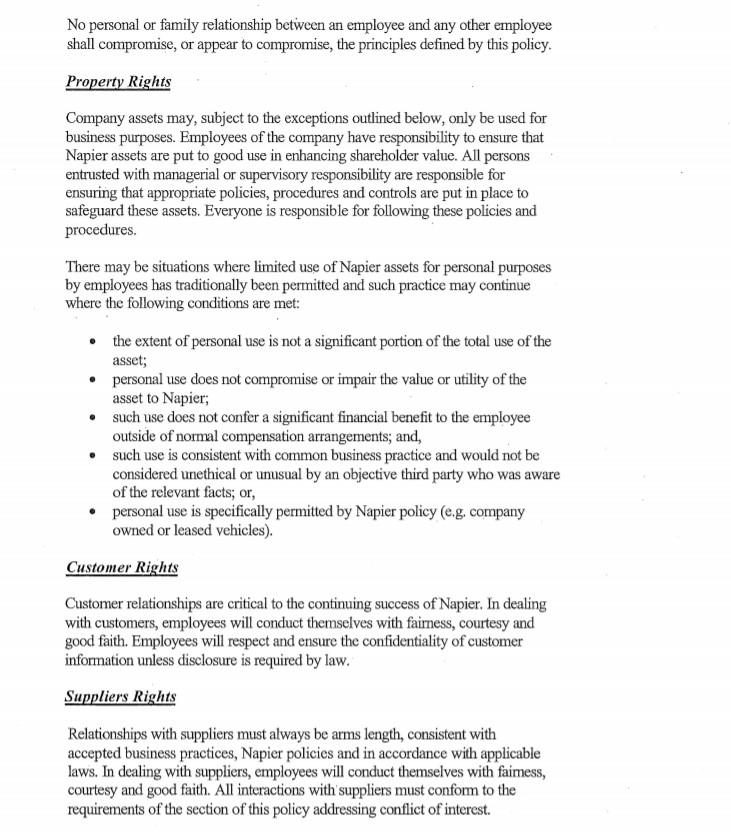
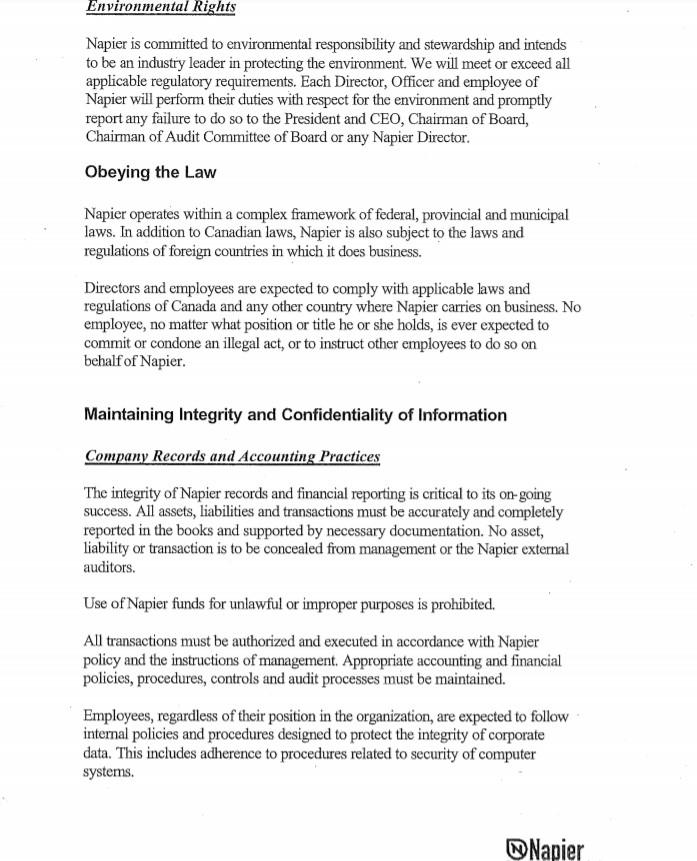
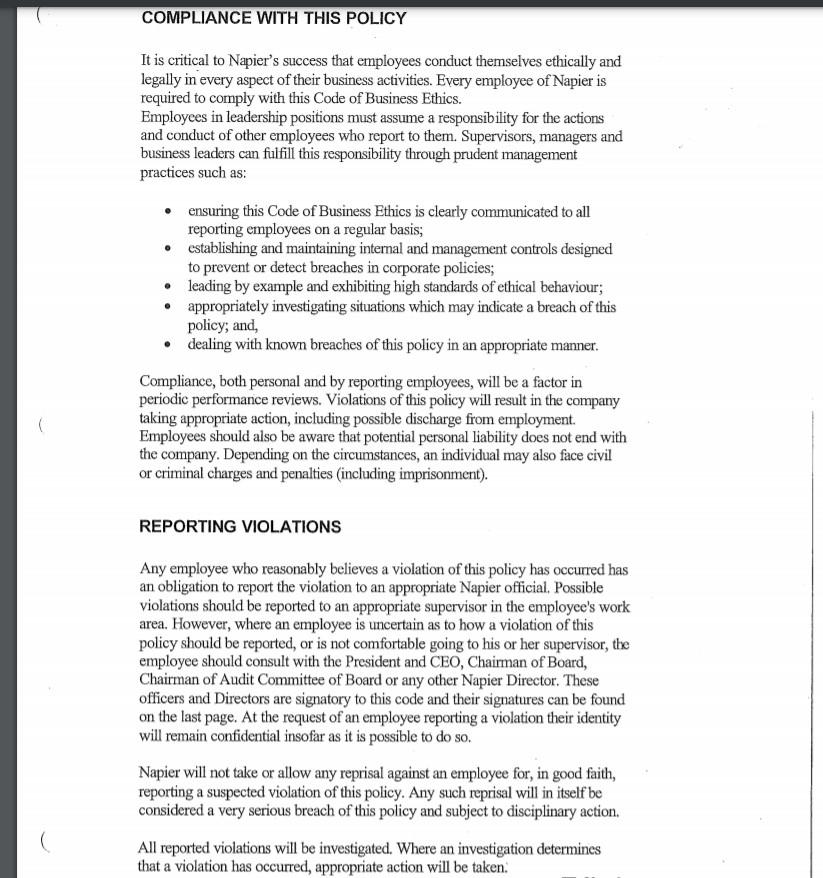
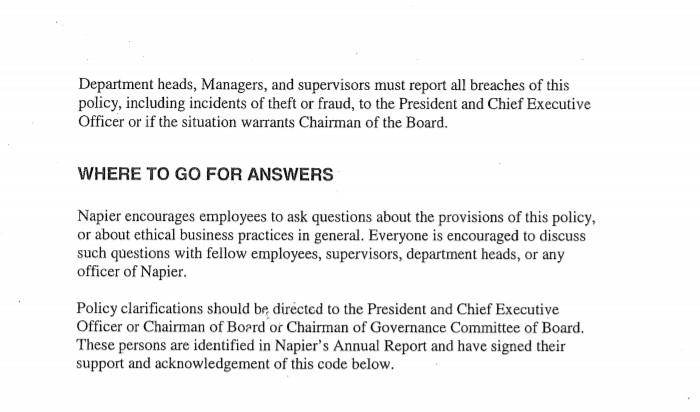
INTRODUCTION NAPIER ENVIRONMENTAL TECHNOLOGIES INC. is a leading supplier to the coating removal and wood restoration industry. It is committed to increasing shareholder value through growth and product development of superior, cost- effective products that are environmentally friendly. This Code of Business Ethics defines the ethical behaviour of Napier Environmental Technologies Inc. in dealing with stakeholders. It was developed to help employees make the right business decisions, consistent with Napier values of integrity, involvement and improvement, and to behave in a manner that reflects high ethical standards, Application of the principles outlined in this policy is essential to achieving our corporate goals. Every employee, officer and director is responsible for knowing the contents of the policy and applying its principles in day-to-day business activities. The alternative of ignoring the policy or making unethical business decisions could have serious consequences for Napier and its employees. Principles of Business Ethics: Doing what is right Respecting the rights of others Obeying the law Maintaining the integrity and confidentiality of information Avoiding conflicts of interest Conducting ourselves appropriately This Code of Business Ethics applies equally to all directors, officers and employees regardless of their position within the organization. Throughout this document the term employees refers to individuals employed with Napier, including officers and management personnel. Officers are senior management personnel holding such titles as President, Executive Vice President, Vice President, and Corporate Secretary. A listing of officers and directors can be found in the Napier Annual Report. c Nanier The Board of Directors of Napier Environmental Technologies Inc has approved this Code of Business Ethics. Employees must not only consider whether they are in compliance with this policy but also how their decisions and actions will appear to an outside party. The perception of wrongdoing is potentially as damaging as an actual breach of ethics. Therefore, it is essential that employees not only conduct Napier business according to high ethical standards but also be seen to do so. PRINCIPLES OF BUSINESS ETHICS Doing What is Right To be ethical is to know the difference between right and wrong, and to do what is right. Before taking any action employees must always ask the following questions: . is it legal? is it fair? . is it right? Asking these questions and applying this Code of Business Ethics ensures that actions are ethical and consistent with Napier values. Where an employee is uncertain about the ethics or legality of any planned action, it is his or her responsibility to consult with a supervisor, manager or business leader or seek advice from any of the sources listed in this Code of Business Ethics. Respecting the Rights of Others Employee Rights Management makes decisions regarding hiring and promotion of employees on the basis of merit and in accordance with applicable provisions contained in human rights legislation. Employees have the right to pursue their careers at Napier free from discrimination and harassment based on any ground prohibited by law, including age, sex, race, colour, religion, creed, national origin, citizenship, language, marital status, family status, pregnancy or childbirth, sexual orientation, disability or political belief. No personal or family relationship between an employee and any other employee shall compromise, or appear to compromise, the principles defined by this policy. Property Rights Company assets may, subject to the exceptions outlined below, only be used for business purposes. Employees of the company have responsibility to ensure that Napier assets are put to good use in enhancing shareholder value. All persons entrusted with managerial or supervisory responsibility are responsible for ensuring that appropriate policies, procedures and controls are put in place to safeguard these assets. Everyone is responsible for following these policies and procedures. There may be situations where limited use of Napier assets for personal purposes by employees has traditionally been permitted and such practice may continue where the following conditions are met: the extent of personal use is not a significant portion of the total use of the asset; personal use does not compromise or impair the value or utility of the asset to Napier; such use does not confer a significant financial benefit to the employee outside of normal compensation arrangements; and, such use is consistent with common business practice and would not be considered unethical or unusual by an objective third party who was aware of the relevant facts; or, personal use is specifically permitted by Napier policy (e.g. company owned or leased vehicles). Customer Rights Customer relationships are critical to the continuing success of Napier. In dealing with customers, employees will conduct themselves with fairness, courtesy and good faith. Employees will respect and ensure the confidentiality of customer information unless disclosure is required by law. Suppliers Rights Relationships with suppliers must always be arms length, consistent with accepted business practices, Napier policies and in accordance with applicable laws. In dealing with suppliers, employees will conduct themselves with faimess, courtesy and good faith. All interactions with suppliers must conform to the requirements of the section of this policy addressing conflict of interest. Environmental Rights Napier is committed to environmental responsibility and stewardship and intends to be an industry leader in protecting the environment. We will meet or exceed all applicable regulatory requirements. Each Director, Officer and employee of Napier will perform their duties with respect for the environment and promptly report any failure to do so to the President and CEO, Chairman of Board, Chairman of Audit Committee of Board or any Napier Director. Obeying the Law Napier operates within a complex framework of federal, provincial and municipal laws. In addition to Canadian laws, Napier is also subject to the laws and regulations of foreign countries in which it does business. Directors and employees are expected to comply with applicable laws and regulations of Canada and any other country where Napier carries on business. No employee, no matter what position or title he or she holds, is ever expected to commit or condone an illegal act, or to instruct other employees to do so on behalf of Napier. Maintaining Integrity and Confidentiality of Information Company Records and Accounting Practices The integrity of Napier records and financial reporting is critical to its on-going success. All assets, liabilities and transactions must be accurately and completely reported in the books and supported by necessary documentation. No asset, liability or transaction is to be concealed from management or the Napier external auditors. Use of Napier funds for unlawful or improper purposes is prohibited. All transactions must be authorized and executed in accordance with Napier policy and the instructions of management, Appropriate accounting and financial policies, procedures, controls and audit processes must be maintained. Employees, regardless of their position in the organization, are expected to follow internal policies and procedures designed to protect the integrity of corporate data. This includes adherence to procedures related to security of computer systems. Napier Financial reports which are made available to the shareholders and the public are prepared in accordance with generally accepted accounting principles as well as applicable laws and regulations. All employees are encouraged to question and report transactions that appear to be contrary to established policies and procedures. Confidentiality of Information Many employees have access to corporate information that is sensitive or confidential. Information such as personnel records, payroll records, customer information, company strategies, financial and competitive information is all confidential. Release of such information is potentially harmful to Napier employees and customers. In some cases it is illegal. Employees must use extreme care when dealing with confidential or sensitive information. As a general rule, such information shall not be released to anyone inside or outside of the company who is not authorized or legally entitled to receive it. Care must be taken not to discuss confidential information in social or public settings. Employees are responsible for ensuring confidential information is not released to outside parties. Where an employee is uncertain as to whether certain information can or should be released he or she shall consult with his or her supervisor, manager, or business leader or make other necessary inquiries prior to complying with requests for such information. Napier will not disclose personal information about an employee to third parties without the employee's permission, unless required by law. Avoiding Conflicts of Interest A conflict of interest arises when an employee must choose between Napier's best interests or their own. Any situation where an employee's judgment may be compromised, where he or she shows undue favouritism to any party or where he or she receives a benefit of some kind is potentially a conflict of interest. All employees must strive to avoid situations that create a conflict, create the appearance of a conflict, or have the potential to create a conflict. If any of these situations occur, employees are responsible for disclosing and, where appropriate, taking action to remedy the conflict of interest. In most instances, an employee should make such disclosures to their immediate supervisor. Situations that can potentially give rise to a conflict of interest are numerous. Some of the more significant areas causing conflicts of interest are discussed below. All of the comments in this section are applicable to employees, spouses (including common law partners) and family members. Personal Interest in Transactions No employee shall have any direct personal interest in a transaction to which Napier is a party, unless fully disclosed and approved by an independent manager. For example it is inappropriate for an employee's spouse to set up a business that sells goods or services to Napier where the employee either directly makes or approves the decision to purchase such goods or services. No employee shall use his or her position to solicit or conduct business for personal benefit or gain. A potential conflict of interest exists where an employee, his or her spouse or immediate family owns a share or has an interest in any business which competes with Napier. This does not prohibit small holdings of shares in public companies that compete with Napier. Use of Insider Information Trading of publicly listed securities on the basis of insider information is against the law and can result in significant fines and even jail sentences. Insider information is generally considered to be any corporate information that has not been made public which, if known to the market, will likely cause share prices to either rise or fall. In the course of performing their duties, employees may become aware of or have direct access to such information. Sharing this information with anyone inside or outside the company or using it for personal gain by buying or selling shares of Napier or any other publicly traded company is a serious breach of company policy and Canadian law. Supplying information to other people ("tipping") is an offence, even if there is no personal gain to the employee. Gifts and Benefits Receiving and giving gifts and benefits in a business context is a sensitive area which requires judgment and common sense. Employees should not accept gifts or benefits from customers, suppliers, business associates or companies who wish to do business with Napier, if such gifts might be perceived as a bribe or appear to influence business decisions. The same principle applies to giving gifts or benefits on behalf of Napier and to gifts given to, or received by, family members and spouses. Generally, gifts or other benefits may be given and accepted by employees when they: are consistent with local business practice and custom, are not excessive in value, are not in contravention of applicable laws and ethical standards, and, are able to withstand public scrutiny. It is prohibited to receive or give a gift in cash or cash equivalent. Gifts of more than nominal value are to be refused. Where an employee feels such a gift must be accepted to avoid damaging business relationships, the employee must consult with his or her immediate supervisor as to the appropriate course of action. Abuse of Position Employees must not inappropriately use their position and authority for personal benefit or to the detriment of other employees. None should take unfair advantage of anyone through manipulation, concealment, abuse of privileged information or misrepresentation of material facts. Taking a Second Job It is acceptable for employees to have a second job, provided it does not interfere with the employee's ability to adequately perform his or her duties at Napier. The second job must not create, or appear to create, a conflict of interest . For example, it is not acceptable for employees to work for a direct competitor of Napier. Where an employee currently has a second job or is considering taking a second job, potential conflicts must be discussed with the employee's immediate supervisor Running a Business Employees may have other business interests outside of Napier. While there is nothing ethically wrong in principle with employees running or managing other businesses, such situations can give rise to significant conflicts of interest. For example, it would be a conflict for an employee to set up a business that is in direct competition with Napier or that sells goods and services to Napier. As with taking a second job, running or managing a business should not interfere with the employee's ability to adequately perform his or her duties at Napier, Where an employee is currently managing a business or is considering doing so, potential conflicts must be discussed with the employee's immediate supervisor. Serving as a Director of Another Organization Directors and employees may serve as a director of another organization, such as a limited company, a non-profit or a religious organization, provided that it does not interfere with their ability to perform their duties at Napier and is in accordance with existing company policies. Where serving as a director creates a conflict of interest, it must be disclosed and, where appropriate, remedied. Conducting Ourselves Appropriately Community and Public Relations Napier's standing in the communities in which it does business and the perceptions of the general public, shareholders and the investment communities are critical to its success. All employees are ambassadors of Napier and need to be aware of how their actions, conduct and public statements can impact the public perception of the company. Employees and officers may not speak publicly for the company, unless specifically authorized by senior management. Employees may not use company stationary or titles in communications which do not directly involve Napier, Employees expressing personal opinions when speaking or writing should not imply company endorsement or in fact associate Napier in any way with personal affairs. Internal Communication Napier strongly believes in the importance of honest and open communication. Communication regarding business and work related issues should normally follow established organizational channels. E-mails and other internal communication must respect the feelings and attitudes of all employees who may encounter the written material. For issues involving possible violations of this Code of Business Ethics, employees should refer to the section on Reporting Violations for guidance. Professional Standards Employees holding professional credentials such as lawyers, accountants and engineers are required to comply with all relevant professional standards and rules of conduct when practicing their vocation in the service of Napier. COMPLIANCE WITH THIS POLICY It is critical to Napier's success that employees conduct themselves ethically and legally in every aspect of their business activities. Every employee of Napier is required to comply with this Code of Business Ethics. Employees in leadership positions must assume a responsibility for the actions and conduct of other employees who report to them. Supervisors, managers and business leaders can fulfill this responsibility through prudent management practices such as: ensuring this Code of Business Ethics is clearly communicated to all reporting employees on a regular basis; establishing and maintaining internal and management controls designed to prevent or detect breaches in corporate policies; leading by example and exhibiting high standards of ethical behaviour; appropriately investigating situations which may indicate a breach of this policy, and, dealing with known breaches of this policy in an appropriate manner. Compliance, both personal and by reporting employees, will be a factor in periodic performance reviews. Violations of this policy will result in the company taking appropriate action, including possible discharge from employment Employees should also be aware that potential personal liability does end with the company. Depending on the circumstances, an individual may also face civil or criminal charges and penalties (including imprisonment). ( REPORTING VIOLATIONS Any employee who reasonably believes a violation of this policy has occurred has an obligation to report the violation to an appropriate Napier official. Possible violations should be reported to an appropriate supervisor in the employee's work area. However, where an employee is uncertain as to how a violation of this policy should be reported, or is not comfortable going to his or her supervisor, the employee should consult with the President and CEO, Chairman of Board, Chairman of Audit Committee of Board or any other Napier Director. These officers and Directors are signatory to this code and their signatures can be found on the last page. At the request of an employee reporting a violation their identity will remain confidential insofar as it is possible to do so. Napier will not take or allow any reprisal against an employee for, in good faith, reporting a suspected violation of this policy. Any such reprisal will in itself be considered a very serious breach of this policy and subject to disciplinary action, All reported violations will be investigated. Where an investigation determines that a violation has occurred, appropriate action will be taken. Department heads, Managers, and supervisors must report all breaches of this policy, including incidents of theft or fraud, to the President and Chief Executive Officer or if the situation warrants Chairman of the Board. WHERE TO GO FOR ANSWERS Napier encourages employees to ask questions about the provisions of this policy, or about ethical business practices in general. Everyone is encouraged to discuss such questions with fellow employees, supervisors, department heads, or any officer of Napier. Policy clarifications should be directed to the President and Chief Executive Officer or Chairman of Board or Chairman of Governance Committee of Board. These persons are identified in Napier's Annual Report and have signed their support and acknowledgement of this code below









 Study Help