





Question: 1) Compound interest can be calculated using the formula A(t)=P(1+rn)nt A(t) is the account value , t is measured in years , P is the
1) Compound interest can be calculated using the
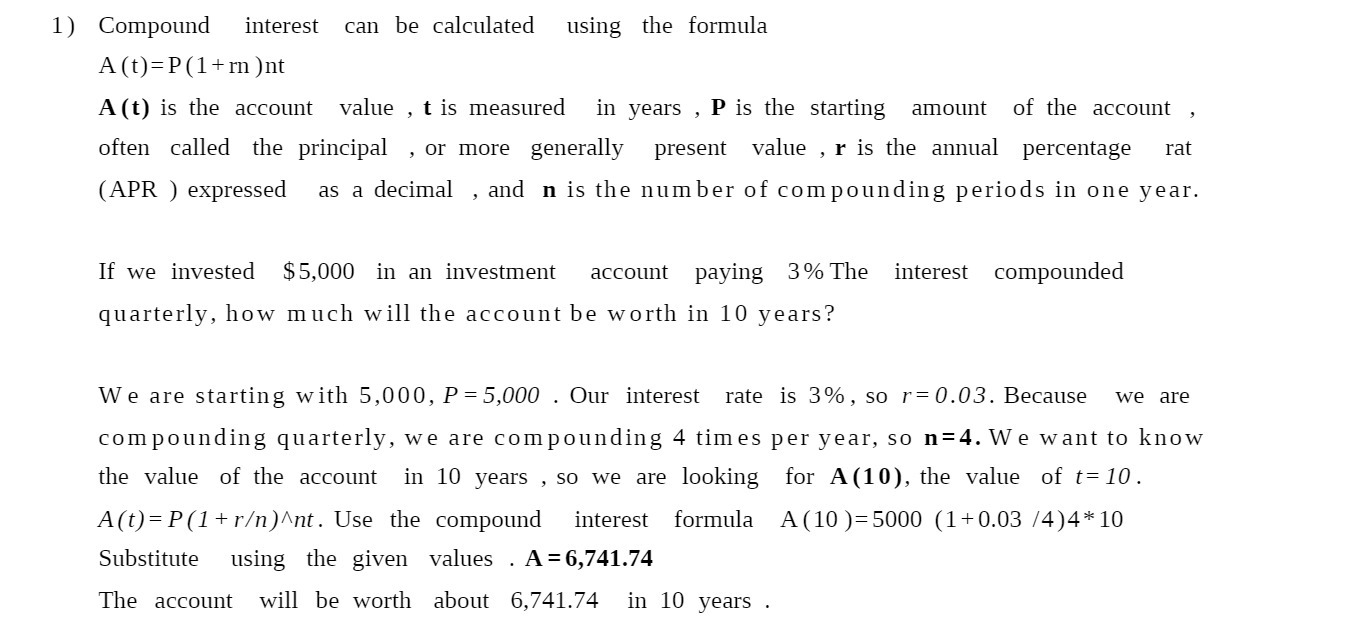
1) Compound interest can be calculated using the formula A(t)=P(1+rn)nt A(t) is the account value , t is measured in years , P is the starting amount of the account , often called the principal , or more generally present value , r is the annual percentage rat (APR ) expressed as a decimal , and n is the number of compounding periods in one year. If we invested $5,000 in an investment account paying 3% The interest compounded quarterly, how much will the account be worth in 10 years? We are starting with 5,000, P=5,000 . Our interest rate is 3%, so r=0.03. Because we are compounding quarterly, we are compounding 4 times per year, so n=4. We want to know the value of the account in 10 years , so we are looking for A(10), the value of 210. A(t)=P(1 +r)/\ t. Use the compound interest formula A(10 ):5000 (1+0.03 f4)4*10 Substitute using the given values .A=6,741.74 The account will be worth about 6,741.74 in 10 years

Step by Step Solution

There are 3 Steps involved in it

1 Expert Approved Answer
Step: 1 Unlock blur-text-image

Question Has Been Solved by an Expert!

Get step-by-step solutions from verified subject matter experts

Step: 2 Unlock
Step: 3 Unlock

Students Have Also Explored These Related Mathematics Questions!