



Question: 1. Compute the mean, median, standard deviation, and variance for hair length (in inches) in 18 healthy women. Calculate the values for s and s'
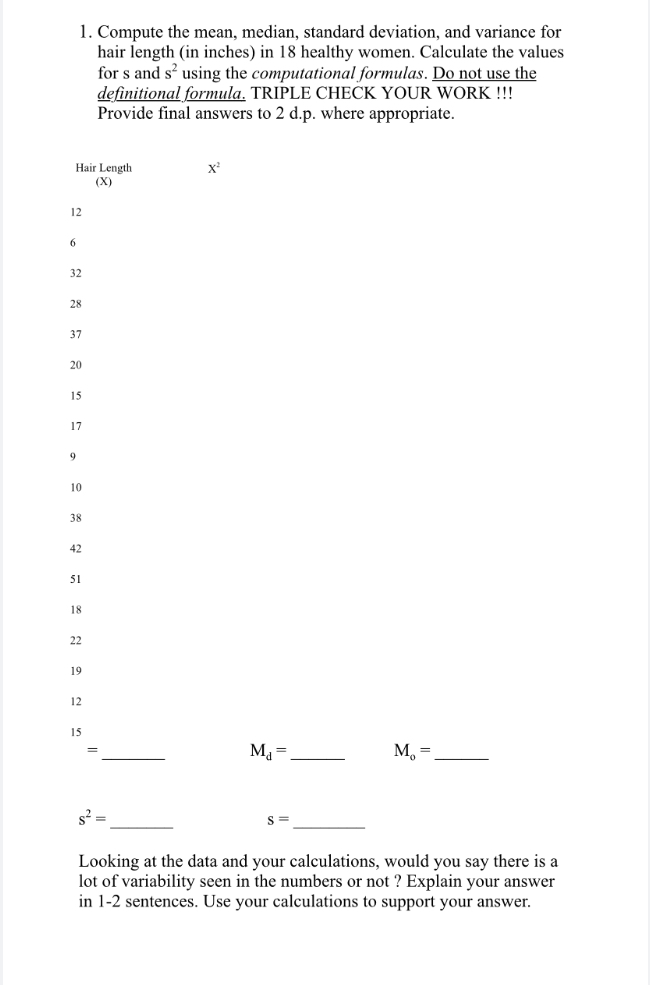
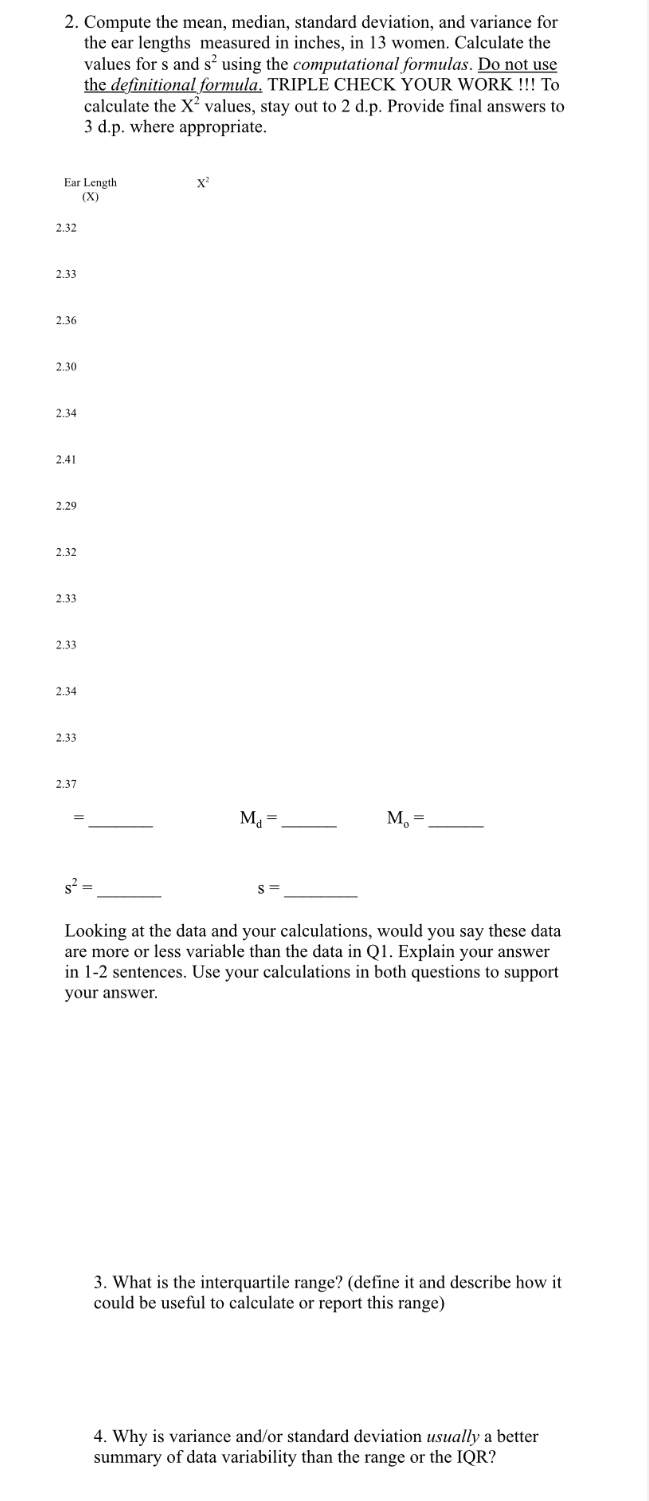
1. Compute the mean, median, standard deviation, and variance for hair length (in inches) in 18 healthy women. Calculate the values for s and s' using the computational formulas. Do not use the definitional formula. TRIPLE CHECK YOUR WORK ! Provide final answers to 2 d.p. where appropriate. Hair Length X' (X) 12 6 32 28 37 20 15 17 10 38 42 51 18 22 19 12 15 M = M = S= Looking at the data and your calculations, would you say there is a lot of variability seen in the numbers or not ? Explain your answer in 1-2 sentences. Use your calculations to support your answer.2. Compute the mean, median, standard deviation, and variance for the ear lengths measured in inches, in 13 women. Calculate the values for s and s2 using the computational famulas. Do not use Wigwam. TRIPLE CHECK YOUR WORK I]! To calculate the X2 values, stay out to 2 d.p. Provide nal answers to 3 d.p. where appropriate. Ear Length X2 (X) 2.32 2.33 2.36 2.30 2.34 2.4I 2.29 2.32 2.33 2.33 2.34 2.33 2.3TII s l s Looking at the data and your calculations, would you say these data are more or less variable than the data in Q1. Explain your answer in 1-2 sentences. Use your calculations in both questions to support your answer. 3. What is the interquartile range? {dene it and describe how it could be useful to calculate or report this range) 4. Why is variance andfrn' standard deviation usually a better summary of data variability than the range or the IQR
Step by Step Solution
There are 3 Steps involved in it

Get step-by-step solutions from verified subject matter experts