







Question: 1. Compute the sums using the common sum formulas: 100 50 (a) E (i-50) + > 100 (b) >(-5)3 1 50 11 E(-1)2 for n
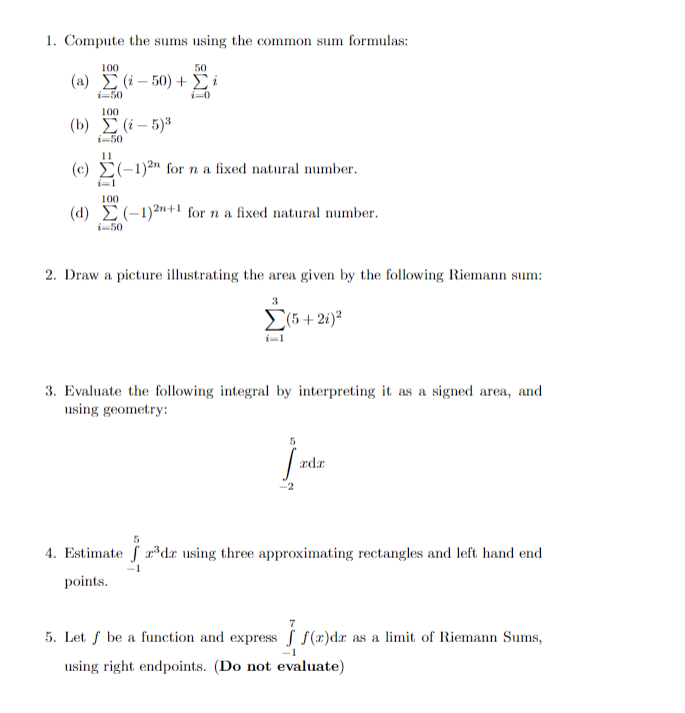
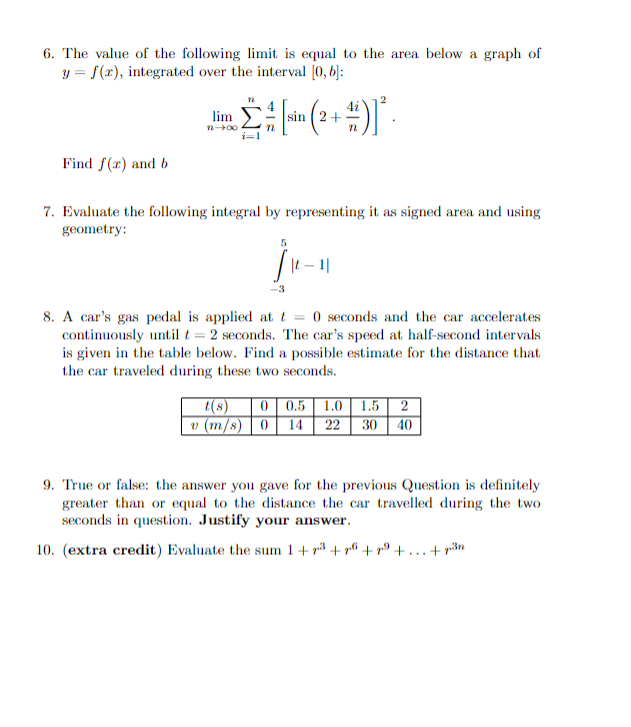
1. Compute the sums using the common sum formulas: 100 50 (a) E (i-50) + > 100 (b) >(-5)3 1 50 11 E(-1)2" for n a fixed natural number. 100 (d) E (-1)2+ for n a fixed natural number. i-50 2. Draw a picture illustrating the area given by the following Riemann sum: E(5+27)2 3. Evaluate the following integral by interpreting it as a signed area, and using geometry: -2 4. Estimate / rode using three approximationg rectangles and left hand end points. 5. Let f be a function and express I f(x)dr as a limit of Riemann Sums, using right endpoints. (Do not evaluate)6. The value of the following limit is equal to the area below a graph of y = f(x), integrated over the interval [0, b]: lim n-+00 EM [in ( 2 + #4 ) ]" Find f(x) and b 7. Evaluate the following integral by representing it as signed area and using geometry: 1 1 - 11 8. A car's gas pedal is applied at t = 0 seconds and the car accelerates continuously until t = 2 seconds. The car's speed at half-second intervals is given in the table below. Find a possible estimate for the distance that the car traveled during these two seconds. 1(8) 0 0.5 1.0 1.5 2 v (m/s) 0 14 22 30 40 9. True or false: the answer you gave for the previous Question is definitely greater than or equal to the distance the car travelled during the two seconds in question. Justify your answer. 10. (extra credit) Evaluate the sum 1 +" trotro + ... +pan
Step by Step Solution
There are 3 Steps involved in it

Get step-by-step solutions from verified subject matter experts
 Study Help