





Question: 1. Consider a short, 10-meter link, over which a sender can transmit at a rate of 150 bits/sec in both directions. Suppose that packets containing
1. Consider a short, 10-meter link, over which a
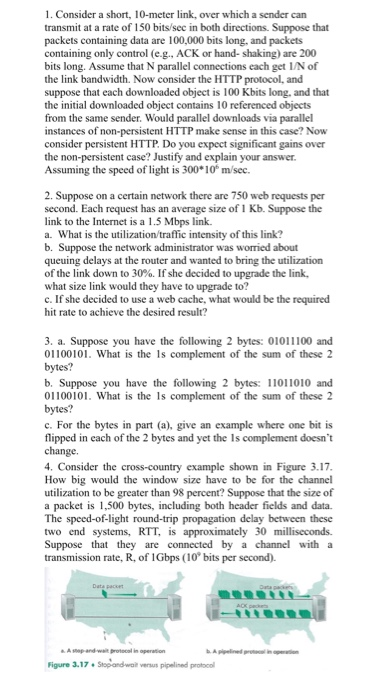
1. Consider a short, 10-meter link, over which a sender can transmit at a rate of 150 bits/sec in both directions. Suppose that packets containing data are 100,000 bits long, and packets containing only control (e.g., ACK or hand-shaking) are 200 bits long. Assume that N parallel connections each get 1/N of the link bandwidth. Now consider the HTTP protocol, and suppose that each downloaded object is 100 Kbits long, and that the initial downloaded object contains 10 referenced objects from the same sender. Would parallel downloads via parallel instances of non-persistent HTTP make sense in this case? Now consider persistent HTTP. Do you expect significant gains over the non-persistent case? Justify and explain your answer. Assuming the speed of light is 300*10 m/sec. 2. Suppose on a certain network there are 750 web requests per second. Each request has an average size of 1 Kb. Suppose the link to the Internet is a 1.5 Mbps link. a. What is the utilization/traffic intensity of this link? b. Suppose the network administrator was worried about queuing delays at the router and wanted to bring the utilization of the link down to 30%. If she decided to upgrade the link, what size link would they have to upgrade to? c. If she decided to use a web cache, what would be the required hit rate to achieve the desired result? 3. a. Suppose you have the following 2 bytes: 01011100 and 01100101. What is the Is complement of the sum of these 2 bytes? b. Suppose you have the following 2 bytes: 11011010 and 01100101. What is the Is complement of the sum of these 2 bytes? c. For the bytes in part (a), give an example where one bit is flipped in each of the 2 bytes and yet the Is complement doesn't change. 4. Consider the cross-country example shown in Figure 3.17. How big would the window size have to be for the channel utilization to be greater than 98 percent? Suppose that the size of a packet is 1,500 bytes, including both header fields and data. The speed-of-light round-trip propagation delay between these two end systems, RTT, is approximately 30 milliseconds. Suppose that they are connected by a channel with a transmission rate, R, of 1Gbps (10 bits per second). Data Astep and wat grocolin Figure 3.17 Stop and wat versus pipelined protocol

Step by Step Solution

There are 3 Steps involved in it

1 Expert Approved Answer
Step: 1 Unlock blur-text-image

Question Has Been Solved by an Expert!

Get step-by-step solutions from verified subject matter experts

Step: 2 Unlock
Step: 3 Unlock

Students Have Also Explored These Related General Management Questions!