







Question: 1. Consider an economy whose economy is accurately represented by the Solow Model. However, for simplicity, assume that there is no productivity growth and
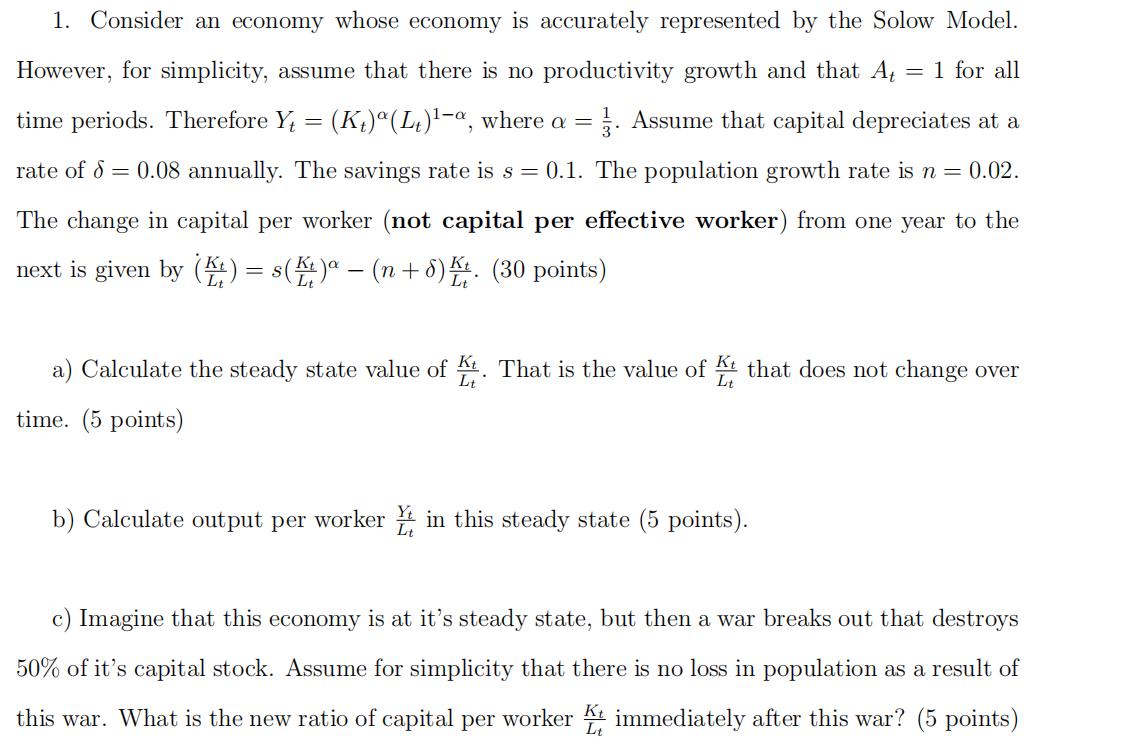
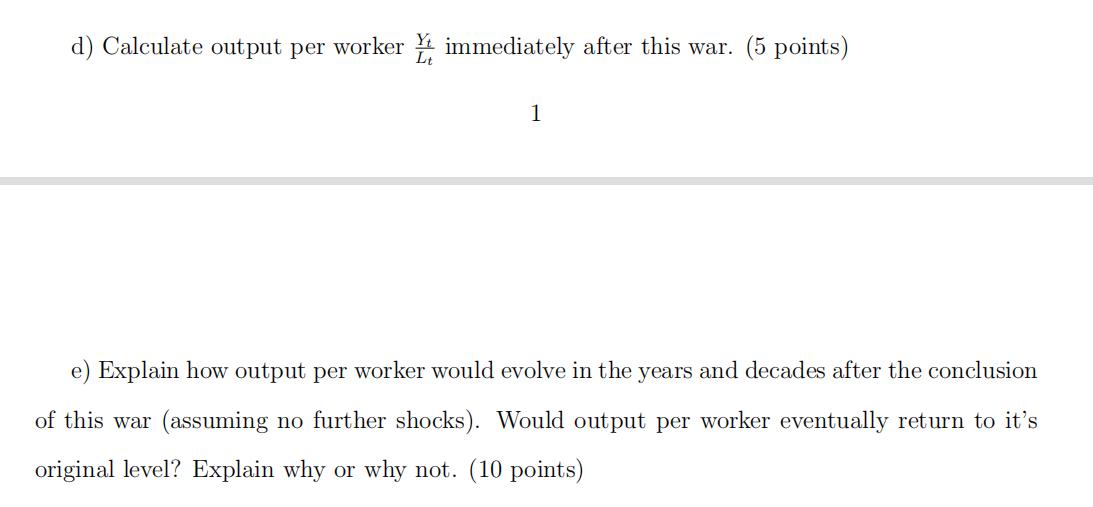
1. Consider an economy whose economy is accurately represented by the Solow Model. However, for simplicity, assume that there is no productivity growth and that A = 1 for all time periods. Therefore Y (K;) (Lt)-a, where a =. Assume that capital depreciates at a rate of & = 0.08 annually. The savings rate is s = 0.1. The population growth rate is n = 0.02. The change in capital per worker (not capital per effective worker) from one year to the next is given by () = s() (n + 8). (30 points) a) Calculate the steady state value of At. That is the value of At that does not change over Lt Lt time. (5 points) b) Calculate output per worker in this steady state (5 points). c) Imagine that this economy is at it's steady state, but then a war breaks out that destroys 50% of it's capital stock. Assume for simplicity that there is no loss in population as a result of this war. What is the new ratio of capital per worker t immediately after this war? (5 points) d) Calculate output per worker immediately after this war. (5 points) 1 e) Explain how output per worker would evolve in the years and decades after the conclusion of this war (assuming no further shocks). Would output per worker eventually return to it's original level? Explain why or why not. (10 points) 1. Consider an economy whose economy is accurately represented by the Solow Model. However, for simplicity, assume that there is no productivity growth and that A = 1 for all time periods. Therefore Y (K;) (Lt)-a, where a =. Assume that capital depreciates at a rate of & = 0.08 annually. The savings rate is s = 0.1. The population growth rate is n = 0.02. The change in capital per worker (not capital per effective worker) from one year to the next is given by () = s() (n + 8). (30 points) a) Calculate the steady state value of At. That is the value of At that does not change over Lt Lt time. (5 points) b) Calculate output per worker in this steady state (5 points). c) Imagine that this economy is at it's steady state, but then a war breaks out that destroys 50% of it's capital stock. Assume for simplicity that there is no loss in population as a result of this war. What is the new ratio of capital per worker t immediately after this war? (5 points) d) Calculate output per worker immediately after this war. (5 points) 1 e) Explain how output per worker would evolve in the years and decades after the conclusion of this war (assuming no further shocks). Would output per worker eventually return to it's original level? Explain why or why not. (10 points) 1. Consider an economy whose economy is accurately represented by the Solow Model. However, for simplicity, assume that there is no productivity growth and that A = 1 for all time periods. Therefore Y (K;) (Lt)-a, where a =. Assume that capital depreciates at a rate of & = 0.08 annually. The savings rate is s = 0.1. The population growth rate is n = 0.02. The change in capital per worker (not capital per effective worker) from one year to the next is given by () = s() (n + 8). (30 points) a) Calculate the steady state value of At. That is the value of At that does not change over Lt Lt time. (5 points) b) Calculate output per worker in this steady state (5 points). c) Imagine that this economy is at it's steady state, but then a war breaks out that destroys 50% of it's capital stock. Assume for simplicity that there is no loss in population as a result of this war. What is the new ratio of capital per worker t immediately after this war? (5 points) d) Calculate output per worker immediately after this war. (5 points) 1 e) Explain how output per worker would evolve in the years and decades after the conclusion of this war (assuming no further shocks). Would output per worker eventually return to it's original level? Explain why or why not. (10 points)
Step by Step Solution
3.48 Rating (151 Votes )
There are 3 Steps involved in it
Date Page No Pages The aynegate fonduc... View full answer

Get step-by-step solutions from verified subject matter experts
 Study Help