







Question: 1. Consider first the specific-factors model with two countries (Home and Foreign) and two goods (cell phones and textiles). There are three factors of
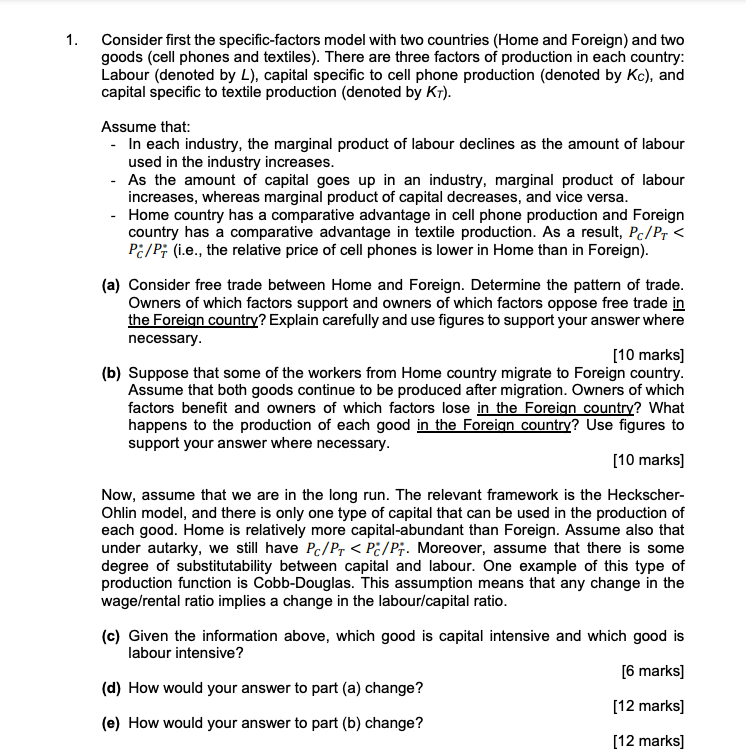
1. Consider first the specific-factors model with two countries (Home and Foreign) and two goods (cell phones and textiles). There are three factors of production in each country: Labour (denoted by L), capital specific to cell phone production (denoted by Kc), and capital specific to textile production (denoted by KT). Assume that: In each industry, the marginal product of labour declines as the amount of labour used in the industry increases. - As the amount of capital goes up in an industry, marginal product of labour increases, whereas marginal product of capital decreases, and vice versa. - Home country has a comparative advantage in cell phone production and Foreign country has a comparative advantage in textile production. As a result, Pc/PT < PC/P; (i.e., the relative price of cell phones is lower in Home than in Foreign). (a) Consider free trade between Home and Foreign. Determine the pattern of trade. Owners of which factors support and owners of which factors oppose free trade in the Foreign country? Explain carefully and use figures to support your answer where necessary. [10 marks] (b) Suppose that some of the workers from Home country migrate to Foreign country. Assume that both goods continue to be produced after migration. Owners of which factors benefit and owners of which factors lose in the Foreign country? What happens to the production of each good in the Foreign country? Use figures to support your answer where necessary. [10 marks] Now, assume that we are in the long run. The relevant framework is the Heckscher- Ohlin model, and there is only one type of capital that can be used in the production of each good. Home is relatively more capital-abundant than Foreign. Assume also that under autarky, we still have PC/PT < Pc/Pr. Moreover, assume that there is some degree of substitutability between capital and labour. One example of this type of production function is Cobb-Douglas. This assumption means that any change in the wage/rental ratio implies a change in the labour/capital ratio. (c) Given the information above, which good is capital intensive and which good is labour intensive? (d) How would your answer to part (a) change? (e) How would your answer to part (b) change? [6 marks] [12 marks] [12 marks]
Step by Step Solution
3.42 Rating (149 Votes )
There are 3 Steps involved in it
a Pattern of trade under free trade Under free trade Home country will specialize in and export cell phones while Foreign country will specialize in and export textiles This is because Home has a comp... View full answer

Get step-by-step solutions from verified subject matter experts
 Study Help