







Question: 1. Consider the below information with the simple Economic Order Quantity (EOQ) model: Annual Demand (D): 1,500 units Ordering Cost (S): $100 per order Holding
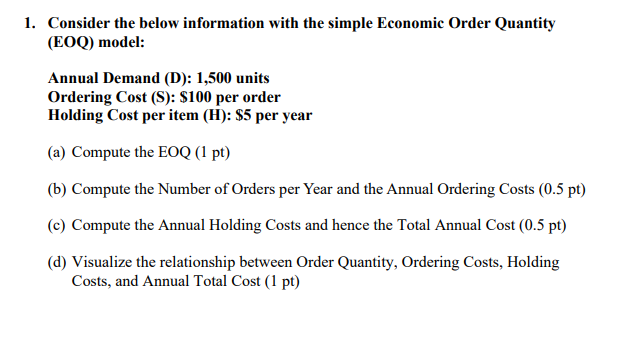
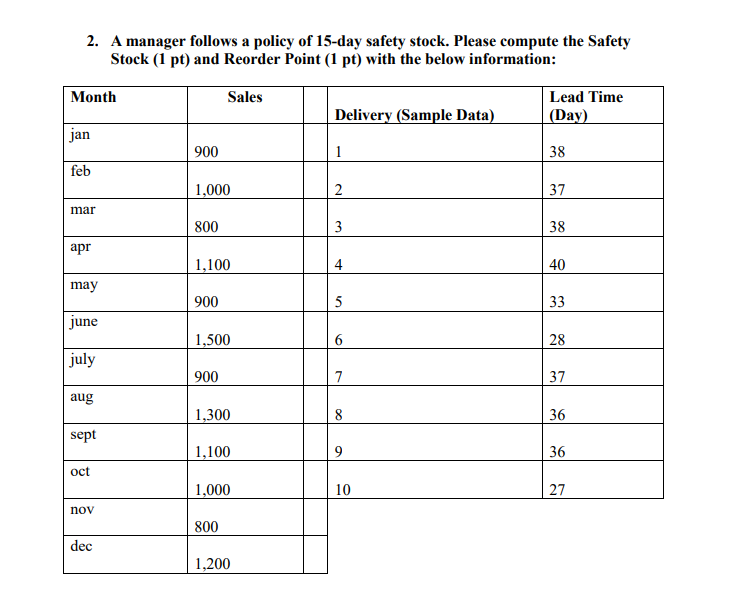
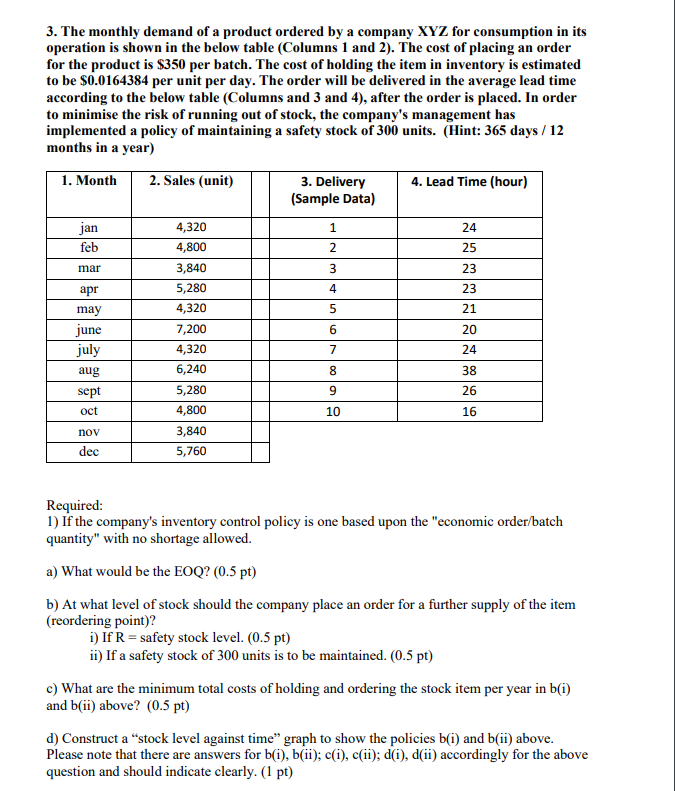
1. Consider the below information with the simple Economic Order Quantity (EOQ) model: Annual Demand (D): 1,500 units Ordering Cost (S): $100 per order Holding Cost per item (H) : $5 per year (a) Compute the EOQ (1 pt) (b) Compute the Number of Orders per Year and the Annual Ordering Costs ( 0.5pt) (c) Compute the Annual Holding Costs and hence the Total Annual Cost (0.5 pt) (d) Visualize the relationship between Order Quantity, Ordering Costs, Holding Costs, and Annual Total Cost (1 pt) 2. A manager follows a policy of 15-day safety stock. Please compute the Safety Stock (1 pt) and Reorder Point (1 pt) with the below information: 3. The monthly demand of a product ordered by a company XYZ for consumption in its operation is shown in the below table (Columns 1 and 2). The cost of placing an order for the product is $350 per batch. The cost of holding the item in inventory is estimated to be $0.0164384 per unit per day. The order will be delivered in the average lead time according to the below table (Columns and 3 and 4 ), after the order is placed. In order to minimise the risk of running out of stock, the company's management has implemented a policy of maintaining a safety stock of 300 units. (Hint: 365 days / 12 months in a year) Required: 1) If the company's inventory control policy is one based upon the "economic order/batch quantity" with no shortage allowed. a) What would be the EOQ? (0.5pt) b) At what level of stock should the company place an order for a further supply of the item (reordering point)? i) If R= safety stock level. (0.5pt) ii) If a safety stock of 300 units is to be maintained. (0.5pt) c) What are the minimum total costs of holding and ordering the stock item per year in b(i) and b(ii) above? (0.5 pt) d) Construct a "stock level against time" graph to show the policies b(i) and b(ii) above. Please note that there are answers for b(i), b(ii); c(i), c(ii); d(i), d(ii) accordingly for the above question and should indicate clearly. (1 pt)
Step by Step Solution
There are 3 Steps involved in it

Get step-by-step solutions from verified subject matter experts
 Study Help