





Question: 1. Consider the cobweb model for supply and demand discussed in Lecture 7 (and recorded lectures 7 and 8). We will use the same notation
1. Consider the cobweb model for supply and
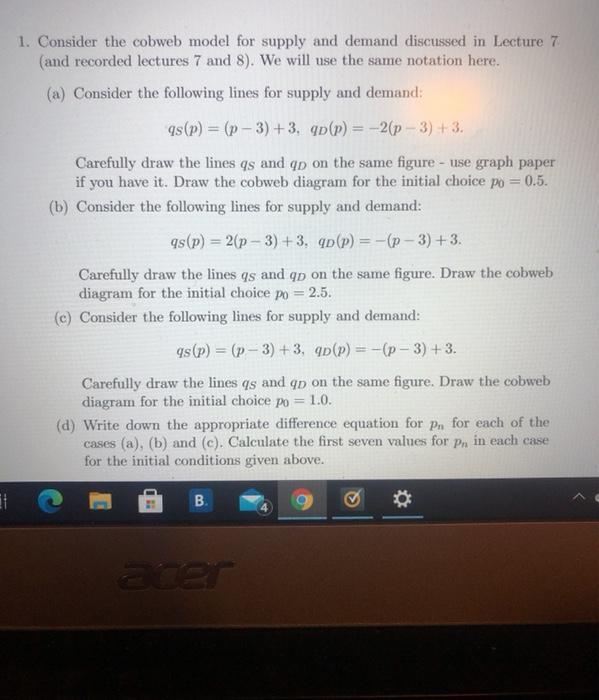
1. Consider the cobweb model for supply and demand discussed in Lecture 7 (and recorded lectures 7 and 8). We will use the same notation here. (a) Consider the following lines for supply and demand: as(p) = (p - 3) +3. qp(p) = -2(p - 3) + 3. Carefully draw the lines qs and qp on the same figure - use graph paper if you have it. Draw the cobweb diagram for the initial choice po = 0.5. (b) Consider the following lines for supply and demand: qs(P) = 2(p - 3) +3, 4p(p) = -(P-3) +3. Carefully draw the lines qs and go on the same figure. Draw the cobweb diagram for the initial choice po = 2.5. (c) Consider the following lines for supply and demand: 98(P) = (p - 3) +3, qp(P) = -(p - 3) +3. Carefully draw the lines qs and go on the same figure. Draw the cobweb diagram for the initial choice po = 1.0. (d) Write down the appropriate difference equation for Pn for each of the cases (a), (b) and (c). Calculate the first seven values for p in each case for the initial conditions given above. . 1. Consider the cobweb model for supply and demand discussed in Lecture 7 (and recorded lectures 7 and 8). We will use the same notation here. (a) Consider the following lines for supply and demand: as(p) = (p - 3) +3. qp(p) = -2(p - 3) + 3. Carefully draw the lines qs and qp on the same figure - use graph paper if you have it. Draw the cobweb diagram for the initial choice po = 0.5. (b) Consider the following lines for supply and demand: qs(P) = 2(p - 3) +3, 4p(p) = -(P-3) +3. Carefully draw the lines qs and go on the same figure. Draw the cobweb diagram for the initial choice po = 2.5. (c) Consider the following lines for supply and demand: 98(P) = (p - 3) +3, qp(P) = -(p - 3) +3. Carefully draw the lines qs and go on the same figure. Draw the cobweb diagram for the initial choice po = 1.0. (d) Write down the appropriate difference equation for Pn for each of the cases (a), (b) and (c). Calculate the first seven values for p in each case for the initial conditions given above.

Step by Step Solution

There are 3 Steps involved in it

1 Expert Approved Answer
Step: 1 Unlock blur-text-image

Question Has Been Solved by an Expert!

Get step-by-step solutions from verified subject matter experts

Step: 2 Unlock
Step: 3 Unlock

Students Have Also Explored These Related General Management Questions!