







Question: 1. Consider the consumer problem, where the utility function is: max U(c, 1) = 0.3 Inc +0.7 Inl, cl where c represents consumption expenditure and
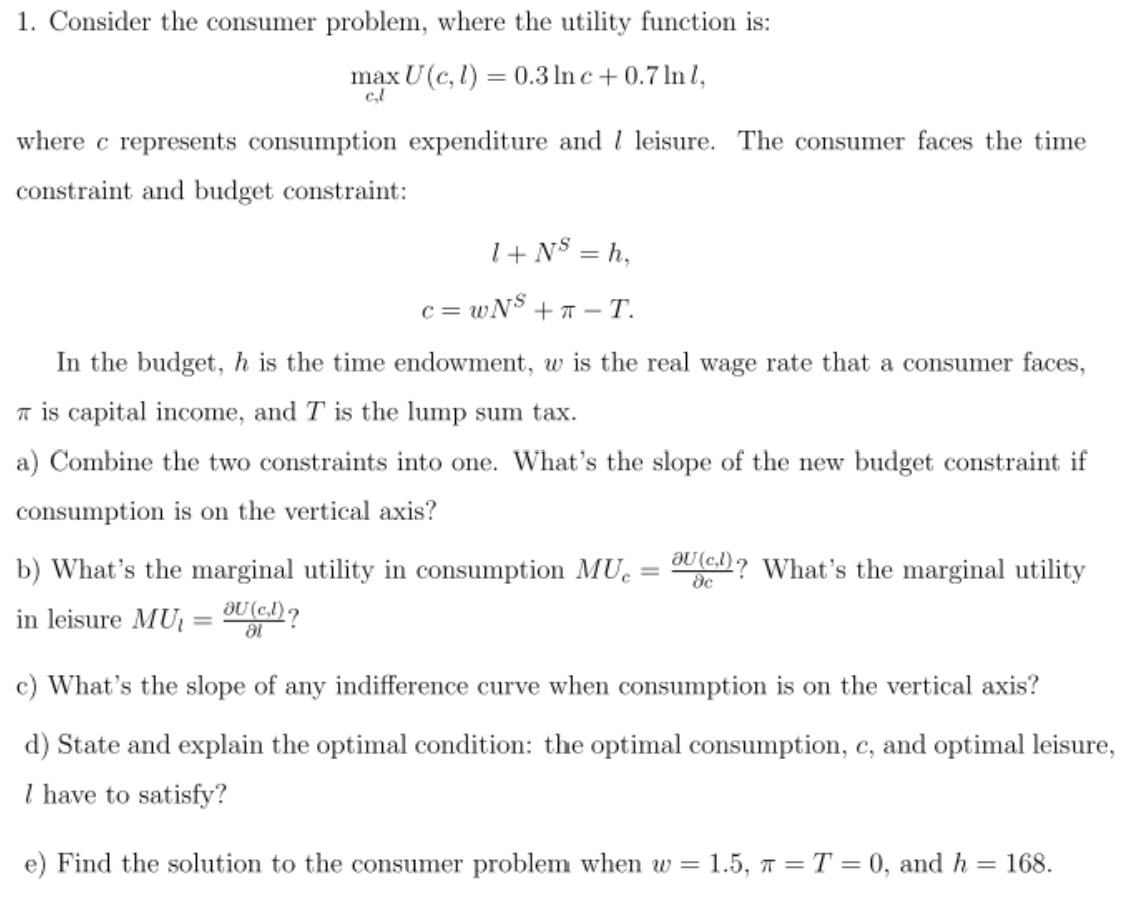
1. Consider the consumer problem, where the utility function is: max U(c, 1) = 0.3 Inc +0.7 Inl, cl where c represents consumption expenditure and I leisure. The consumer faces the time constraint and budget constraint: 1+ NS = h, c=wNS + 7 -T. In the budget, h is the time endowment, w is the real wage rate that a consumer faces, 7 is capital income, and T is the lump sum tax. a) Combine the two constraints into one. What's the slope of the new budget constraint if consumption is on the vertical axis? b) What's the marginal utility in consumption MU. = Uc.!)? What's the marginal utility in leisure MU = U(c,d)? al c) What's the slope of any indifference curve when consumption is on the vertical axis? d) State and explain the optimal condition: the optimal consumption, c, and optimal leisure, I have to satisfy? e) Find the solution to the consumer problem when w = 1.5, 7 =T = 0, and h = 168
Step by Step Solution
There are 3 Steps involved in it

Get step-by-step solutions from verified subject matter experts
 Study Help