







Question: Step by step calculations QUESTION 4 Consider a market for a homogeneous good, which is produced at zero cost. Market inverse demand is given by
Step by step calculations
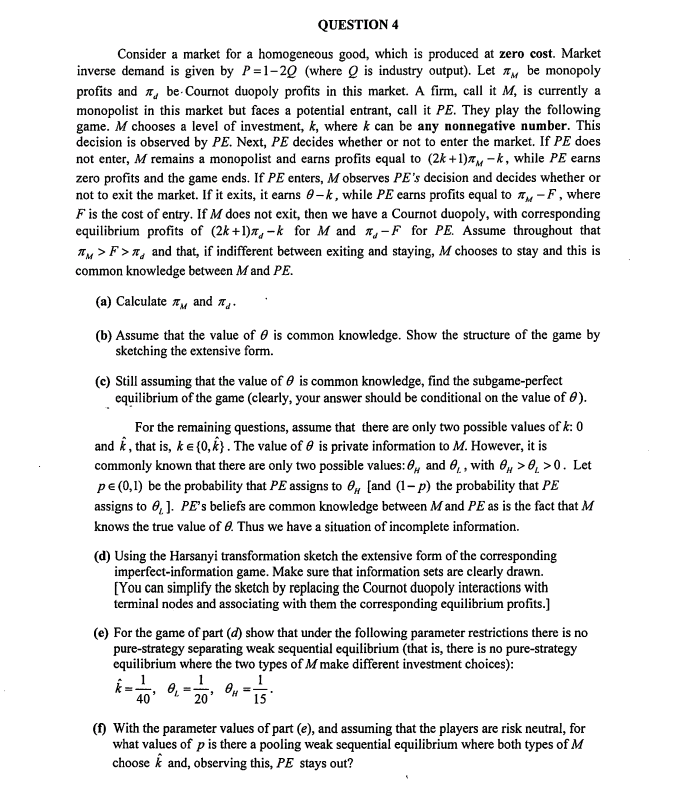
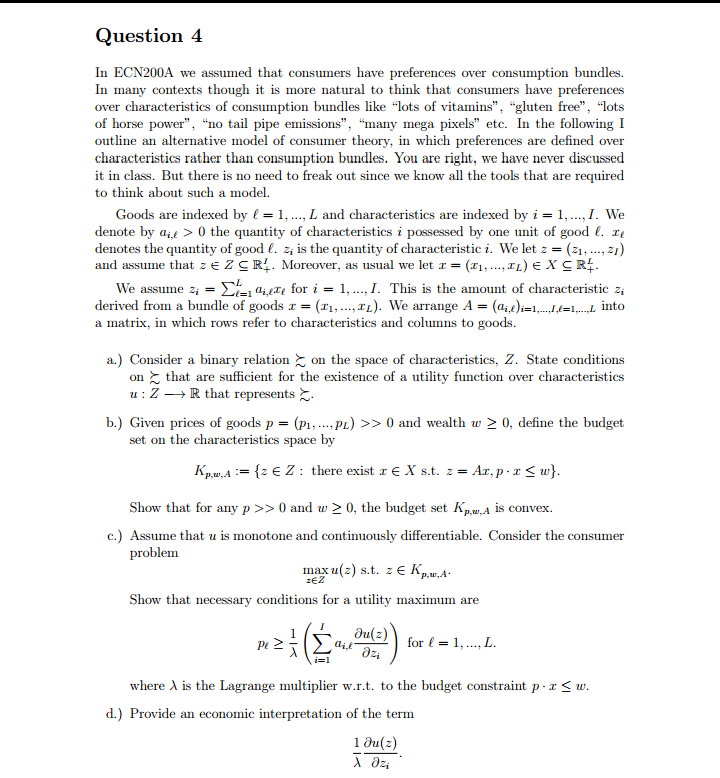
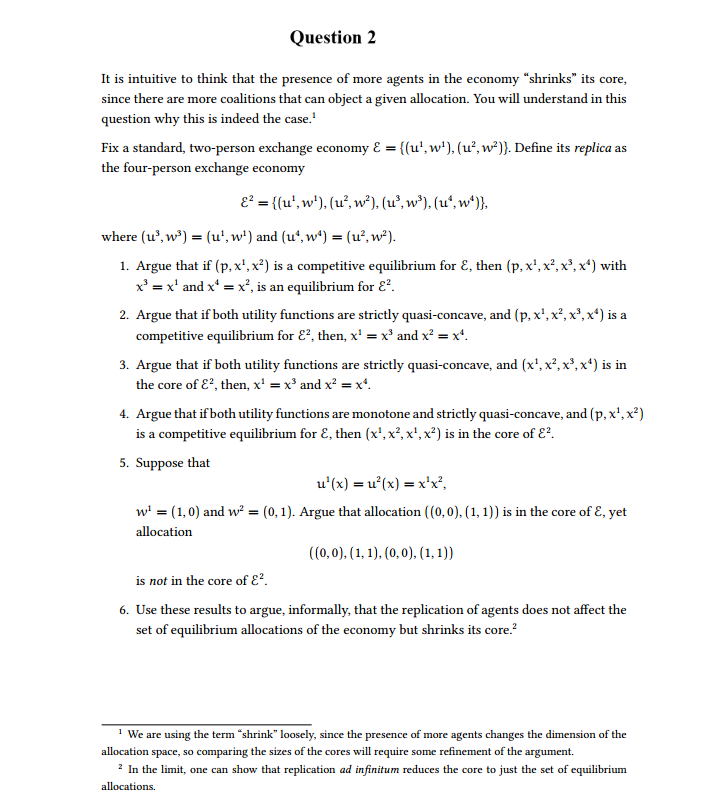
QUESTION 4 Consider a market for a homogeneous good, which is produced at zero cost. Market inverse demand is given by P=1-20 (where ( is industry output). Let #, be monopoly profits and #, be Cournot duopoly profits in this market. A firm, call it M, is currently a monopolist in this market but faces a potential entrant, call it PE. They play the following game. M chooses a level of investment, A, where & can be any nonnegative number. This decision is observed by PE. Next, PE decides whether or not to enter the market. If PE does not enter, M remains a monopolist and earns profits equal to (2* +1)7, -*, while PE earns zero profits and the game ends. If PE enters, M observes PE's decision and decides whether or not to exit the market. If it exits, it earns 0-k, while PE earns profits equal to *, -F, where F is the cost of entry. If M does not exit, then we have a Cournot duopoly, with corresponding equilibrium profits of (2k +1)x -k for M and * -F for PE. Assume throughout that " > > >, and that, if indifferent between exiting and staying, M chooses to stay and this is common knowledge between M and PE. (a) Calculate , and #2. (b) Assume that the value of O is common knowledge. Show the structure of the game by sketching the extensive form. (c) Still assuming that the value of O is common knowledge, find the subgame-perfect equilibrium of the game (clearly, your answer should be conditional on the value of @). For the remaining questions, assume that there are only two possible values of k: 0 and &, that is, ke (0,k) . The value of @ is private information to M. However, it is commonly known that there are only two possible values: @, and @, , with 0,, > 0, >0. Let pe (0,1) be the probability that PE assigns to @, [and (1-p) the probability that PE assigns to 0, ]. PE's beliefs are common knowledge between Mand PE as is the fact that M knows the true value of 8. Thus we have a situation of incomplete information. (d) Using the Harsanyi transformation sketch the extensive form of the corresponding imperfect-information game. Make sure that information sets are clearly drawn. [You can simplify the sketch by replacing the Cournot duopoly interactions with terminal nodes and associating with them the corresponding equilibrium profits.] (e) For the game of part (d) show that under the following parameter restrictions there is no pure-strategy separating weak sequential equilibrium (that is, there is no pure-strategy equilibrium where the two types of M make different investment choices): 15 (f) With the parameter values of part (e), and assuming that the players are risk neutral, for what values of p is there a pooling weak sequential equilibrium where both types of M choose k and, observing this, PE stays out?Question 4 In ECN200A we assumed that consumers have preferences over consumption bundles. In many contexts though it is more natural to think that consumers have preferences over characteristics of consumption bundles like "lots of vitamins", "gluten free", "lots of horse power", "no tail pipe emissions", "many mega pixels" etc. In the following I outline an alternative model of consumer theory, in which preferences are defined over characteristics rather than consumption bundles. You are right, we have never discussed it in class. But there is no need to freak out since we know all the tools that are required to think about such a model. Goods are indexed by / = 1, ..., L and characteristics are indexed by i = 1, ..., I. We denote by a; > 0 the quantity of characteristics i possessed by one unit of good . If denotes the quantity of good 6. z, is the quantity of characteristic i. We let = = (21, ..., 27) and assume that z e Z C R. Moreover, as usual we let r = (21, .... II) EX CR+. We assume 2 = 2 diet for i = 1, ..., I. This is the amount of characteristic z; derived from a bundle of goods I = (T1, ..., IL). We arrange A = (ait)izl,.,1,/=1...,L into a matrix, in which rows refer to characteristics and columns to goods. a.) Consider a binary relation > on the space of characteristics, Z. State conditions on _ that are sufficient for the existence of a utility function over characteristics u : Z - R that represents _. b.) Given prices of goods p = (P1, ...; PL) > > 0 and wealth w 2 0, define the budget set on the characteristics space by Kow,A := {= c Z : there exist r ( X s.t. = = Ar,p. ISw). Show that for any p > > 0 and w 2 0, the budget set Kow,A is convex. c.) Assume that u is monotone and continuously differentiable. Consider the consumer problem max u(z) s.t. z E Kpu,A. Show that necessary conditions for a utility maximum are pe 2 du (2) for { = 1, .... L. where A is the Lagrange multiplier w.r.t. to the budget constraint p. r S w. d.) Provide an economic interpretation of the term 1 du(z) A dziQuestion 2 It is intuitive to think that the presence of more agents in the economy "shrinks" its core, since there are more coalitions that can object a given allocation. You will understand in this question why this is indeed the case.' Fix a standard, two-person exchange economy & = ((u', wl ), (u', w?)). Define its replica as the four-person exchange economy 82 = ((u', w'), (u', wa), (u', w'), (u', wa)). where (u', w3) = (u', w') and (u', wi ) = (uz, w?). 1. Argue that if (p, x', x?) is a competitive equilibrium for &, then (p, x', x], x3, x' ) with x3 = x' and x* = x', is an equilibrium for &?. 2. Argue that if both utility functions are strictly quasi-concave, and (p, x', x', x', x* ) is a competitive equilibrium for &', then, x' = x3 and x? = x*. 3. Argue that if both utility functions are strictly quasi-concave, and (x], x?, x3, x* ) is in the core of &', then, x' = x3 and x] = x*. 4. Argue that if both utility functions are monotone and strictly quasi-concave, and (p, x', x?) is a competitive equilibrium for &, then (x], x3, x], x?) is in the core of &?. 5. Suppose that u' (x) = u'(x) =x'x?, wi = (1, 0) and w2 = (0, 1). Argue that allocation ((0, 0), (1, 1)) is in the core of &, yet allocation ((0, 0), (1, 1), (0,0), (1, 1)) is not in the core of &?. 6. Use these results to argue, informally, that the replication of agents does not affect the set of equilibrium allocations of the economy but shrinks its core." 1 We are using the term "shrink" loosely, since the presence of more agents changes the dimension of the allocation space, so comparing the sizes of the cores will require some refinement of the argument. In the limit, one can show that replication ad infinitum reduces the core to just the set of equilibrium allocations
Step by Step Solution
There are 3 Steps involved in it

Get step-by-step solutions from verified subject matter experts
 Study Help