







Question: 1. Consider the First and Second degree price discrimination model discussed in class. a. In the case of the Second Degree Price Discrimination example,
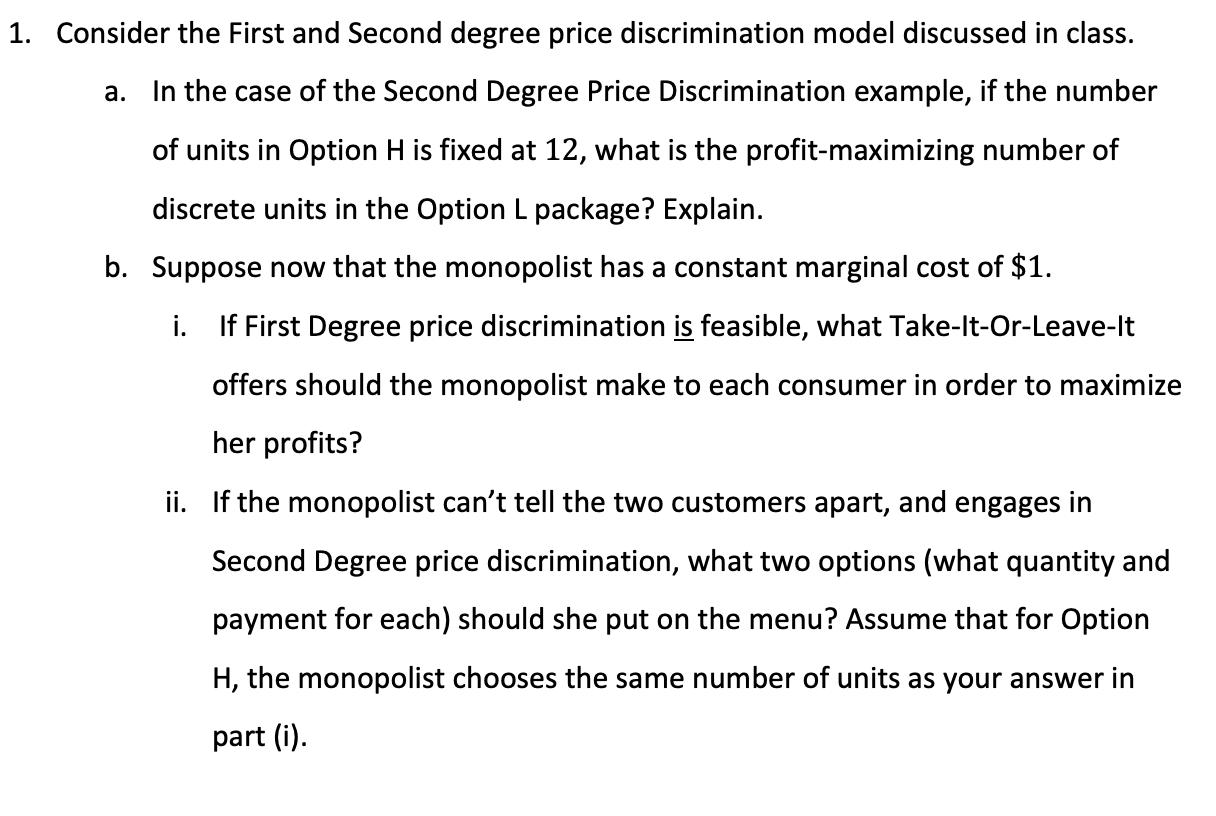

1. Consider the First and Second degree price discrimination model discussed in class. a. In the case of the Second Degree Price Discrimination example, if the number of units in Option H is fixed at 12, what is the profit-maximizing number of discrete units in the Option L package? Explain. b. Suppose now that the monopolist has a constant marginal cost of $1. i. If First Degree price discrimination is feasible, what Take-It-Or-Leave-It offers should the monopolist make to each consumer in order to maximize her profits? ii. If the monopolist can't tell the two customers apart, and engages in Second Degree price discrimination, what two options (what quantity and payment for each) should she put on the menu? Assume that for Option H, the monopolist chooses the same number of units as your answer in part (i). Option L: Buy a package, containing 8 units, for a total payment of $32. Option H: Buy a package, containing 12 units, for a total payment of $72.
Step by Step Solution
3.49 Rating (156 Votes )
There are 3 Steps involved in it
The detailed answer for the above question is provided below aThe profitmaximizing number of discret... View full answer

Get step-by-step solutions from verified subject matter experts
 Study Help