







Question: 1. Consider the following binary relation R: {(a, a), (c, d), (d, b) } where each ordered pair belongs to the Cartesian product {a, b,
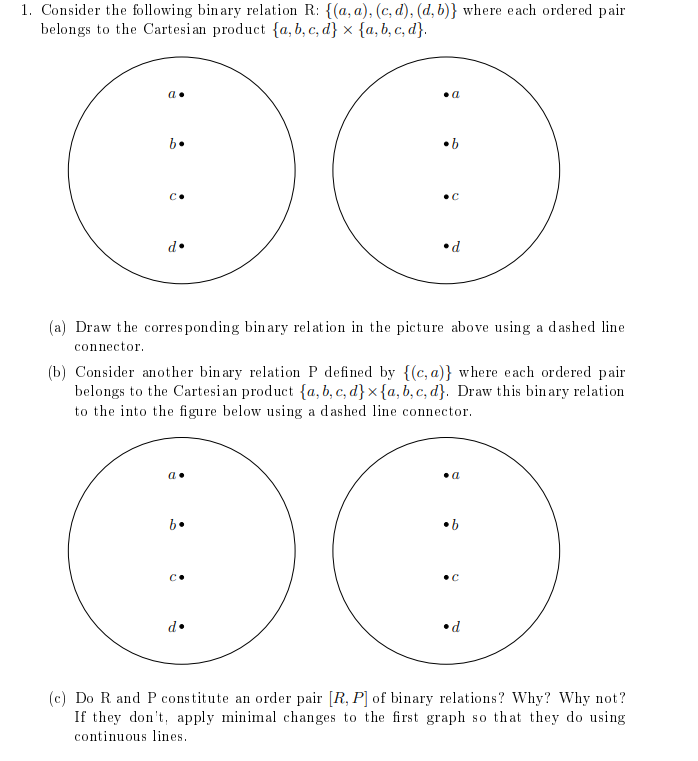
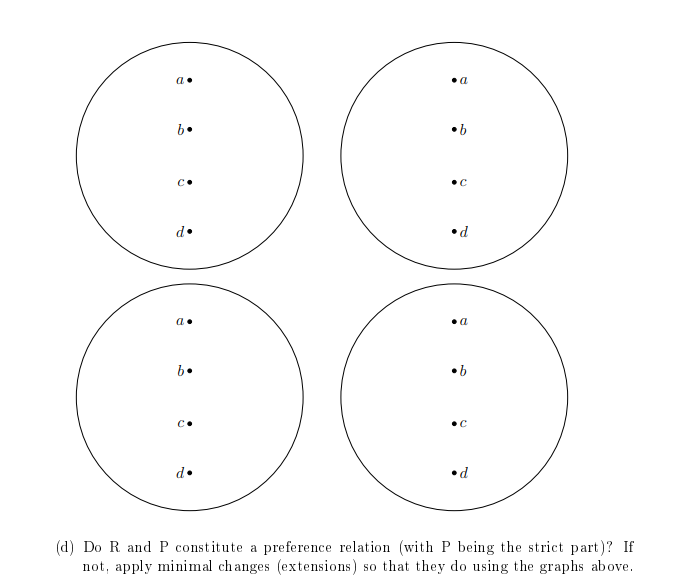
1. Consider the following binary relation R: {(a, a), (c, d), (d, b) } where each ordered pair belongs to the Cartesian product {a, b, c, d} x {a, b, c, d}. a . b . . b C. d . . d (a) Draw the corresponding binary relation in the picture above using a dashed line connector. (b) Consider another binary relation P defined by { (c, a) } where each ordered pair belongs to the Cartesian product {a, b, c, d} x {a, b, c, d}. Draw this binary relation to the into the figure below using a dashed line connector. a . . 0 b . C. d . (c) Do R and P constitute an order pair [ R, P] of binary relations? Why? Why not? If they don't, apply minimal changes to the first graph so that they do using continuous lines.(d) Do R and P constitute a preference relation (with P being the strict part]? If not: apply minimal changes [extensions] so that they do using the graphs above
Step by Step Solution
There are 3 Steps involved in it

Get step-by-step solutions from verified subject matter experts
 Study Help