





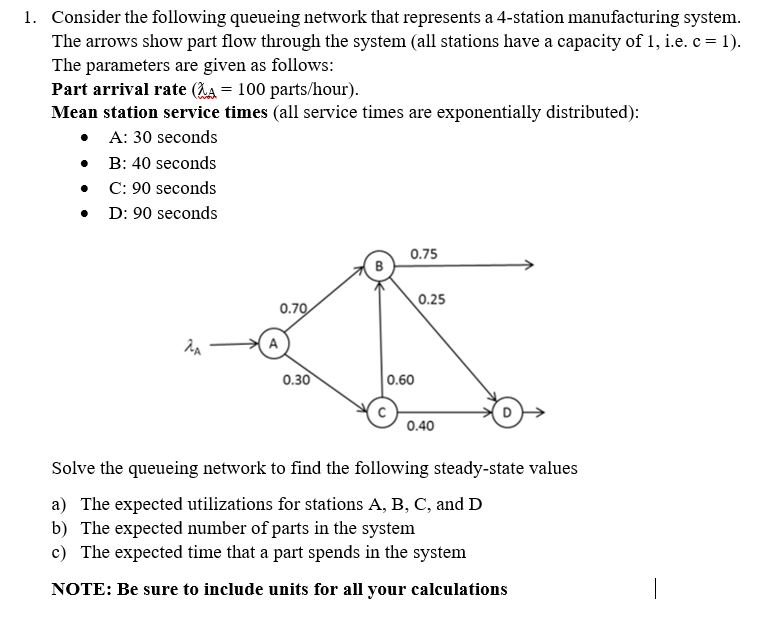
Question: 1. Consider the following queueing network that represents a 4-station manufacturing system. The arrows show part flow through the system (all stations have a capacity
1. Consider the following queueing network that

1. Consider the following queueing network that represents a 4-station manufacturing system. The arrows show part flow through the system (all stations have a capacity of 1, i.e. c = 1). The parameters are given as follows: Part arrival rate (a = 100 parts/hour). Mean station service times (all service times are exponentially distributed): A: 30 seconds B: 40 seconds C: 90 seconds D: 90 seconds 0.75 0.25 0.70 0.70 0.30 0.60 0.40 Solve the queueing network to find the following steady-state values a) The expected utilizations for stations A, B, C, and D b) The expected number of parts in the system c) The expected time that a part spends in the system NOTE: Be sure to include units for all your calculations 1. Consider the following queueing network that represents a 4-station manufacturing system. The arrows show part flow through the system (all stations have a capacity of 1, i.e. c = 1). The parameters are given as follows: Part arrival rate (a = 100 parts/hour). Mean station service times (all service times are exponentially distributed): A: 30 seconds B: 40 seconds C: 90 seconds D: 90 seconds 0.75 0.25 0.70 0.70 0.30 0.60 0.40 Solve the queueing network to find the following steady-state values a) The expected utilizations for stations A, B, C, and D b) The expected number of parts in the system c) The expected time that a part spends in the system NOTE: Be sure to include units for all your calculations

Step by Step Solution

There are 3 Steps involved in it

1 Expert Approved Answer
Step: 1 Unlock blur-text-image

Question Has Been Solved by an Expert!

Get step-by-step solutions from verified subject matter experts

Step: 2 Unlock
Step: 3 Unlock

Students Have Also Explored These Related General Management Questions!