







Question: 1. Consider the function f (at) = 8(2 is?) . (The parentheses indicate that all of that is in the exponent.) Your goal in this
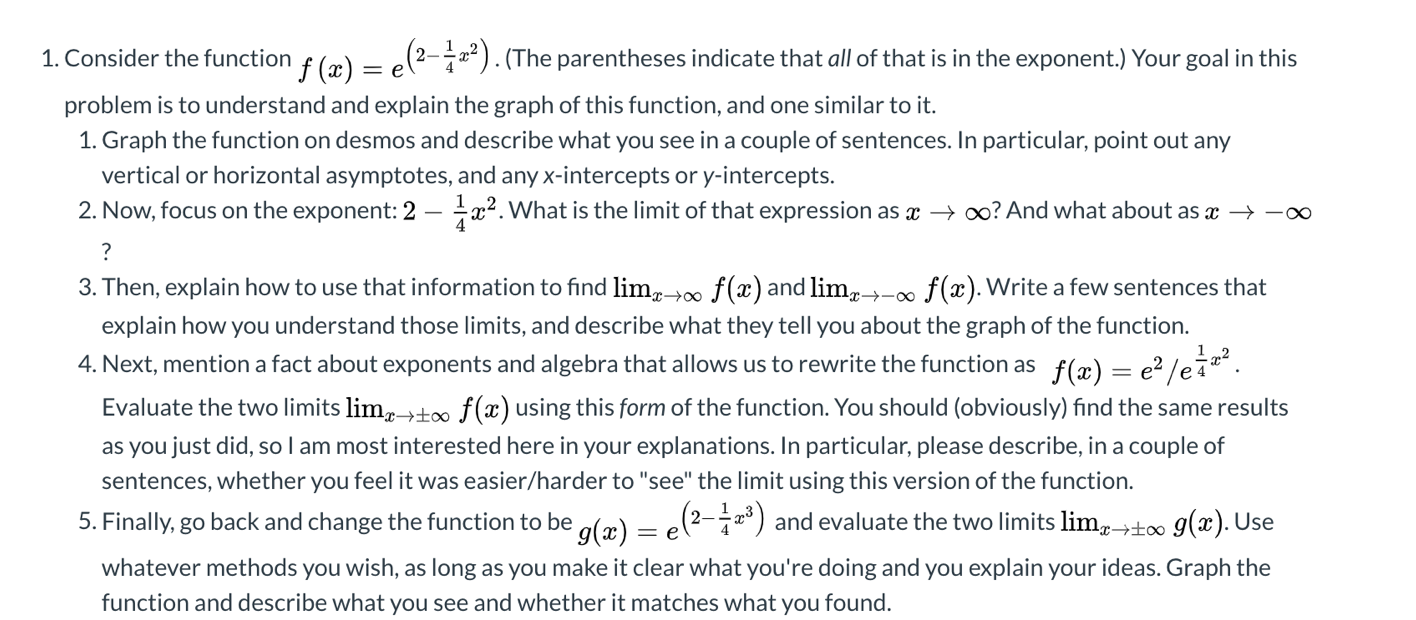
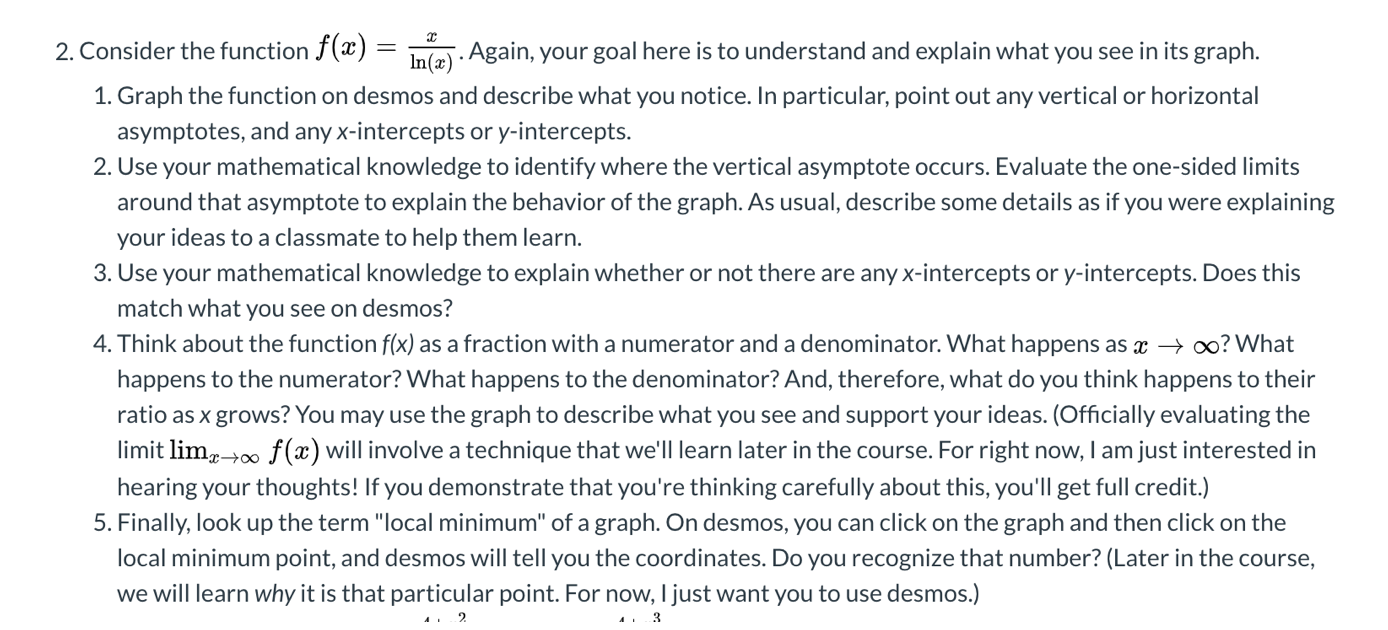
1. Consider the function f (at) = 8(2 is?) . (The parentheses indicate that all of that is in the exponent.) Your goal in this problem is to understand and explain the graph of this function, and one similar to it. 1. Graph the function on desmos and describe what you see in a couple of sentences. In particular, point out any vertical or horizontal asymptotes, and any x-intercepts or yintercepts. 2. Now, focus on the exponent: 2 i332. What is the limit of that expression as a: > 00? And what about as a: } oo ? 3. Then, explain how to use that information to flni:l1itr1..,,_,c,o f (m) and limw_,_w ay). Write a few sentences that explain how you understand those limits, and describe what they tell you about the graph of the function. 4. Next, mention a fact about exponents and algebra that allows us to rewrite the function as \"3) = e2 /%'~'2. Evaluate the two limits limakhtco f (m) using this form of the function. You should (obviously) find the same results as you just did, so I am most interested here in your explanations. In particular, please describe, in a couple of sentences, whether you feel it was easier/harder to "see" the limit using this version of the function. 5. Finally, go back and change the function to be 90\") = 3(2_%\"3) and evaluate the two limits limxsiw 9(m). Use whatever methods you wish, as long as you make it clear what you're doing and you explain your ideas. Graph the function and describe what you see and whether it matches what you found. 2. Consider the function flit) = 111:\") .Again, your goal here is to understand and explain what you see in its graph. 1. Graph the function on desmos and describe what you notice. In particular, point out any vertical or horizontal asymptotes, and any xintercepts or y-intercepts. 2. Use your mathematical knowledge to identify where the vertical asymptote occurs. Evaluate the one-sided limits around that asymptote to explain the behavior of the graph. As usual, describe some details as if you were explaining your ideas to a classmate to help them learn. 3. Use your mathematical knowledge to explain whether or not there are any xintercepts or yintercepts. Does this match what you see on desmos? 4. Think about the function x) as a fraction with a numerator and a denominator. What happens as a: > 00? What happens to the numerator? What happens to the denominator? And, therefore, what do you think happens to their ratio as x grows? You may use the graph to describe what you see and support your ideas. (Ofcially evaluating the limit liman f(:r) will involve a technique that we'll learn later in the course. For right now. I am just interested in hearing your thoughts! lfyou demonstrate that you're thinking carefully about this, you'll get full credit.) 5. Finally, look up the term "local minimum" of a graph. On desmos, you can click on the graph and then click on the local minimum point, and desmos will tell you the coordinates. Do you recognize that number? (Later in the course. we will learn why it is that particular point. For now, | just want you to use desmos.) ' . 2 . _ 3
Step by Step Solution
There are 3 Steps involved in it

Get step-by-step solutions from verified subject matter experts
 Study Help