





Question: 1. Consider the matrices 2. Consider the two simultaneous cx + y = 6 A = (2 4 ). B - ( 9 8 7
1. Consider the matrices 2. Consider the two
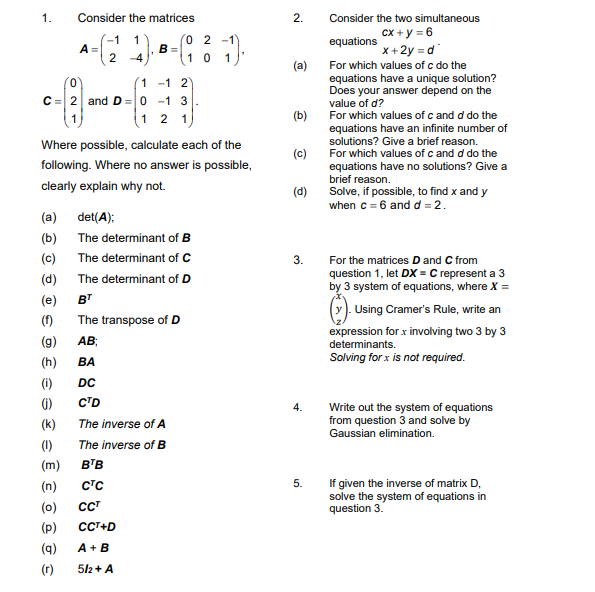
1. Consider the matrices 2. Consider the two simultaneous cx + y = 6 A = (2 4 ). B - ( 9 8 7 ). equations x +2y =d (a) For which values of c do the 1 -1 2 equations have a unique solution? Does your answer depend on the C = 2 and D = 0 -1 3 value of d? 1 2 For which values of c and o do the equations have an infinite number of Where possible, calculate each of the solutions? Give a brief reason. (c) For which values of c and d do the following. Where no answer is possible, equations have no solutions? Give a clearly explain why not. brief reason (d) Solve, if possible, to find x and y when c = 6 and d = 2. (a) det(A); (b) The determinant of B (C) The determinant of C 3. For the matrices D and C from (a) The determinant of D question 1, let DX = C represent a 3 by 3 system of equations, where X = (e) ). Using Cramer's Rule, write an (f) The transpose of D expression for x involving two 3 by 3 (9) AB; determinants. (h ) BA Solving for x is not required. (1) DC (j) CTD 4. Write out the system of equations ( K ) The inverse of A from question 3 and solve by Gaussian elimination. (1) The inverse of B (m) BIB CTC 5. If given the inverse of matrix D, solve the system of equations in (0) CC question 3. (P) CCT+D (q) A + B (r) 5/2+ A

Step by Step Solution

There are 3 Steps involved in it

1 Expert Approved Answer
Step: 1 Unlock blur-text-image

Question Has Been Solved by an Expert!

Get step-by-step solutions from verified subject matter experts

Step: 2 Unlock
Step: 3 Unlock

Students Have Also Explored These Related Mathematics Questions!