



Question: 1. Consider the RLC circuit with R = 22, L = 20 mH and C = 20 mF. The AC voltage source creates a
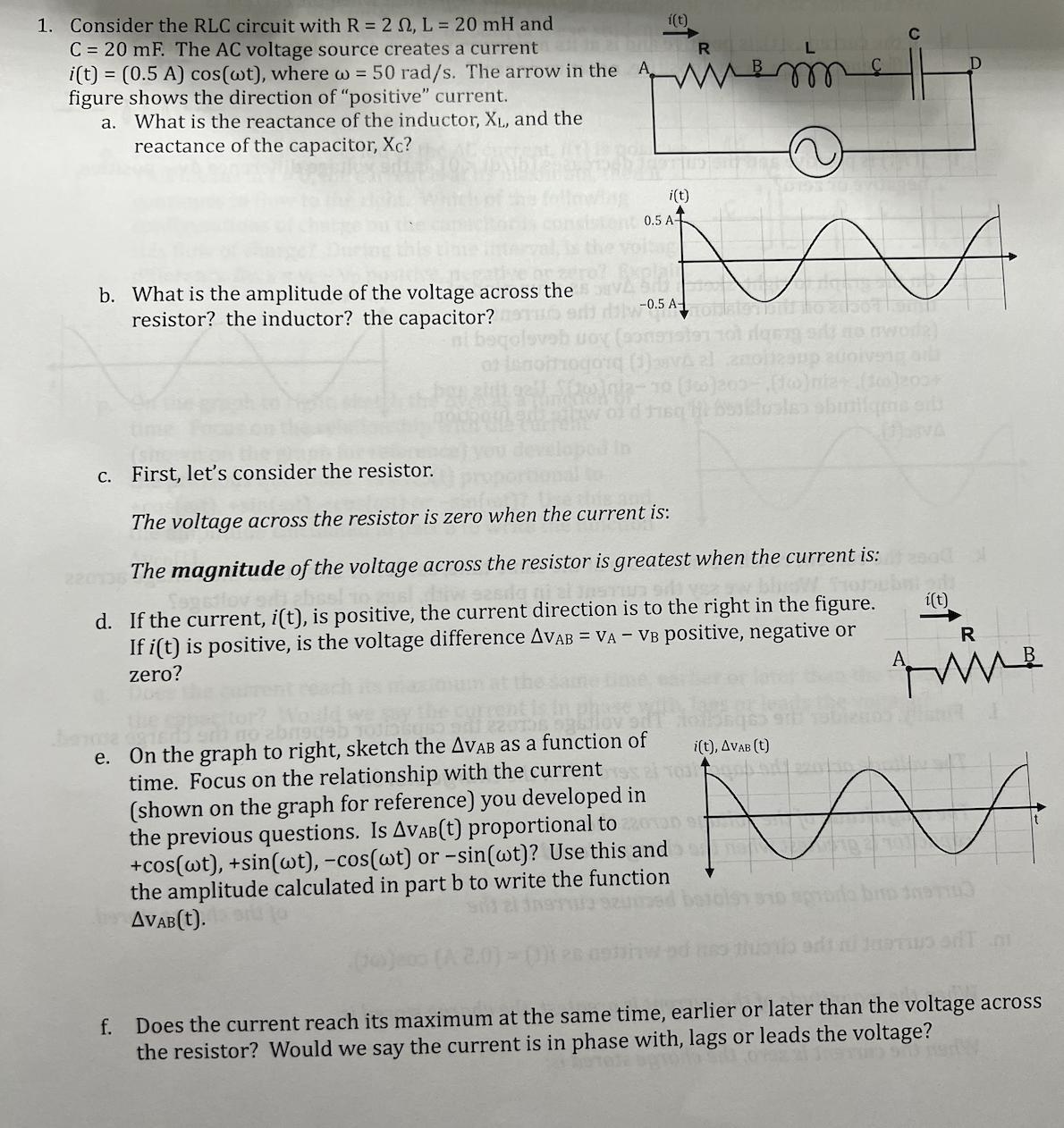
1. Consider the RLC circuit with R = 22, L = 20 mH and C = 20 mF. The AC voltage source creates a current i(t)= (0.5 A) cos(wt), where w = 50 rad/s. The arrow in the figure shows the direction of "positive" current. a. What is the reactance of the inductor, XL, and the reactance of the capacitor, Xc? A i(t) i(t) 0.5 A b. What is the amplitude of the voltage across the VA -0.5 A resistor? the inductor? the capacitor? T adi dilw R smo no abrgneb to 200 e. On the graph to right, sketch the AVAB as a function of time. Focus on the relationship with the currents al (shown on the graph for reference) you developed in the previous questions. Is AVAB (t) proportional to 22000 +cos(wt), +sin(wt), -cos(wt) or -sin (wt)? Use this and bo the amplitude calculated in part b to write the function AVAB (t). m C A vob uoy (soner daar siy no woda) at jenomogorq (1)VA al zmolizoup univeng ara 359-10 (300)200 (16)nia (100)20a+ old risq i beskhasias obuilqus erit VA c. First, let's consider the resistor. The voltage across the resistor is zero when the current is: The magnitude of the voltage across the resistor is greatest when the current is: > zual daw sasda ni al just si d. If the current, i(t), is positive, the current direction is to the right in the figure. If i(t) is positive, is the voltage difference AVAB = VA - VB positive, negative or zero? i(t), AVAB (t) C 2000 i(t) R time A and M 310 sporo bip 109T03 f. Does the current reach its maximum at the same time, earlier or later than the voltage across the resistor? Would we say the current is in phase with, lags or leads the voltage?
Step by Step Solution
3.39 Rating (143 Votes )
There are 3 Steps involved in it
a Reactance of inductor XL L 50 rads 002 H 1 Reactance of capacitor XC 1 C 1 50 rads 002 F 1 1 1 b A... View full answer

Get step-by-step solutions from verified subject matter experts