







Question: 1. Consider two cases: Case I: Vertical plate (0.9 m high; 0.5 m wide at 32C with air at 22C). Case 2: Vertical plate (0.5
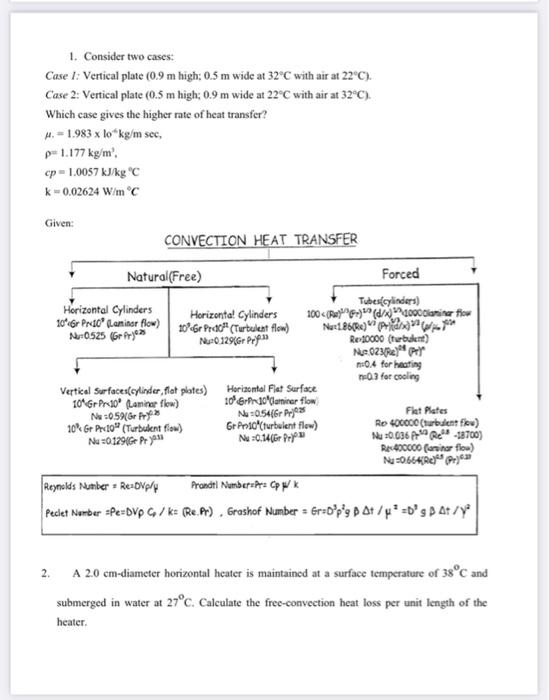
1. Consider two cases: Case I: Vertical plate (0.9 m high; 0.5 m wide at 32C with air at 22C). Case 2: Vertical plate (0.5 m high: 0.9 m wide at 22C with air at 32C). Which case gives the higher rate of heat transfer? 4. = 1.983 x lokg/m sec, pu 1.177 kg/m', cp-1.0057 kJ/kg "C * -0.02624 W/m Given: CONVECTION HEAT TRANSFER Natural(Free) Forced Tubes cylinders) Horizontal Cylinders 1046 Pro Kaniner flow)tol Gr Prado (Tertulent flow) Horizonta! Cylinders 100(Rap)(d/4000 lariner fow Nu1.86006) Vipw Nur0.525 (Gr Pryes N:0.129(Gr Pro Re 10000 (turbulent) Nus: 023/Re/ 0.4 for heating 0.3 for cooling Vertical Surfaces(cylinder, flat plates) Horizontal Flat Surface 104 Gr Pr 10" Laminar flow) 10 ErP 30 (larnier flow Nu 50.59(Gr Pre* Ny=0.54(6r Pje Flat Plates 10 Gr Px10" (Turbulent flow) Er Posch(turbulent flow) Rp 400000 (turbdient few) Nu 30129(Ge Prym Nu +0.14(Gr Pro Nu 50.0969 Re-18700) Rec400000 (ering flow) N=0.664 Reyes Prew Reynolds Number - Re-Ovply Prandtl Number: CWK Peclet Number =Pe=bVp G /k= (e. Ar). Grashof Number = Gr=0%p's D A+/y* =D'S PA+/" 2. A 2.0 cm-diameter horizontal heater is maintained at a surface temperature of 38C and submerged in water at 27C. Calculate the free-convection heat loss per unit length of the heater
Step by Step Solution
There are 3 Steps involved in it

Get step-by-step solutions from verified subject matter experts
 Study Help