







Question: 1. Consider two charged particles, separated by distance d > 0, and located at points (0, $, 0) and (0, -4, 0) respectively. One has
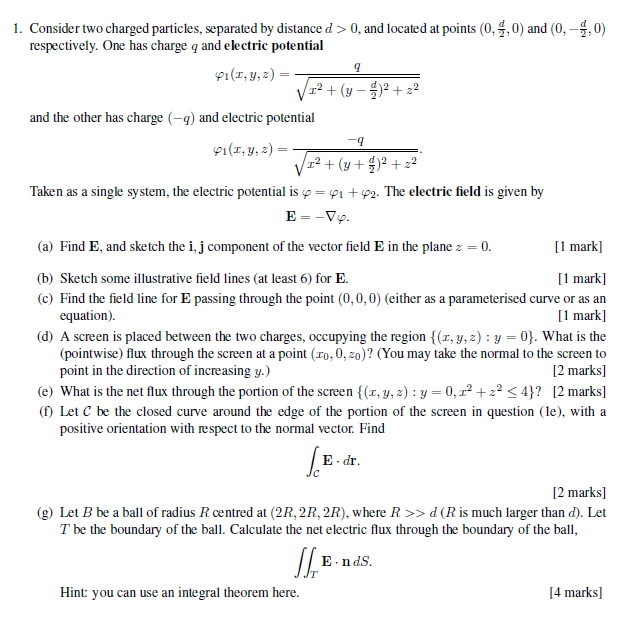
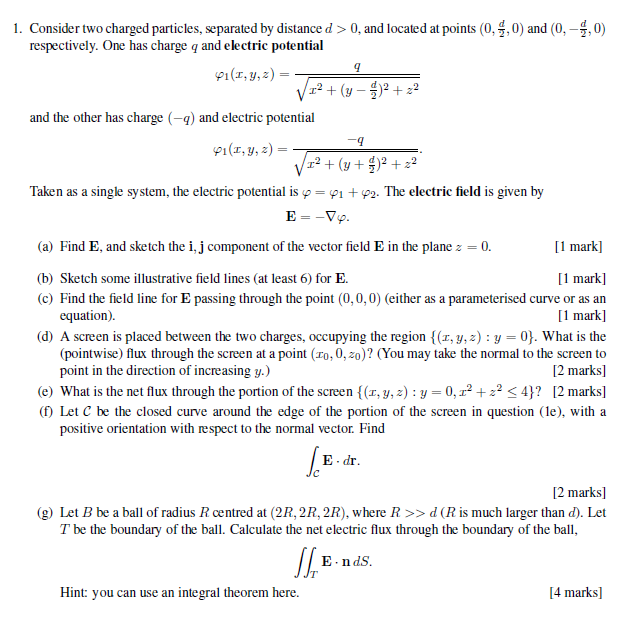
1. Consider two charged particles, separated by distance d > 0, and located at points (0, $, 0) and (0, -4, 0) respectively. One has charge q and electric potential PI ( I, y, 2 ) = V12+ (y -$)3+22 and the other has charge (-q) and electric potential 21( I, y, 2) = -4 Vi?+ (y +$ )2+2 2 Taken as a single system, the electric potential is a = 41 + 42. The electric field is given by E= -VY. (a) Find E, and sketch the i, j component of the vector field E in the plane z = 0. [1 mark] (b) Sketch some illustrative field lines (at least 6) for E. [1 mark] (c) Find the field line for E passing through the point (0, 0, 0) (either as a parameterised curve or as an equation). [1 mark] (d) A screen is placed between the two charges, occupying the region {(r, y, z) : y = 0}. What is the (pointwise) flux through the screen at a point (ro, 0, zo)? (You may take the normal to the screen to point in the direction of increasing y.) [2 marks] (e) What is the net flux through the portion of the screen { (r, y, =) : y = 0, 12 + 2? > d (R is much larger than d). Let T be the boundary of the ball. Calculate the net electric flux through the boundary of the ball, IL E. nas. Hint: you can use an integral theorem here. [4 marks]
Step by Step Solution
There are 3 Steps involved in it

Get step-by-step solutions from verified subject matter experts
 Study Help